





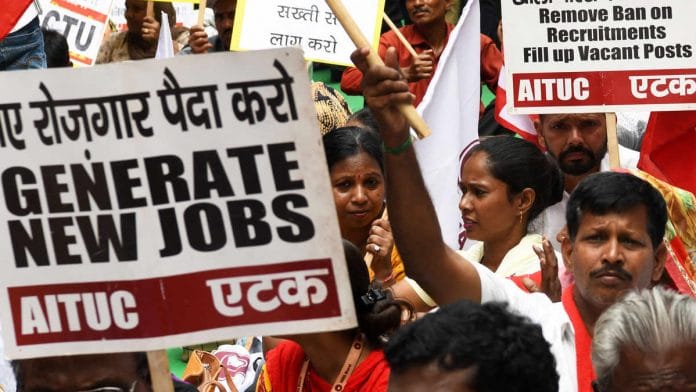



The trade union movement has come to play a very significant role in all the advanced economies of the world. Even where the movement is ruthlessly suppressed, as in communist countries, it still exerts a pressure upon the system to achieve some of its ends. Recent developments in Poland are an illustration of what could happen even in communist countries.
The trade union movement in most western countries as well as in India was started to improve the working conditions of the work force. There is no question that they made a very substantial contribution, in the early stages of the movement, to ameliorating the conditions of the working classes and there is scope even now for bona fide trade union activities in certain sectors of the economy. But trade union bosses soon came to realise that their power lay not only in their capacity to withhold their labour from the employer. In a modern democracy, they had also acquired the power to influence, if not actually to coerce, the political system. The trade union movement therefore has become a very important and significant part of the political system in most countries, except possibly in America where, in spite of the power which they have, the trade unions have continued to have a healthy distrust of the political system.
Employers themselves have contributed not a little to add to the power of the trade unions. This happens where they are engaged in activities which are of a monopolistic or oligopolistic nature, or where the goods are in short supply as in the controlled economies of the developing countries. Employers have in these circumstances not hesitated to arrive at liberal settlements with their trade unions in paying wages and other benefits which are totally out of line with their skills, or comparable levels of salary in other industries. In India, for instance, many employers, in spite of a legal provision to the contrary, have made under various guises settlements involving payment of bonus at rates of 35 to 40 per cent. This they have been able to do because they have felt confident that the increased burden will be passed on to the consumer in the form of higher prices without in any way impairing the profitability of their businesses. We have instances now of large public companies where company drivers appear in the list of persons drawing a remuneration of more than Rs. 3,000 per month and yet there are people who even today pay a salary of Rs 300 per month to the drivers employed by them.
By a tacit concurrence, businessmen and trade unions are able to raise the wages of their work forces only at the expense of reducing employment opportunities or at the expense of other workers who receive lower wages. Several economists have felt that collective bargaining will inevitably lead to an increase in both unemployment and the rate of inflation.
I think that it is necessary to make suitable legal provisions for curbing the power of the trade unions along the following lines:-
(a) Elimination of inter-union rivalry through a provision that only one union will be recognised as a bargaining agent in any manufacturing enterprise.
(b) In order that the actual status of the union can be ascertained, a system of union checkoff must be introduced so that union contributions can be collected in a bona-fide and voluntary manner.
(c) All contracts entered into by a union would be legally binding and the union and its officials would be liable for financial and other penalties for breach of contracts as in the case of any other commercial contract.
(d) No strikes can be started except as a result of a strike ballot and with the support of a majority of the work force, whether unionised or not.
The collusion between the new class of bureaucrats, politicians, businessmen and trade union bosses perpetuates itself partly because of the short-run benefits and also partly because they see no way out of the system. The average businessman realises that his profits in the existing system are only illusory. They are the profits of inflation. The real worth of his enterprise is not going to sustain him long. The bureaucrat is also aware of the limits to the fiscal capacity of the government, and of the fact that the bureaucracy’s expenditure of government resources does not create my great wealth.
As has been demonstrated in India, the limit of taxation is reached soon enough and there are therefore no additional resources available. Hence the constant complaint of the politician, at least in this country, of a resource constraint. The politician too nurses a fear that if the economy does not grow, it would be prone to internal turbulence as well as external dangers. The trade union bosses know only too well that their action has reduced the growth of employment, and the rapidly growing but unorganised group of rural workers, the self-employed and the workers in the unorganised sector constitute a threat to their cosy system.
It is time now that the bureaucrat, the politician, the businessman and the trade union boss shed their cloak of pretence and open up to the real issues that threaten a bleak future. If they begin to be true to themselves and prepare themselves for a workable reform, there should not be any question about their being able to change the system. A vicious system is not amenable to change, without those operating it themselves accepting the need for reform. I feel that the time has now come for this. There.is a slow recognition even in our country that there is a need for a radical reform of the present system. There is, still a lot of groping in the dark about what needs to be done but I personally feel that it is a hopeful sign that there is a recognition of the need for reform.
This essay is part of a series from the Indian Liberals archive, a project of the Centre for Civil Society. This article is excerpted from an essay titled ‘The New Class in a State Dominated Economy’ by MH Mody, published in the journal “Forum of Free Enterprise” in December 1980. The original version can be read here.