






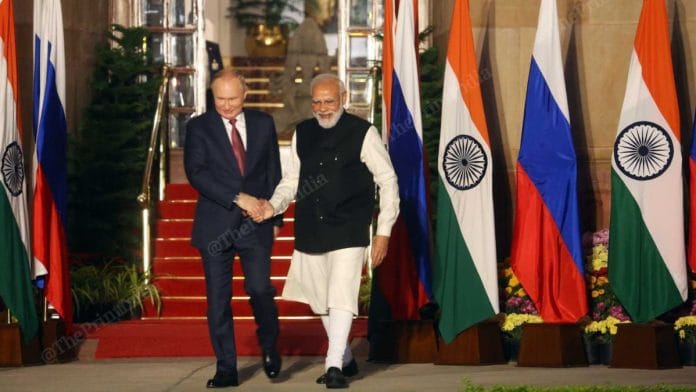



The Russian Duma ratified the Reciprocal Exchange of Logistics Support (RELOS) agreement one day before President Vladimir Putin touched down in New Delhi. It implies more than mere operationalisation of another defence instrument between long-standing partners, India and Russia.
The agreement has closed a loop that had been left incomplete for years. Instead, it has opened fresh maritime engagement, one stretching from the warm waters of Chennai in the Indian Ocean to the ice edges of the Arctic.
RELOS, negotiated since 2019 and signed earlier this year, is India’s newest enabler into a world where geography and geopolitics are changing at extraordinary speed and unpredictability.
Evolving maritime vision
India’s journey to signing logistics agreements has been discerning—and rooted in its long transformation from a continental to a maritime power. For much of its independent history, India’s strategic gaze remained fixed on continental security concerns, and for good reason. The seas were viewed as highways for trade, not as domains of geopolitical competition. India’s early maritime doctrine in the 2000s reflected this modest imagination—they were built around the concept of “using the seas,” not shaping or “securing them”.
Yet, as India’s economic centre moved southward to its ports and coastlines, its maritime consciousness began to deepen. The Security and Growth for All in the Region (SAGAR) doctrine in 2015 was the first articulation of a more expansive role, followed by the Indo-Pacific Oceans Initiative (IPOI), the Indian Ocean Naval Symposium (IONS), and the Information Fusion Centre–Indian Ocean Region (IFC-IOR). Fueling this shift in New Delhi was China’s assertive wolf-warriorism in the South China Sea after 2013 and its steady encirclement of India through dual-use ports and dubious partnerships with India’s neighbours. These developments collectively awakened India to the need for a maritime strategy that projected power, protected sea lanes and shaped regional norms. Logistics Support Agreements (LSAs) became one of the natural instruments of this shift.
Even then, New Delhi treated such arrangements with hesitation, worried that reciprocal access to military facilities could erode the country’s strategic autonomy. That psychological barrier was overcome only in 2016 with India’s first such pact, the Logistics Exchange Memorandum of Agreement (LEMOA), with the United States. What followed was a remarkable shift. India began negotiating logistics agreements almost simultaneously with Japan, Australia, France, Oman, the Philippines, and Russia. But the agreement with Russia, then called the Agreement on Reciprocal Logistics Support (ARLS), got delayed.
India proceeded to sign not only these agreements with other partners but also another two, the Communications Compatibility and Security Agreement (COMCASA) and Basic Exchange and Cooperation Agreement (BECA), with Washington, deepening interoperability and exchange across domains even further. The India-Russia pact, in contrast, remained on a slow burn.
Its eventual ratification, therefore, carries both the weight of delay and the promise of strategic value. RELOS signals that the India-Russia resilient defence partnership is adapting to new strategic opportunities. It equips the Indian Navy with the ability to turn around more quickly, sustain deployments at great distances, and contemplate missions in waters that once seemed beyond reach. In the process, it brings into focus the vast northern Russian frontier that India has, until now, engaged with only at the margins—the Arctic.
At the technical level, RELOS lays down procedures for dispatching warships, military aircraft, and even mutual troop deployments for various activities between India and Russia, while governing the logistical support they can access. It applies in both peace and crisis—during exercises, training, humanitarian assistance, disaster relief, and other mutually agreed tasks. Russian officials have conveyed that the pact may give India reciprocal access to over 40 Russian naval and air bases, including key Arctic and Pacific facilities. If this holds, India would gain unprecedented operational reach, stretching far beyond its traditional comfort zone in the Indian Ocean and the Indo-Pacific.
Such agreements become crucial enablers for more reasons. LSAs act as the ‘behind-the-scenes’ scaffolding of modern naval power. They allow navies to refuel, rest, repair, and resupply at partner facilities—activities that cumulatively determine the tempo and reach of maritime operations. They build trust, create communication channels, and improve overall readiness.
RELOS, therefore, is not an isolated endeavour. It is part of a recalibration of India’s maritime aspirations—one that embraces multi-alignment at sea, recognises the future of global trade, and seeks to participate in the emerging governance of the world’s last great frontier, the Arctic.
Also read: No country built rare earths resilience alone. India must take lessons from Japan, Taiwan
Relos and India’s Arctic aspirations
India’s relationship with the Arctic is older than common knowledge. Over a century ago, in 1920, India was one of the original signatories to the Svalbard Treaty, which granted rights to engage in scientific and commercial activities in the archipelago under Norwegian sovereignty. Fast-forward to 2008, India established its first Arctic research station, Himadri, in Svalbard, a signal of its scientific intent. In 2013, it gained Observer status at the Arctic Council. After a brief hiatus, India released its first Arctic Policy in 2022, crystallising its interests in science, climate, connectivity and resource security.
Today, the Arctic is no longer a distant curiosity. Its ice is melting rapidly, laying bare untapped hydrocarbons, critical minerals and most importantly, new maritime routes that may alter global shipping patterns. The Northern Sea Route (NSR), controlled largely by Russia, promises to shorten the journey between Asia and Europe by up to 40 per cent. For a fast-growing economy deeply dependent on imported energy and increasingly anxious about supply-chain vulnerabilities and weaponisations of commodities, India sees both opportunity and necessity in engaging with the Arctic.
Russia is not the only player in the region, but it matters to New Delhi’s calculus. The Russian Arctic—with its vast LNG projects, minerals, and emerging infrastructure—is one of the few places where India is looking forward to investing. Russian officials in their discussions with me (for ThePrint WorldView) have welcomed India’s interest in projects such as the Belkomur railway, the Northern Latitudinal Passage, new LNG terminals, and other Northern Sea Route-related infrastructure.
The Chennai-Vladivostok Eastern Maritime Corridor (EMC) has been operational since 2024. At roughly 5,600 nautical miles, it cuts travel time between India and Russia from over 40 days via Suez to about 24 days. It already moves crude, coal, fertilizers, machinery and textiles to India, and its potential extension to Paradip sounds promising. There are plans to include Southeast Asian countries such as Indonesia and Vietnam. These developments and discussions point to a future in which the Bay of Bengal, the Russian Far East, and the Arctic could be part of a single connectivity arc.
For this emerging ecosystem to be credible and secure, RELOS will prove to be indispensable. Logistics access enhances the Indian Navy’s ability to protect sea lanes, support commercial routes, and maintain presence along the eastern maritime arc. It also undergirds India’s aspirations for a meaningful role in shaping the Eurasian maritime order emerging from a thawing north.
Yet, enthusiasm should be tempered with realism. The India-Russia trade deficit has ballooned to nearly $ 64 billion. While Russian energy exports to India have surged, India’s exports have managed to reach only $ 5 billion. Sanctions complicate payment channels, the rupee-ruble mechanism has stumbled, and Indian exporters face structural impediments in accessing the Russian market. Unless both countries devise creative economic solutions—local currency settlements, specialised financing windows, and joint ventures in Russian manufacturing—the partnership will continue to operate on unequal economic foundations.
Moreover, the shadow of the Russia-Ukraine war complicates Moscow’s reintegration into global trade systems and deepens its dependence on China. India ultimately needs to return to a minimum geopolitical normalcy for stable long-term cooperation.
In the coming months, the full text of RELOS may become public, offering clarity on its provisions. That said, as Prime Minister Narendra Modi and Putin look ahead to broader cooperation, from Su-30 fleet upgrade to new economic partnerships, RELOS makes for a good start.
Swasti Rao is a Consulting Editor (International and Strategic Affairs) at ThePrint. She tweets @swasrao. Views are personal.
(Edited by Ratan Priya)