










Spatial disparities in income and development have been a persistent challenge in India, with certain districts lagging behind national averages in education, health, and infrastructure for decades (World Bank, 2009). Weak State capacity in these regions is often attributed as the reason for slow progress (Pritchett 2013). Accordingly, policymakers are increasingly considering “place-based” interventions designed to achieve better outcomes in structurally disadvantaged regions (MacKinnon et al. 2021).
Launched in 2018, India’s Aspirational Districts Programme (ADP) is an example of a place-based intervention targeting 112 underdeveloped districts with a vision to improve outcomes in health, education, skills, and infrastructure development. The programme coordinates the existing government schemes under a unified framework with intense monitoring and accountability.
In our ongoing research (Das, Gupta, and Singhal 2025), we evaluate the impact of the ADP on educational outcomes that include school participation and learning proficiency for school-going children. We also explore some of the potential mechanisms that can explain the observed effects.
A central motivation for ADP’s focus on education is the persistent disconnect between schooling inputs and learning outcomes. Research across developing countries shows that expanding inputs like more schools, teachers or better infrastructure do not necessarily lead to improvement in student achievement (Pritchett 2013). In India, for example, greater investment in infrastructure and teacher hiring have failed to close gaps in basic literacy and numeracy, in part due to weak accountability and inefficiencies (Andrews et al. 2017).
Teachers are frequently absent or poorly motivated, and programmes often emphasise inputs rather than learning. Targeted interventions that directly incentivise outcomes have been more effective, for example, teacher performance pay has been found to raise test scores (Muralidharan and Sundararaman 2011), and conditional cash transfers have been documented to improve school participation (Patel-Campillo and Salas García 2022). However, these interventions do not address multiple constraints simultaneously (Das and Sarkhel 2023).
ADP takes a broader approach, simultaneously targeting multiple bottlenecks: improving facilities, ensuring teacher availability, engaging communities, and holding district officials accountable for dropout rates, transition rates, and provision of basic school infrastructure. Early trends suggested progress: within two years of the programme’s launch, transition rates from primary to upper-primary rose and so did the share of schools with a functional girls’ toilet (Kapoor and Green 2020).
These improvements possibly indicate that the programme directed attention to persistent problems such as middle school dropout and girls’ sanitation – though there can be other initiatives that can explain these improvements. Further, whether such gains translate into actual learning requires careful and systematic evaluation.
The Aspirational Districts Programme
The Government of India launched the ADP with the goal of addressing persistent disparities at the subnational level (NITI Aayog, 2022). This flagship initiative seeks to narrow down inter-district inequalities by accelerating development in 112 of the country’s most underdeveloped districts (Figure 1).
The ADP is in line with the global commitment to the principle of “Leave No One Behind” as part of the 2030 Sustainable Development Agenda. At its core, the ADP aims to help these districts “catch up” with the rest of the country, ensuring more equitable development outcomes. The programme stands out for its sharper targeting, use of real-time data, and emphasis on measurable outcomes, applied to a smaller number of carefully chosen districts.
The ADP’s implementation is supported by a structured institutional framework that functions at three levels. This decentralised, multi-tiered setup empowers local administrators while ensuring alignment with broader policy objectives. Evidently, unlike other interventions, the ADP’s emphasis on data-driven governance, regular performance tracking, and competitive spirit – along with the three-tier structure – marks a clear departure from traditional, long-horizon development approaches.
Figure 1. Aspirational Districts in India
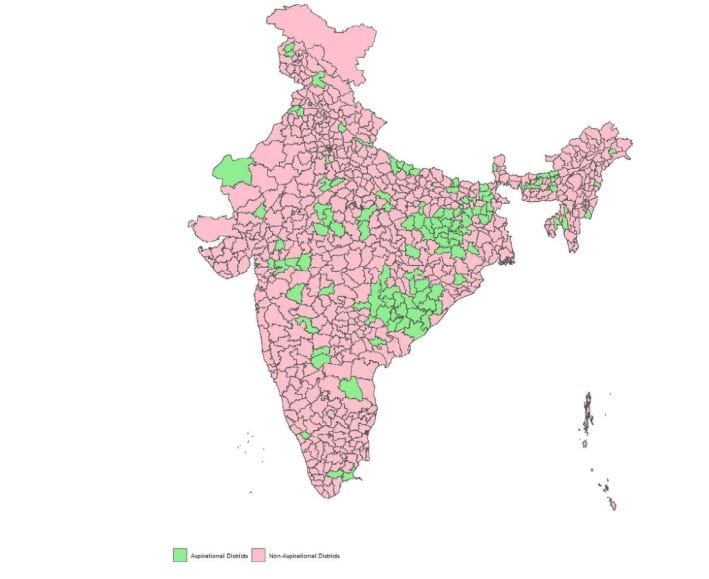
Source: Image reused from Agarwal and Mishra (2024).
Notes: (i) ADP was adopted in 2018. The previous years are considered as pre-intervention. (ii) The sample consists of district-year observations from 2010-2024. Data are missing for 2020. (iii) Estimates are obtained using the Callaway and Sant’Anna (2021) difference-in-differences estimator with district and year fixed effects. Standard errors are clustered at the district level. The regression controls for child age and child gender.
Data and findings
We draw on pooled household-level data from the Annual Status of Education Report (ASER) for the period 2010 to 2024. ASER is a biennial, district-representative survey that documents educational outcomes among children in rural India. The timeline of the survey allows us to study the conditions both prior to and following the implementation of the ADP among children in the intervened districts and compare them with those from the neighbouring districts (identified using state-level maps), which remained unexposed to the programme.
The assumption here is that an intervened district would have substantial similarities with its neighbouring non-intervened districts in terms of social, cultural, and economic characteristics. We consider children of age group 8 to 16 years from both these sets of districts and use a ‘difference-in-differences’ (DID) methodology to estimate the effects of the intervention on the probability of ‘never been enrolled’ in school and dropout, along with the probability of achieving certain reading and mathematics skills.
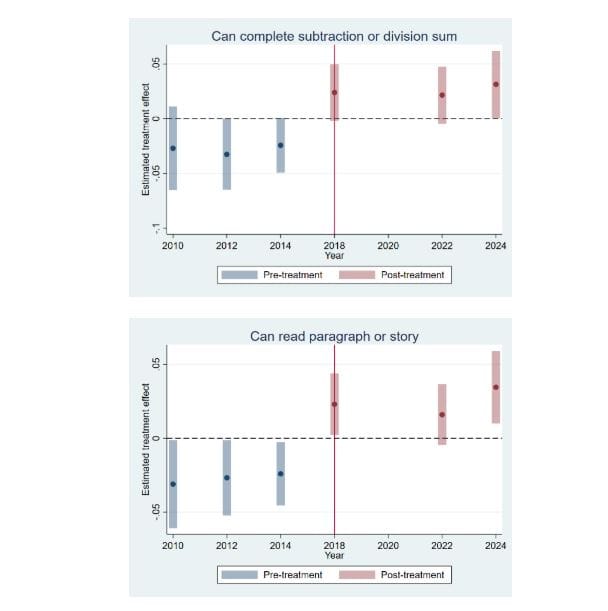
Our primary analysis (conducted for children of ages 8 and above) reveals a positive and statistically significant impact of the programme on foundational learning outcomes, namely reading and arithmetic proficiency (Figure 2). In particular, the intervention seems to have resulted in an increase in the probability of children being able to complete basic reading and arithmetic tasks, that is, reading a paragraph or story and solving a subtraction or division problem, respectively.
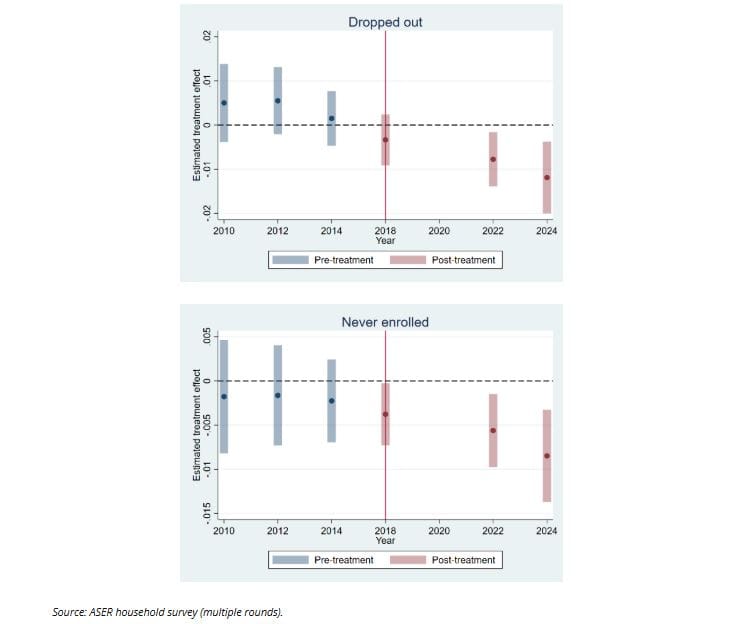
The effect size is as large as 2 percentage points in some cases. Concurrently, we also find that the programme improved school participation and retention, measured through the probability of ‘never been enrolled’ and dropout rate. These indicators have fallen in the post-intervention years for the ADP districts (indicating an improvement). These findings are consistent with the programme’s goals of improving educational engagement.
Figure 2. Impact of ADP on educational outcomes in rural children (ages 8 and above)
Source: ASER household survey (multiple rounds).
Notes: (i) ADP was adopted in 2018. The previous years are considered as pre-intervention. (ii) The sample consists of district-year observations from 2010-2024. Data are missing for 2020. (iii) Estimates are obtained using the Callaway and Sant’Anna (2021) difference-in-differences estimator with district and year fixed effects. Standard errors are clustered at the district level. The regression controls for child age and child gender.
Using ASER’s school-level survey, we further explore the effect of ADP on the attendance of staff and students. We find that staff attendance (teachers and principals) improved in schools located in ADP districts (Figure 3), potentially leading to the observed learning gains reported earlier. We also find an improvement in student attendance (Figure 3) in the schools from ADP districts, in comparison to those from non-ADP districts. It is possible that higher teacher presence reinforced student presence, resulting in learning improvement.
Figure 3. Impact of ADP on staff and student attendance in rural government schools
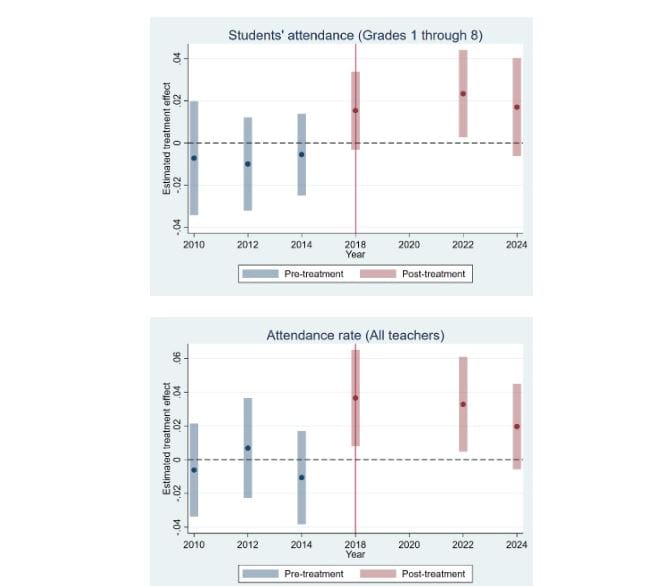
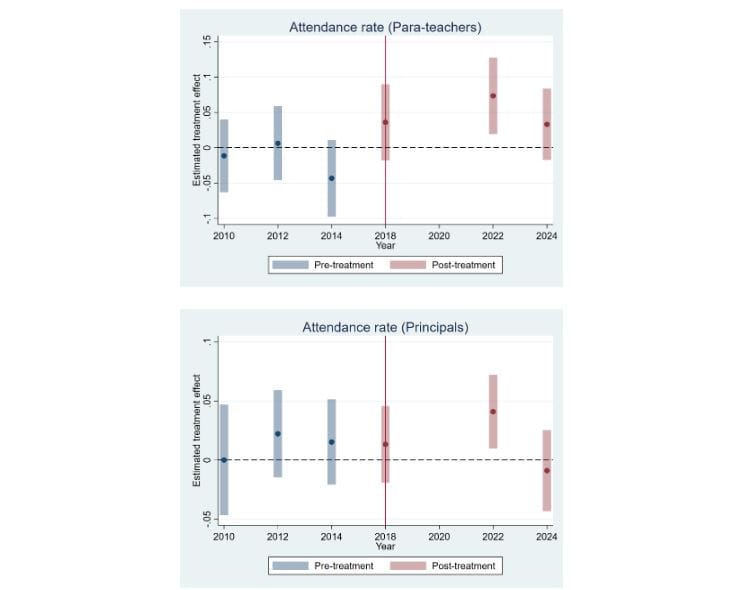
Source: ASER school survey (multiple rounds).
Notes: ADP was adopted in 2018. The previous years are considered as pre-intervention. The sample consists of district–year observations from 2010-2024. Data are missing for 2020. Estimates are obtained using the Callaway and Sant’Anna (2021) difference-in-differences estimator with district and year fixed effects. Standard errors are clustered at the district level. The regression controls for child age and child gender.
Discussion and policy implications
Early evidence from our study points to modest but encouraging improvements in math and reading proficiency in Aspirational Districts, along with an observable decline in out-of-school and dropout rates. Given that the ADP operates in some of the country’s most historically underserved regions, even these incremental gains are notable. The patterns suggest that the programme may have been particularly successful in reaching children who were previously at risk of falling behind. A likely channel is the programme’s emphasis on monitoring and coordination. District officials faced clear targets, regular reviews, and peer comparison through public rankings, and these features appear to coincide with improvements in teacher and student attendance. Although this is suggestive of a supply-side mechanism, confirming the exact pathways will require additional analysis and future research.
These early findings offer tentative insights for policy. They point to the potential value of governance-focused approaches that emphasise accountability, data use, and regular feedback loops, rather than relying solely on additional resources. Although the learning gains are modest – and six years may be too short a period to expect large shifts in human development outcomes – the presence of measurable improvements, despite implementation challenges, is informative.
While our study cannot fully disentangle which components mattered most, the patterns suggest that better coordination and clearer incentives for local officials may support incremental progress. Future work, including ongoing evaluations, will help clarify the mechanisms further and the extent to which such approaches can be replicated elsewhere.
This article was originally published on the Ideas for India website.