






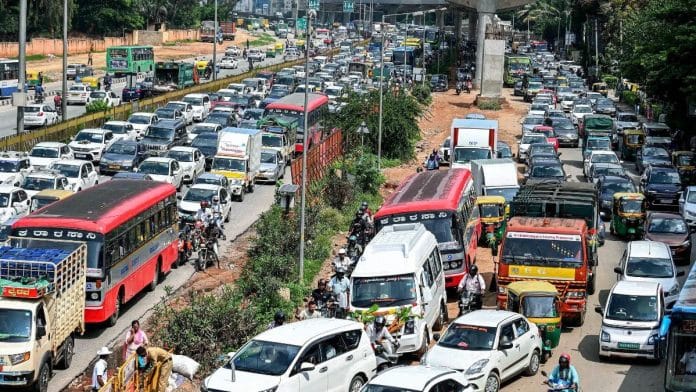



Among India’s many policy failures, the failure to emphasise public transport over private is surely one of its biggest. In calender 2025, thanks to goods and services tax (GST) cuts, Indians bought 4.5 million four-wheelers and over 20 million two-wheelers, adding to urban congestion and pollution at a time when urban living conditions are worsening.
Put simply, the GST reforms – while welcome for breathing life into automobile assembly lines – have a clear downside. This does not mean the tax cuts should not have been done, but that the negative social and economic effects of forcing people to depend more on private transport must be dealt with as an urgent issue.
There are two ways to tax private vehicles: one is to tax them at source though indirect taxes (like GST), and the other is to tax them at local levels through registration charges, higher parking fees and tolls.
While tolls are a ubiquito by us feature on highways, they don’t exist inside cities, which are at the receiving end of congestion and pollution-related problems.
It is time for Indian cities to start charging congestion surcharges, and raise yearly fitness certification fees for older vehicles, especially those that are more than 10 years old, and/or are polluting more than new cars.
The infrastructure and tools to start charging cars and two-wheelers for entering congested city roads already exist in the form of the Fastag. Union Transport Minister Nitin Gadkari’s plans to shift to GPS-based tolling to avoid stoppages at toll nakas by the end of 2026. This is when congestion surcharges are easily be imposed in busy city areas.
Large cities, especially Delhi, Mumbai, Bengaluru, Kolkata and Chennai must begin preprations now to start levying a congestion surcharge and also introduce yearly hikes in fitness/registration charges for vehicles that are too old or excessively polluting.
One of the big downsides of the shift to GST is that cities have lost revenue flexibility, not least because taxes like octroi and entry taxes have been subsumed in GST, and municipal corporations are now dependent on state governments for revenue grants.
Also read: I’ve been driving an EV for 2 years—Indian roads are ready to switch to electric
The introduction of congestion surcharges will give municipalities some revenue flexibility, especially if these funds are now used to subsidise public transport. A study by the Economic Advisory Council to the Prime Minister found that the expansion of the metro network has improved household finances as spending on private vehicles was reduced. By adding electric buses and fuel-efficient public transport, these savings can only be augmented.
The case for taxing private vehicles more at the local body level has never been stronger. If we are going to tax the sale of such vehicles far less than before, there is no reason why we should not tax their usage more in congested areas, where parking slots are fewer, and pollution a bigger problem than before.
Only after providing world-class public transport and pavements should public transport be emphasised. Anyway, socialist India already overtaxes private transport. I, as the imaginary Prime Minister from the non-existent Capitalist Party of India, would have ensured free trade, flooded the market with EVs, ended socialism, and spent heavily on street infrastructure and public transport. Congested roads themselves drive people towards mass rapid transit, according to free-market principles; there is no need to overtax anything, including through congestion charges.