






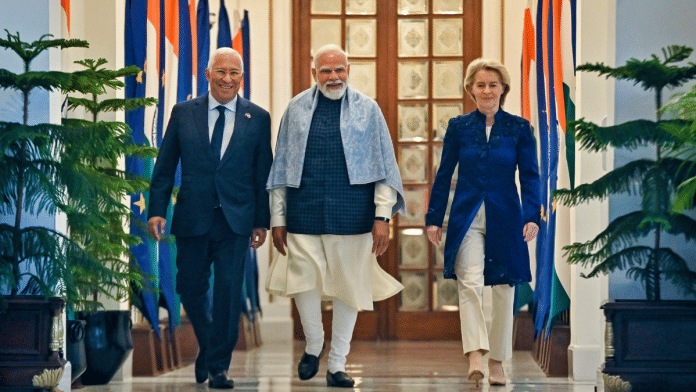



Ending negotiations spanning over two decades, India and the 27-member European Union agreed on a landmark Free Trade Agreement. It is expected to benefit nearly two billion people and open up the Indian and EU markets to both parties, besides others who are in the loop. The two sides have also announced a security and defence partnership that includes a broader strategic roadmap. While the details of these agreements will need more time to study and analyse, the immediate trigger for the EU to put the FTA on fast track is understandable on two counts—the deal is an insulation of the EU’s economy from the vagaries of the US President Donald Trump, and it secures EU’s interests from possible security threats from ‘known enemies and highly undependable friends’.
For India and the EU, the reliance on the US for security needs and on China for goods and services is associated with greater risks and vulnerability to major disruptions.
Although the Chinese agenda is a stand-alone one, it is overtly incompatible with the present and future interests of the EU and Asian economies, especially Indian trade interests. And Trump has not concealed his plans to divide European unity. A disunited Europe serves America’s interests best.
Based on reports from January 2026, a high-level, trilateral meeting involving US, Russian, and Ukrainian negotiators, which is scheduled to take place on or around 1 February, in the United Arab Emirates has totally ignored the EU which has been a strong supporter of Ukraine. The new peace deal could increase America’s leverage with Kiev and starve the EU of assured energy supplies from Russia.
Trump’s use of tariffs as a weapon to hit the EU’s economic citadel may have a definite term—as long as Trump occupies the White House—but future dispensations could be encouraged to continue to benefit from a fractured EU and volatile geopolitics.
The Covid-19 pandemic also exposed the dangers of over-dependence on China-controlled supply chain mechanisms. The agreement on India-EU FTA, which could be inked in a few months from now to become fully operationalised, will likely redraw the supply chain mechanism to suit the emerging new world order in a multipolar setting.
This possible emergence of a new supply chain mechanism and a robust trade between India and EU could be one the reasons behind the cautious approach of the US toward this “Mother of Deals”, notwithstanding Trump’s caustic and unpleasant comments on this phrase.
The US would probably look at the India-EU FTA from a prism of its strategic influence, rules-setting power, and the overall market access of the two economies. American negotiators have time and again raised the issue of India’s high tariff regime, localisation norms, and regulatory uncertainty. They are now seeking relaxation to the extent of zero tariff, promising a reciprocal approach.
Preferential EU access to the Indian market—especially in autos, high-value manufacturing, spirits, and green technologies could further disadvantage US firms. In such a situation, if the EU secures concessions based on this FTA, which Washington has so far failed to obtain, pressure will mount on New Delhi’s negotiators for parity treatment.
In addition to these concessions, the US might favour sectoral and framework-based deals instead of an FTA on the lines of the Indo-Pacific Economic Framework (IPEF) structure. New Delhi should be prepared to be flexible enough to redefine the India-US trade deal and accommodate a new format, which in turn would be a win-win situation for both.
Also read: Cars cheaper, wine smoother — how TV news channels sold India-EU FTA to viewers
Conditions for success
As the India-EU FTA stabilises over the next few months, it would be interesting for both India and America to see how it goes beyond bilateral trade and impacts other platforms like the Quad, G20, IPEF and the BRICS. Interestingly, these trade blocks do not address all the trade related issues in a streamlined manner.
If New Delhi and Brussels are able to do away with tariff-based trade and work out a normative rule-based structure to reshape data flows, trade-related climate policies and forge a strong supply and value chain architecture, it will have a highly consequential impact on other regional and bilateral trade forums and deals. With the inevitable merger of geopolitics and geo-economics, shifts in trade rebalancing and economic strategy will greatly impact India’s strategic roadmap in the ongoing great power contestation.
There are some roadblocks that need urgent attention and careful approach from the Indian side. This includes the EU’s GDPR-driven regulatory framework, India-EU disagreements over data localisation, cross-border data flows, and digital market access, EU’s insistence on TRIPS-plus provisions, meaning longer patent terms and data exclusivity, to the detriment of India’s growing generic pharmaceutical industry, EU’s Carbon Border Adjustment Mechanism (CBAM) increasing the concerns of Indian exports of steel, aluminium, cement, and chemicals, EU’s stringent norms for climate commitments, labour standards, and environmental regulations and cutting down tariffs.
However, cutting tariffs is easier said than done, especially in the background of Make in India and Atmanirbhar Bharat promises. At the core of this issue lies the divergence of economic models and priorities between the EU and India. The EU is looking for unrestricted access to several protected sectors within the ambit of India’s employment-oriented non-capital intensive MSMEs. The government had committed to ensure protection through higher tariffs.
The success and optimum utilisation of the potential of the India-EU FTA—the “Mother of All Deals” that promises to open a trade corridor accounting for roughly 25 per cent of global GDP and one-third of global trade—depends on without compromising with quality and efficiency, and the adoption of automation in a big way without adversely impacting the employment market.
Seshadri Chari is the former editor of ‘Organiser’. He tweets @seshadrichari. Views are personal.
(Edited by Theres Sudeep)