






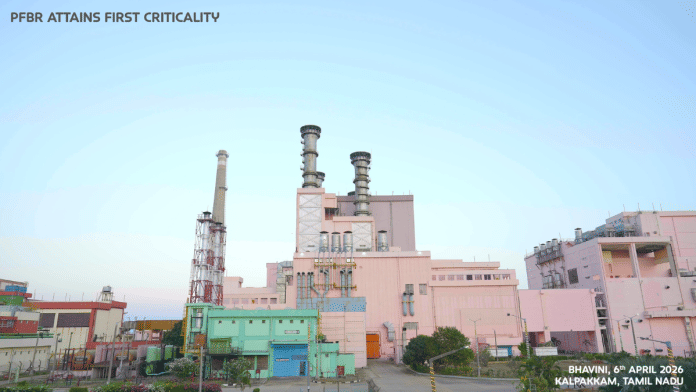



On 6 April 2026, Prime Minister Narendra Modi posted on X: “Today, India takes a defining step in its civil nuclear journey, advancing the second stage of its nuclear programme…It is a decisive step towards harnessing our vast thorium reserves in the third stage of the programme.”
This was no routine government communiqué. It was the public proclamation of India’s formal entry into the second stage of its unique three-stage nuclear power programme; the long-awaited bridge to a thorium-powered future. Barely hours earlier, former Atomic Energy Commission Chairman Dr Anil Kakodkar had also signaled the same milestone from his own X account. Together, the two messages captured both official pride and scientific vindication. Yet, as celebratory as they are, they arrive at a moment when India’s nuclear story demands more than applause. It demands brutal honesty about what still needs to be sorted. Celebrations are justified but one must remember that much needs to be done. The commentariat—both breathless patriots and professional sceptics must take a pause to review and reflect.
The historical perspective
India’s nuclear journey started with scarcity of elements and audacity of hope. The newly Independent nation possessed almost no Uranium, no enrichment technology, and no international friends willing to share them. Dr Homi Bhabha, the visionary founder of the Atomic Energy Establishment (later BARC), understood that India sat on the world’s largest known Thorium reserves (nearly a quarter of global deposits), while Uranium deposits were modest as well as low-grade. He thought of a plan, centered on exploitation of Thorium, which we now know as the famous three-stage programme. The plan was formally articulated in the mid-1950s and refined over decades.
Broadly speaking, the three-stage plan was as follows: First stage would use Pressurised Heavy Water Reactors (PHWRs) running on natural Uranium to produce Plutonium-239 as a by-product. The second stage would deploy fast breeder reactors (FBR) to multiply that plutonium, while irradiating thorium blankets to breed Uranium-233. The third Stage would then deploy Thorium-Uranium-233 fuelled reactors, delivering near-complete energy independence for centuries.
The logic was elegant, although it appeared too ambitious at that time. This was also the era of “atoms for peace”, and international cooperation, especially from the US, was expected.
For seventy years, India, led by the Department of Atomic Energy (DAE), poured talent and treasure into this vision. The first PHWRs at Rajasthan and Madras were built with Canadian help, which was abruptly withdrawn after nuclear tests in 1974. Indigenous capability had to step in. By the early 2000s India had a respectable fleet of PHWRs generating plutonium stocks. But the fast breeder leg proved far harder. The Fast Breeder Test Reactor at Kalpakkam (1985) was a small experimental success; however, scaling to 500 MWe proved much harder.
The Prototype Fast Breeder Reactor (PFBR) project was sanctioned in 2003. Construction began immediately, but sodium coolant chemistry, intricate fuel handling, and first-of-a-kind manufacturing challenge stretched timelines endlessly. What was once slated for completion around 2010 finally reached criticality in April 2026—an achievement that we are (rightfully) celebrating now. This is the price we pay for mastery in one of the world’s most unforgiving reactor technologies. The achievement, albeit delayed, is still significant.
Also read: PFBR hits criticality—what next on India’s nuclear path to thorium
Current breakthroughs
The PFBR criticality is the headline triumph. India now joins Russia as the only nation operating a large-scale sodium-cooled fast breeder reactor. The reactor uses mixed-oxide (MOX) fuel of Plutonium and Uranium, cooled by liquid Sodium, and is designed to demonstrate a breeding ratio greater than one (essentially meaning- using less resources to produce more). It is entirely indigenous; designed by IGCAR, built by BHAVINI, and executed under the watchful eye of the Atomic Energy Regulatory Board. The engineering feat is genuine: Sodium’s reactivity with air and water, the need for inert atmospheres, the precise control of neutron economy in a fast spectrum—all has been mastered domestically.
But the real story of April 2026 is bigger than one reactor. It coincides with a quieter, commercially disruptive breakthrough that has received far less attention—the emergence of ANEEL (Advanced Nuclear Energy for Enriched Life). It is a fuel developed by the US-based startup Clean Core Thorium Energy (CCTE). ANEEL is a proprietary high-burn-up thorium-uranium fuel designed explicitly as a replacement for India’s existing PHWRs. It contains roughly 85 per cent thorium Oxide and 15 per cent high-assay low-enriched Uranium (HALEU). The fuel promises significantly higher burn-up, reduced waste volume, improved economics, and inherent proliferation resistance because the uranium component is never enriched to a level good enough for weapons use.
What makes this development politically and historically significant is the role of Dr Anil Kakodkar himself. The same man who steered India’s indigenous programme for decades, who chaired the Atomic Energy Commission during the critical post-1998 years, and who remains one of the most respected voices on Thorium joined CCTE’s advisory board after his retirement. The fuel is reportedly named ANEEL in respectful reference to him.
Thus, April 2026 offers India not one but two breakthroughs: The long-planned, reactor-centric indigenous milestone (PFBR) and a fuel-centric, near-term accelerator (ANEEL) that could let existing PHWRs begin irradiating Thorium immediately, producing U-233 far faster than waiting for an entire fleet of breeders.
Also read: Why a US firm’s thorium fuel breakthrough is significant for India
Future challenges
While significant, these breakthroughs don’t solve everything. The PFBR must still graduate from criticality to full 500 MWe power, demonstrate stable operation over a few years, and achieve its design breeding ratio. It also needs to be established that the sodium systems, including pumps, heat exchangers, purification, are reliable at commercial scale. Liquid sodium is notoriously unforgiving. Leaks, fires, and maintenance nightmares have doomed breeder programmes around the world. India has already experienced commissioning hiccups; further teething problems are statistically likely.
Even if the prototype succeeds, scaling is the next mountain. Four additional 500 MWe fast breeders have been sanctioned, but the supply chain for specialised steels, remote-handling equipment, and reprocessing plants capable of handling high-actinide spent fuel is still embryonic. The fissile inventory build-up is governed by unforgiving physics. Doubling times for Plutonium or U-233 were once optimistically projected at five to six years; realistic modelling now suggests decades—unless metallic fuels and advanced reprocessing are perfected.
The Thorium fuel cycle itself harbours stubborn technical demons. Protactinium-233, the intermediate decay product, has a 27-day half-life that demands careful decay storage before U-233 extraction. U-232 contamination, inevitable in the thorium route, produces strong gamma-emitting radiations that make fresh fuel highly radioactive and necessitate fully remote, shielded fabrication facilities. Waste management, reprocessing economics, and regulatory harmonisation between the PFBR and any future AHWR fleet would require institutional coordination across DAE, BHAVINI, NPCIL and AERB.
Triumph of hope
Most countries abandoned breeder dreams after the 1980s because Uranium was cheap and proliferation fears dominated. Russia persisted, China is trying, but India alone possesses both the resource base (Thorium) and the institutional memory to make the cycle work. If ANEEL proves successful, India could license or co-develop Thorium fuel technology, turning a domestic energy solution into an exportable strategic asset.
Credit must also go to the human and institutional dimension that rarely makes headlines: The quiet continuity of expertise. Kakodkar’s generation built the scientific foundation under sanctions and isolation. Today’s engineers stand on their shoulders. The real risk is not failure but losing that intergenerational knowledge through bureaucratic churn or lethargic decision cycles marred by political expediency. Beyond the celebrations, we would need sustained funding and considerable patience.
Also read: Thorium utilisation is where India’s nuclear renaissance truly begins: Anil Kakodkar
What the future holds
India stands at a rare inflection point. The PFBR criticality is not the end of the three-stage dream but only a credible beginning. The ANEEL breakthrough is a commercial opportunity driven by pragmatism. Together they offer a hybrid pathway that honours Bhabha’s vision. If policymakers can integrate both tracks, accelerate reprocessing infrastructure, and maintain regulatory independence, while allowing judicious private and international partnerships, the thorium economy could move from 1950s rhetoric to 2030s reality.
PM Modi’s tweet rightly called it a “defining step.” Defining, yes; but only if India now defines the next steps with equal clarity: relentless technical execution, institutional agility, and the wisdom to recognise that self-reliance doesn’t mean self-isolation.
Group Captain Ajay Ahlawat is a retired IAF fighter pilot. He tweets @Ahlawat2012. Views are personal.
(Edited by Theres Sudeep)