









A sea may seem to represent a vast distance between two frontiers. But when civilisations come close to a sea, it is transformed into a bridge for people and culture to move. Such has been the case between India and Oman, where the Indian Ocean maritime network turned the Arabian Sea into one of the most vital and dynamic zones of interaction in human history.
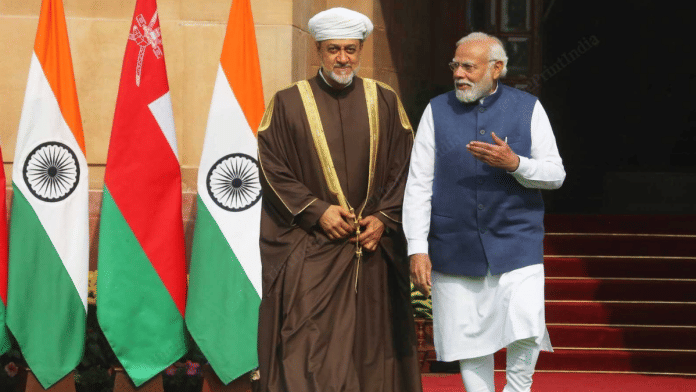
More than the much-hyped Silk Roads, it is this sea-borne enterprise of people, commerce, and ideas that has been of great significance in the advancement of human civilisation. It is this maritime network that has turned India and Oman relations into one of the most enduring partnerships in the history of international relations. Prime Minister Narendra Modi’s visit to the Sultanate of Oman on 17-18 December, accompanied by a high-level delegation, offers a good opportunity to look at India-Oman relations in a long historical perspective.
India-Oman shared history
The history of this partnership dates back to the Harappan times when ships from western ports like Lothal, Dholavira and Balakot sailed toward the land of Magan (ancient name for the Oman region in Mesopotamian sources) carrying beads, pottery, ivory objects, cotton – both raw and textile and even rice. Archaeological discoveries in ancient Oman ports like Sohar and Sumhuram/Khora Rori and other sites have furnished evidence of a flourishing trade since the third millennium BCE.
In return, Oman traders brought copper, frankincense (used for aromatic oils and sticks), certain kinds of stones, and dates, which were an Arabian staple product. Omani ports also served as exchange centres for trans-shipping Indus Valley products to Mesopotamia and further west, greatly expanding the markets for goods from the Indian subcontinent. Stamp seals found in Omani ports, along with weights and measures and button seals found in Indus sites, illustrate the systematic nature of trade between ancient Oman and the Indus Valley civilisation.
By the early Christian centuries, Omani seafarers had developed great expertise in shipbuilding (innovations like fast-moving ships called dhow) and sea navigation, having acquired the knowledge of monsoon winds and navigation using stars and simple instruments like the Kamal.
The entire Indian trade with the Roman world, which figures prominently in Roman sources like Natural History by Pliny the Elder and the Periplus of the Erythraean Sea, was forged with Arabian-Omani traders acting as intermediaries for both the Indians and the Romans. It was this trade that made Indian spices an item of daily use in both the Roman and the Arabian worlds. One can refer to this classical epoch as constituting one of the first globalisation in human history that had such far-reaching consequences in the progress of human civilisation.
Ports like Sohar and Muscat in Oman, Aden in Yemen and Bharuch (Gujarat), Muziris (Pattanam), Nelcynda (Kerala), Sopara (Maharashtra) and Arikamedu (near Puducherry) became ancient cosmopolises having significant Greek, Roman, Omani, and Syrian presence.
The rise of Islam and the bringing of a large Eurasian region under the Caliphate added new layers to the relationship between Oman and India. By now, Gujarati merchants—Hindus, Jains, Muslim Bohras and Khojas—had a sizeable presence in Oman. These traders were formally welcomed and recognised by rulers in Oman.
On the Indian side, there developed an equally sizeable presence of Omani Muslim traders in India, the greatest being on the Malabar coast. Arab Historian al-Masudi, writing in the 10th century, mentions that 10,000 Arab Muslims, including those from Oman, were residing on the western coast of India. Omani traders were the biggest sources of Arabian horses coveted by Indian rulers, while spices, textiles, sandalwood, teak, Indigo, Sugar, rice and other products reached Sohar and Muscat, which had emerged as international hubs in this period. In the Delhi Sultanate and Mughal period, the Hajj pilgrimage to Arabia also contributed to the constant movement of people between the two realms.
Also read: With Modi at the helm, India and the Arab world have become closer than ever. Here’s why
Countering European dominance
The stories of Sindbad, the sailor in the Arabian Nights, highlight the cultural linkages that centuries of relations with the Arab world had forged. Aptly, the fictional home of Sindbad was Sohar, one of the most important coastal cities in Oman. Indian mathematics and science travelled to the Western world through the highway represented by the Indian Ocean maritime network. The Arabs greatly enriched this knowledge and passed it on to the Western world, contributing to the rise of the modern world. This wouldn’t have been possible without the dynamism provided by India-Oman linkages.
The establishment of European dominance across the Indian Ocean network from the 17th century onwards brought the Indian and Omani commercial enterprise into closer alliance to resist European dominance. Thus, Omani rulers, like Imam Ahmad Bin Said, collaborated with Indian powers (Marathas, Mysore’s Tipu Sultan) to counter Portuguese influence, forming military and political pacts. King Zamorin of Calicut, too, had sought the help of Omani merchants to find alternatives to the Portuguese stranglehold on maritime commerce.
When the Omani rulers succeeded in overthrowing Portuguese dominance and expanding ties with East Africa, Gujarati traders were active participants in rebuilding the trade networks, especially in spices, ivory, and textiles, offering capital, credit and logistical support to Omani efforts. Not surprisingly, Oman has the most sizeable presence of Arabs of Indian origin.
India-Oman relations can proudly look back on millennia of tried and tested partnership. Sultan Qaboos’s visit in 1975 and the development of cooperation in many areas were an acknowledgement of this unique partnership between two ancient nations. As Prime Minister Modi visits Oman for the second time since February 2018, it will be a truly fitting moment in India’s engagement with the Arab world, reinforcing ties with India’s oldest strategic partner in the Indian Ocean arena.
Dr. Ashwin Parijat Anshu is an associate professor of History at Delhi University. Views are personal.
(Edited by Ratan Priya)