









When Hannah Arendt coined “banality of evil” to understand the horrors and the psyche of the Nazi regime, she meant simply that ordinary, everyday individuals are capable of executing the most excruciating of all horrors. Such banality of evil is possible because of a bureaucratic and compliant system that rewards cruelty or, at the very least, turns a blind eye to it.
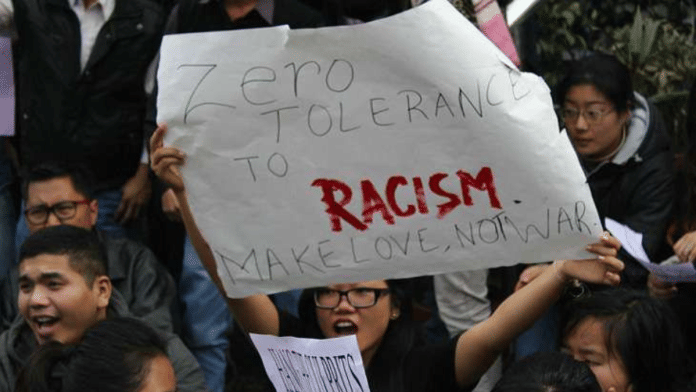
The marginalisation and the racism that folks from India’s Northeast, especially women, routinely face in mainland India, must be understood through this lens. The recent racial attack that three young girls from Arunachal Pradesh were subjected to in South Delhi’s tony Malviya Nagar area by an upper-caste Indian couple (Harsh Singh and his wife Ruby Jain) is not an exception, but the rule in a system that enables such behaviour. The North Indian society, including the Delhi-NCR region, does not hold these perpetrators to account. My article is not about the pervasive racism that we folks from the Northeast have often been subjected to in various parts of mainland India, but about a system that enables such racism.
The otherisation
When the #MeToo movement took the world by storm a few years ago—and in India, the #LoSHA movement a year earlier— it was a moment of reckoning. Survivors of sexual abuse, harassment, and intimate partner violence finally found space to speak and name their abusers within systems that had long failed them.
That reckoning, however, was also short-lived. Few of the men named and shamed for their violence and acts were actually held accountable under “due process”. There is no tab on anyone. It’s the same story with racists like Harsh Singh and Ruby Jain. No accountability enables them to commit such heinous acts, dehumanising and degrading the dignity of young women, only because they look and talk differently in a city of migrants like Delhi.
I came to Delhi in 2010 for my Master’s at Jawaharlal Nehru University, after studying and working in different parts of India, including Pune, Chennai, and Mumbai. I had left my hometown, Guwahati, at a young age in search of better opportunities in higher education and career.
I never felt any apprehension moving to Pune or any of the other cities. But when it was time for me to make a move to Delhi, I was filled with anxiety because of the regular news reports of gender-based violence and the ill-treatment of people from the Northeast.
However, so many years later, with some spells out of town, I find myself back in the city. And the apprehensions, the anxiety, the otherisation still persist, and in more pervasive ways than before.
In 2012, I was part of the protests by JNU students and citizens against the brutal gangrape of a paramedical student on that cold December night. In 2014, I protested the brutal killing of Nido Tania in Lajpat Nagar, another tony South Delhi locality. And in 2026, here I am again wondering how racists like Harsh Singh still exist and operate with impunity. And I think I know the reason why.
Women, Dalits, religious minorities, sexual minorities, and ethnic minorities have always existed in what we term as mainstream Indian society. But the ambit of this marginalisation is widening in contemporary India.
Also read: Kerala, Keral, Keralam. I’m a Malayali and the name change is more annoyance than pride
Hate against animal feeders
In what’s a bizarre travesty in the land where Lord Kaal Bhairav is worshipped, a new category of the marginalised has emerged today—the animal lovers and community feeders. Since mid-2025, India has seen pitched battles in court and on the streets between those who care for the voiceless sentient beings on the streets and those who assert the supremacy of human life alone, and not non-human beings.
Delhi has been in many ways the epicenter of these battles, catalysed in turn by a divisive key figure from the Delhi unit of the BJP, Vijay Goel. All of a sudden, now, as a feeder of community animals, you tick off another box of being the marginalised and the object of hate and bigotry.
In July 2025, a local BJP leader started harassing me for feeding cats in the neighbourhood. I have been feeding in Malviya Nagar since 2024 and have also expanded my family by picking up two kittens from the area in addition to my existing two cats. I am one of the few “non-local” feeders in that area.
The BJP leader harassed me on a few occasions and because my Hindi is not fluent, I often felt I was being singled out. I connected with some animal rescue activists from other parts of Delhi to understand how to handle the situation. Things were calm for a while—until December 2025.
One fine morning, I woke up to see that a small yellow plastic bowl I had kept at the steps of the local meat shop for thirsty animals was gone. I was informed that the same BJP leader got the police over to remove the bowl the previous day. I was upset at the lack of humanity and the levels of cruelty some privileged humans can bestow upon these voiceless creatures.
I reached out again to a few animal rights activists and also posted on X, tagging Delhi Police. That’s when a man named Harsh Singh reached out to me. He claimed to be an ‘animal rights activist’ from the area and said he could help sort out the issue. All I wanted was for the bowl to be put back.
We connected over phone and WhatsApp, and that evening, he came to the meat shop to help reinstate the bowl. But the next morning, the bowl was removed again. I get a message from him that I should delete my post on X. But, I insisted that the bowl is not there anymore, and I will not delete my post.
Then started an endless stream of coercion tactics from Singh, who repeatedly messaged me, called me and intimidated me to remove my tweets. He claimed that the RWA is not “happy” that my posts are still up on X and wants me to remove them. Local shopkeepers started telling me to remove my post.
When I did not relent, he started a slander campaign against me on social media and by calling up people from my locality. He slandered me by trying to paint me as a liar and praising that BJP leader.
This was truly a time when I felt unsafe living where I have stayed for a long time now. As an outsider, a single woman, an Assamese, a Muslim, and now as an animal feeder, I felt unsafe. My friends were also worried about my safety. I had some acquaintances also call up the Malviya Nagar police station to handle the situation and to reinstate the plastic yellow bowl. But, of course, there was no accountability.
My lived experience revealed clearly that this is a system where harassment of the “outsider”, the “marginalised”, the so-called “troublemaker” is rewarded. It is a status quo sustained by collusion among those who hold power, enabling people like Harsh Singh to thrive and carry on with their everyday harassment of anyone deemed non-mainstream.
This is the banality of evil. It enabled the harassment of the Arunachali women in Malviya Nagar. And, I am certain this is not the end. The harassment and racism against Northeast folks will continue.
Shaheen Ahmed is an academic and researcher. Her interests are in the visual arts, cinema, indigenous studies, and borderlands. Views are personal.
(Edited by Ratan Priya)
Three Northeast women get racially abused. A serious issue. So what does this author do with it? Spends half the article on her missing cat bowl.
That is not a joke. A plastic yellow bowl outside a meat shop becomes the centrepiece of a piece that also somehow invokes Hannah Arendt’s “banality of evil” — a concept built to explain the Holocaust. Used here to describe a WhatsApp argument with a neighbour.
Then comes the identity parade. Single. Assamese. Muslim. Animal feeder. Each label carefully stacked. By the time she is done, the three women from Arunachal Pradesh have quietly disappeared. They were never really the point.
The entire North Indian society then gets convicted — not the two people who did the abusing, but an entire population — on the basis of one incident and one author’s feud over a cat bowl.
And the religion angle? Completely gratuitous. It has nothing to do with racism against Northeast Indians. Nothing. It is there purely to add one more grievance to the pile.
The real victim here is the issue itself. Three women deserved serious journalism. Instead they got a personal diary with Nazi references