





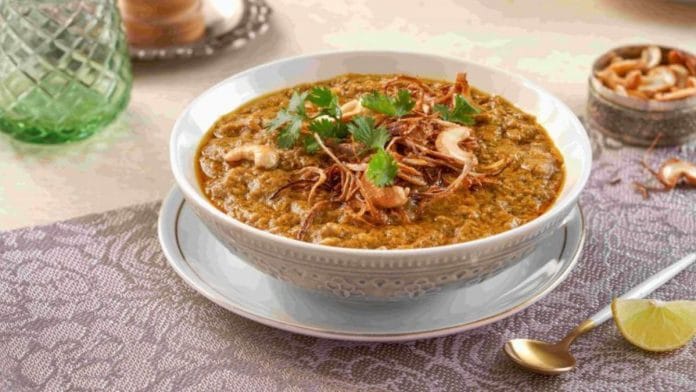



If there is one thing that everyone in Hyderabad anticipates every year, it is Haleem in Ramzan. Originally introduced in hotels during the month as a healthy meal after breaking one’s fast, the meaty dish today has transcended into a course that everyone loves. There are literally ‘Haleem runs’, whereby people try to find the best slow-cooked mutton or beef dish in the city.
Sadly, the dish has also become the target of two things: communalism and bad experiments. Certain right-wing groups on social media have urged non-Muslims not to eat Haleem, saying it is a ‘Muslim’ dish and buying it would help Muslim restaurant owners. The bigotry and a call for economic boycott of Muslims aside, this is simply ridiculous. By this logic, should Muslims also stop eating food made by Telugu Hindus in the state?
Hyderabadis, whether Hindu or Muslim, enjoy their Biryani and Haleem as much as they enjoy their idlis, dosas, bhajjis and even Andhra meals—a prominent Telugu trait. So this attack on anything associated with Muslim culture needs to stop, because food is what many of us bond over.
I am pretty sure these right-wing Hindutvavadis who call for this nonsense sit and eat biryani in the same hotels we visit. Either way, Ramzan is a month that turns Hyderabad into a food Mecca, and nobody really cares who makes what. In fact, it is a good time for people to familiarise themselves with traditional Hyderabad cuisine (especially made in Muslim homes).
Telugu people from Hyderabad and Telangana love Hyderabadi food, and Hindus, Muslims and Christians make the same dishes at home because of the shared culture.
Also read:Haleem hopping in Hyderabad—why Ramzan is worth every sleepless night in this Telangana city
Not-needed combination of Haleem and dosa
My other grouse during Ramzan is the weird marketing Haleem goes through every year. Social media influencers now do ‘30 days of Haleem’ tasting to ‘guide’ us to the best dish, which is highly subjective. Honestly, no one needs that information.
However, what is now starting to annoy me is the butchering that Haleem is going through. An Instagram reel showed a restaurant selling Haleem dosa. Dosa has already faced much abuse over the years, with people using cheese, schezwan, chocolate, and whatnot. But using Haleem on it is crossing the line. It didn’t end there. I saw Swiggy selling ‘Mutton Haleem Cropie’ (croissant). Ummm, what?
Haleem is a dish supposed to be eaten hot. It’s mashed up meat, lentils and spices topped with fried onions. Why does that need to be on a croissant? As it is, some of the restaurants here have begun selling Haleem with a topping of Chicken 65 and Mutton Nallis.
I am generally not a purist, like I don’t have a beef with anyone who says biryani can be vegetarian, but whatever is happening to Haleem needs to stop. As if right-wing communalism, which is part of a more dangerous pattern to marginalise Muslims, wasn’t enough that we now have this butchering of the dish. It’s terrible.
Haleem was first sold in Hyderabad at Madina Hotel in 1947, and for a long time, it was not even a big deal. I remember as a kid going with my family beyond Charminar to eat Haleem during Ramzan. This was in the 1990s, when we could still take our car to the Old City, which is unthinkable today.
So, from a dish that was mildly popular, Haleem has gone on to become a craze now. And as a dish, it deserves that status, so I hope this fad of creating more things with Haleem stops. Let Haleem be, please.
Yunus Lasania is a Hyderabad-based journalist whose work primarily focuses on politics, history and culture. He posts on X @YunusLasania. Views are personal.
A writer can decide what is right or wrong in their own narrative, but somehow people lose that same freedom when they speak for something real, like saving the lives of thousands of goats that would otherwise be killed. The writer can passionately argue over where Haleem should be served or how its pairing with Dosa is culturally inappropriate. But the moment a group voices concern and asks to avoid Haleem altogether, not out of bias but to prevent mass slaughter, it suddenly becomes communal.
This piece is well…just intellectually lazy. Dismissing the boycott as ‘bigotry’ without actually engaging with the argument behind it is weak opinion writing. Strong commentary should dismantle the opposing view, not just label it and move on.
The food-as-unity trope is also a tired cliché in Indian secular writing. People can share a meal and still harbour deep prejudices — culinary overlap doesn’t resolve communal tensions, and invoking it as though it does feels like a shortcut. So-called “binding over food” is trivial and glorifying it as some larger civilisational argument is indeed a stretch.