





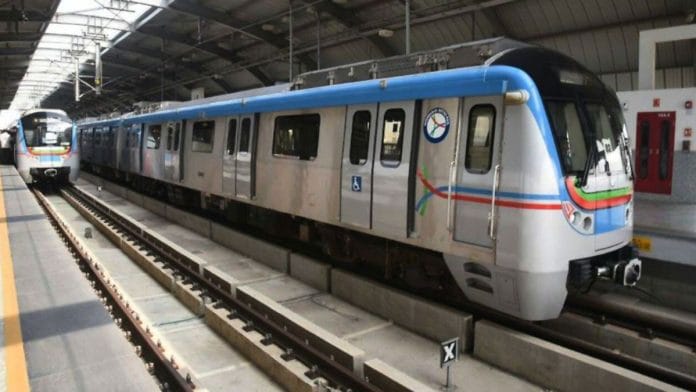



Each time I travel to Delhi, it makes me realise how inefficient the metro rail in Hyderabad is. Don’t get me wrong, I do appreciate the civic infrastructure in my city, but there’s also a reason why vehicle owners like myself do not use the metro.
Actually there are many reasons, and with the state government now taking over the entire project, I think there is a very valid fear among many that the metro’s fate is sealed. L&T was running the Hyderabad metro rail project since it was first inaugurated in 2017. I remember the day very well. It was the same day when Ivanka Trump landed in Hyderabad for the Global Entrepreneurship Summit.
The city was buzzing with excitement about the metro, especially because the Telangana State Road Transport Corporation (TGSRTC), which runs the city’s buses, has always been over burdened with commuters.
Combined with lack of funds and inadequate revenue from ticket fares, it has always been a struggling system. The TGSRTC being a separate entity meant that it didn’t function as part of the government, hence it had issues such as paying taxes to the state government for buses, or the government delaying release of dues for concessions to citizens.
Eventually, the inevitable merger of the TGSRTC with the state government was announced in 2023. As things stand, the process has not been fully completed.
It is this Telangana government, which has still not even fully absorbed the TGSRTC, that is now going to take over the Hyderabad metro rail.
Last September, the Telangana government announced that it is formally taking over the Hyderabad Metro rail project from L&T Metro. Phase one of the existing project will be taken over, plus L&T’s Rs 13,000 crore debt will be absorbed by the government. Moreover, the state has also agreed to pay about Rs 2,000 crore to L&T toward its equity investment as a one-time settlement.
This story is not very different from the TGSRTC, the only difference being that the corporation was always led by a government administration—the Managing Director was always an IAS or IPS officer. Now, with the metro also coming under the state, I don’t have much faith in the government to actually make it better.
All one has to do is to look at social media to see the state of affairs. The situation seems worse in the metro than at bus stops during peak hours. Crowded stations, leaking roofs during rains, and repeated technical issues leading to delays are pretty common.
Also read: Hyderabadi affair with Irani chai is old. Black tea is the new lover
Commuter-centred planning
More than technical aspects, the layout of the Hyderabad Metro rail itself is enough to see that it is not the most efficient system to use. It is however great for a chunk of people in the IT sector.
As of now the metro here has three lines: Blue (Nagole to Hitech City), Red (Miyapur to LB Nagar) and Green (JBS to MGBS). The Blue line is what connects one end of Secunderabad, (the former British cantonment) falling on the north of Greater Hyderabad, to the Hitec City or IT sector areas. This makes it a great option for many who have jobs there.
The red line and green both meet the MGBS stop in the Old City, which drops commuters to the edge of the Old City. This is unlike the Delhi Metro where one can get right to the middle of Old Delhi.
Sure, one can take an auto or bike-taxi to reach their destination, but that is a different game altogether. So far, reaching the Charminar has been a hassle. That line is finally underway but it’s anyone’s guess how long the work may take.
The biggest issue in Hyderabad however is the fact that there is absolutely no last mile connectivity. The stations have all been built on the main roads, which are in fact close to nothing except big malls or landmarks. For example, even though a station on the green line is near my house, I can’t take it to go to an area like Banjara Hills in the west. I can however go to Jubilee Hills, after getting down at Parade Grounds and then changing to the Blue line.
But even then not all of Jubilee Hills is accessible. It is only useful in certain situations, so it is in fact faster and more efficient to use my car or bike to commute.
Many take the metro because they would rather pay a little more and travel in AC as opposed to the bus, but when that is combined with extreme crowds and unending waits, the convenience factor quickly disappears.
So I hope the state government will build commuter-friendly public transport. When I was in Japan last year, I could take a subway station from literally anywhere as stations would be just a few minutes or maximum five minutes away by walk. The city has been built in that way.
I understand we have our own challenges, but Delhi has shown the way. If Old Delhi can have well-thought out stations bang in the middle of Chawri Bazar and Jama Masjid, then I think so can Hyderabad. It all depends on how well the state plans it.
Yunus Lasania is a Hyderabad-based journalist whose work primarily focuses on politics, history and culture. He posts on X @YunusLasania. Views are personal.
(Edited by Theres Sudeep)