









Shakespeare’s Richard III, the Crookback, talks about a “winter of discontent”. It is to such a winter that current media reports are leading us. The talk is of darker days ahead in and around the Strait of Hormuz. I have now lived off and on in Mumbai for five decades. And Mumbai has always had a close connect with Hormuz.
Elderly Gujarati ladies still refer to natural pearls, as distinct from cultured pearls, as “Basra” pearls. The Gulf may have its Bandar Abbas—“bandar/bunder” refers to a landing place, a jetty or a harbour—and in Mumbai, our famous Taj Hotel stands on Apollo Bunder. Those who have played the board game “Trade”, and who are by definition at least fifty years old, may remember Bori Bunder. The mercantile Bohris were prominent at this jetty more than a century ago.
So the Gulf (do note that I am politically correct and do not call it the Persian Gulf, although that was how my school geography texts described it) and the Strait are physically, metaphorically, and emotionally close to us. Now perhaps readers can understand why I am worked up.
But like Maria von Trapp, when I am sad, I can always fall back on remembering my “favourite things”. Admittedly, one of my favourite things is not the Kambaramayanam. But it was my grandfather’s favourite, and it is my friend Seetharam’s favourite. So I decided that to help me get out of my Gulf-Hormuz anxiety, I would head back to Kamban’s classic.
Also Read: The West’s real crisis isn’t war. It is the weakness within
The power of minor characters
In our country, there are literally hundreds of renderings of the Ramayana. In recent times, Ramanand Sagar created his version. Even today, writers, poets, minstrels, sculptors, painters, singers, composers, movie-makers, choreographers, and dancers are creating new versions. And of course, our friends in countries like Thailand and Indonesia are busy adapting inherited versions and creating contemporaneous ones.
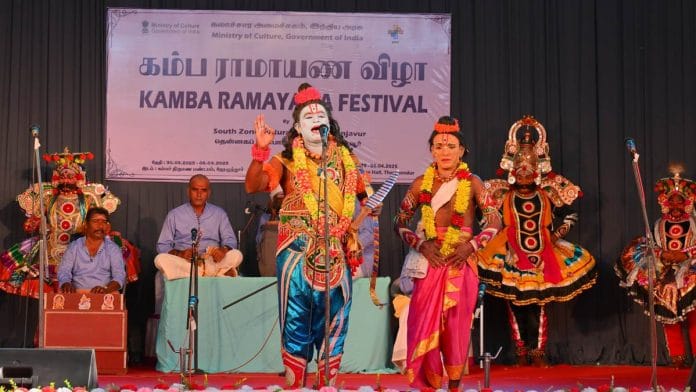
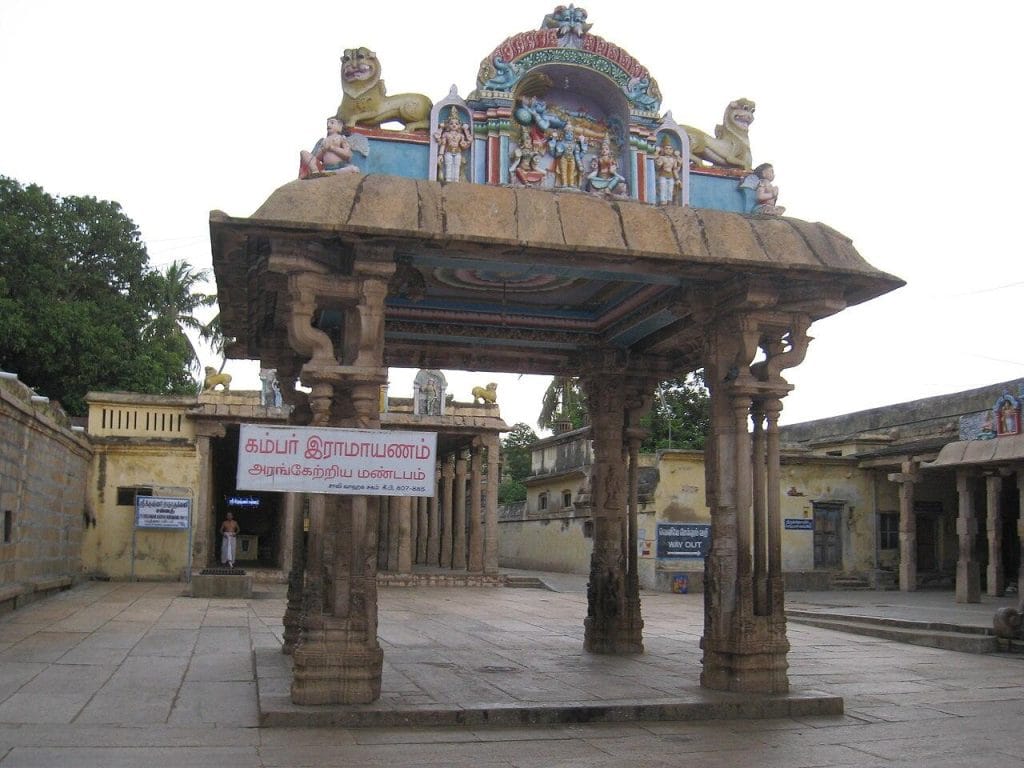
Why is Kamban important? Why do we continue to pay homage to his work with a celebration every year, a thousand years after he wrote his epic, with a special function in the Srirangam temple?
One reason is that Kamban had a near-surgical understanding of the literary craft. Among other matters, he understood the importance of minor characters. To bring it home to readers who may not be close to medieval Tamil, Jacques is important in As You Like It; Rosencrantz and Guildenstern, and even the dead and absent Yorick, are important in Hamlet. And one of the greatest accomplishments in English literature has to be the role accorded to the Convict in Great Expectations. After all, it turns out in the end that Estella is his daughter (apologies for giving it away to young readers who may not have read Great Expectations, assuming that older readers know it anyway).
Kamban is actually a better canvas painter than either Shakespeare or Dickens when it comes to minor characters. Rama, Sita, Hanuman, Lakshmana, Bharata, Ravana, and Vibhishana are all central to the Ramayana. Kaikeyi, Mantara, Guha, Shabari, Jatayu, Vishwamitra, Janaka, Vali, Kumbhakarna, and Indrajit (or Meghnad, as Bengalis like to call him) are all important minor characters.
One can only attribute it to Kamban’s genius that he draws our attention to Angada and Mandodari. Not important for others. But for Kamban, they provide the canvas on which he writes his immortal and beauteous words.
Lessons in honour and diplomacy
Angada is Vali’s son. And let us not forget that Rama killed Vali. And yet, so luminous is Rama’s presence that, in Kamban’s epic, Angada becomes an acolyte and a loyal follower of Rama. Rama actually sends Angada as an emissary to Ravana to see if a war can be prevented.
Incidentally, this, according to our Dharmic traditions, is what all honourable people do. And Rama was, of course, honourable. It is tragic that today’s Gulf-Hormuz protagonists have walked away from honourable conduct.
When Angada turns up in Ravana’s court, he is asked to identify himself. In Kambaramayanam, he says: “Ramasami toodan-a-da”—I am Lord Rama’s ambassador. Long ago, I asked my grandfather why Angada refers to Ravana as “da”, an expression used only with familiar persons or with subordinates. My grandfather told me that Kamban was making the point that Angada was a prince in his own right, and, as such, he was signalling that he was talking to a familiar equal.
Kamban’s ability to weave in an interesting detail of this kind, in his considered choice of even a syllable, is what sets him apart as an all-time literary great. The arrogant, hubris-driven Ravana does not listen to the diplomatic outreach. But, in fairness to Ravana, he does adhere to the Vienna Convention. Angada is not harmed.
Now to engage with the underlying themes that Kamban tells us. Here is a person whose father has been killed by Rama, and yet he is representing Rama as his ambassador. What does Kamban mean to tell us about Rama’s sheer charisma? Here is a peace offering to someone who has stolen Rama’s wife. What does that tell you about Rama’s dharmic generosity of spirit? And here is the demonic Rakshasa Ravana treating Angada as a diplomat entitled to diplomatic rights. Kamban understands completely the ambiguous nature of the human condition. Quite simply, Kamban gets it all. That is why he is special.
Kamban’s Rama is not just special. He is luminously special. On the ninth day of the battle, Ravana is visibly tired. Rama says to him, “Inru poi naalai vaa”—go now and come back tomorrow.
What is Rama trying to say? Kamban, through his Rama, tells us that one who is brave, confident, and, above all, honourable does not shoot arrows at a tired man. One does not kick a man who is down. The final fight is reserved for another day, with a fully rested Ravana.
Love and war
Nowhere is Kamban more brilliant than in his delineation of the oft-forgotten Mandodari, Ravana’s wife and a virtuous woman. Our grandmothers, and sometimes even our mothers, have told us that thinking about Mandodari will result in blessings being showered upon us. But otherwise, she is marginal in the grand Ramayana story. Not for Kamban. He pays great attention to Mandodari and her angst.
The apogee of Mandodari’s tragic yet lyrical delineation comes after her husband Ravana lies dead on the battlefield. Mandodari turns up to throw sesame seeds on her husband’s body. After all, in our country we associate sesame seeds with our offerings to the dead. Kamban tells us that Mandodari finds no space on Ravana’s body to shower the seeds, because every inch, every square millimetre, has been pierced by Rama’s arrows.
And then comes Mandodari’s extraordinary elegiac lament. Were Rama’s arrows trying to discover the part in Ravana’s frame where resided the forbidden lust for Janaki (Sita, the daughter of Janaka)? Where was this wicked lust hidden? And as she describes Sita, Mandodari refers to the honeyed flowers in Sita’s hair. Kamban has achieved the effect he wants. Mandodari is not given to jealousy or dislike of Sita for captivating Ravana. She understands human agency. She sees it only as her husband Ravana’s fault. There is a hint of an almost sisterly concern for Sita.
Kamban is trying to tell us that in Mandodari we have someone who may perhaps even exceed Rama in honour. And in seeking the exact position of her husband’s illicit lust, Kamban makes sure that his Mandodari reminds all of us that we too possess and hide forbidden passions within us.
Kamban tells us that Mandodari is a complex character. She has every reason to dislike her husband. But on the battlefield, as she looks at Ravana’s body, it is quite clear that disapproval does not eliminate earlier affection, fondness, admiration, and love. Modern psychologists need to learn about love-disapproval ambiguities from Kamban. Mandodari laments that her husband was strong enough to shake Shiva’s abode, Mount Kailasa. Is there a hint that, despite his lusts that defy virtue, it is Ravana’s strength that she admires? And now he lies dead, with arrows covering him all over. Kamban understands, at a deep level, that death ends all controversies and makes sure that we, his readers, understand the same.
Also Read: Strait of Hormuz is Iran’s trump card. Why has US superiority not secured the seas?
A dharmic hope
The Kambaramayanam is central to our culture. My grandfather frequently quoted from Kamban. My father’s friend, the prominent politician PG Karuthiruman, presented us with an annotated Kambaramayanam that he had written. In our youth, we were brought up on stories of Justice MM Ismail, Chief Justice of the Madras High Court, who was close to the senior Shankaracharya, the Mahaswami of Kanchi. Ismail was a scholar of Tamil literature and specialised in the Kambaramayanam. It is generally accepted that, to this day, there has probably not been a better analyst of the Kambaramayanam than Ismail. Clearly, Kamban, his hero Rama, and his work speak to scholars and admirers across religious identities.
Dear Reader, if you are upset today, do not fret too much. A thousand years ago, Kamban gave us a gift. Kamban reminds us that the terrible war—which included Indrajit’s tragic death, Lakshmana being rendered unconscious, and the strange machinations of Ahi Ravana and Mahi Ravana—did end. Given Mandodari’s lament, as Kamban presents it, all did not end completely well. But it did end. At Rameshwaram, Sita helped Rama pray to Shiva as an act of remorse and redemption.
The world moved on and, as the Uttarakanda of the Ramayana tells us, not necessarily very well. That is a warning to us not to expect a simplistic, rosy future. But the world did move on. We have to confront our despondency today. There is no point running away from it. But to paralyse ourselves is not the answer.
Sober, quiet dharmic responses are what we have to cultivate. We have to be Angadas. Let us not forget that one of the great Sikh Gurus was Angad. Perhaps Kamban’s valorisation of Angada travelled all the way to Punjab to make this choice of name happen. In any event, Guru Angad remains an inspirational figure to this day, and the Guru would not have approved of despondency.
Read the Kambaramayanam, fully or in part, in the original stately Tamil or in translation. Immerse yourself in it. The irksome wars and issues of today will fade. Rama and the Ramayana are ours forever. And Kamban’s words will stay with us for generations to come.
And we can always hope that the combatants of today will learn not just from Rama’s honour, which in any event they may not be able to emulate, but from Kamban’s Angada and Mandodari that wars can be humanised and wars can end. Perhaps we can hope they may even, across distances, pay attention to the insights of Justice Ismail. We, in this not-so-distant part of the world, will be like Justice Ismail, appealing to Rama for peace.
Jaithirth ‘Jerry’ Rao is a retired entrepreneur who lives in Lonavala. He has published three books: ‘Notes from an Indian Conservative’, ‘The Indian Conservative’, and ‘Economist Gandhi’. Views are personal.
(Edited by Asavari Singh)