






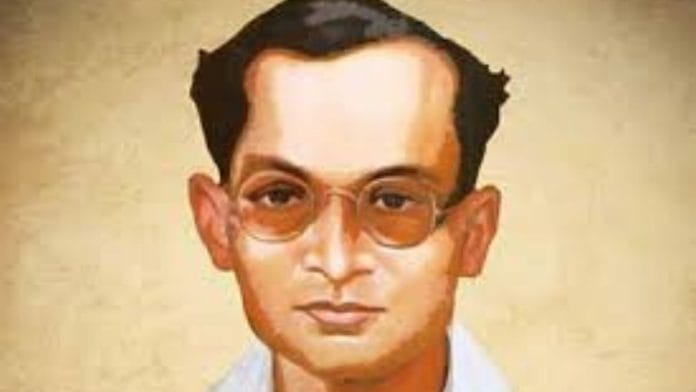



In what is perhaps one of the most recognisable verses in Assamese sangeet, Jyoti Prasad Agarwala writes:
Amare xokhiyai akul biyakule xopunor hahiti sai
Xopunot kuwore ahudi anile motoliya xokhi khai
(My friend grew restless after she dreamed of a smile. It was a prince who had ushered her in, captivating her with his smile. Upon waking, she was desperate to meet the prince.)
This piece is the retelling of the story of Usha, the daughter of King Bana, a devotee of Lord Shiva. It recalls the instance that Aniruddh, a Yadav prince and a descendant of Lord Krishna comes to her in her dream and they fall in love. The song is sung from the perspective of Chitralekha, Usha’s friend and a painter with mystical powers. It is Chitralekha who flies a sleeping Aniruddh and brings him to Usha.
This is one of over 300 Assamese songs, forming a blend of folklore, classical influences and original melodies, that Jyoti Prasad Agarwala wrote during his lifetime. Together they form what is known as Jyoti Sangeet.
Born in 1903 in Dibrugarh district, Jyoti Prasad Agarwala arrived in an Assam that was soon to be merged with Eastern Bengal post the Partition of Bengal in 1905. This led to a rise in linguistic and cultural nationalism, as many literary giants used the Assamese language as a tool of resistance fearing a repeat of the Dark Age of Assamese Language (1836-78), when Bengali was made the official language of the state. The colonial government’s policy of encouraging peasant migration from East Bengal into the Brahmaputra valley also fuelled this resistance. This was the backdrop against which Jyoti Prasad Agarwala eventually came to the forefront of the Assamese literary and cultural scene.
In 1935, Agarwala wrote, directed, produced and composed the music for Joymoti, the first Assamese feature film. It was a retelling of a crucial story in Assamese history. Joymoti was killed by Laluksola Barphukan, who ruled in the name of the puppet ruler, Sulikphaa. She was tortured for the whereabouts of her husband, Gadapani, who would later go on to be the Ahom ruler Gadadhar Singha.
Though not an immediate commercial success, the cultural impact of the film was immense. Agarwala’s cinematic efforts laid the foundation for the Assamese film industry.
Also read: Magh Bihu isn’t like Pongal or Makar Sankranti. It is rebellious at heart, with tribal origins
An Assamese icon
Jyoti Prasad Agarwala was an Assamese literary giant, producing some of the earliest and most notable works of modern Assamese drama such as Sonit-Kuwari, Karengar Ligiri, Lobhita, among many others.
Deeply involved in the Indian freedom movement, he engaged in Satyagraha and Civil Disobedience, getting imprisoned for his activism. Through the revival of the Assamese newspaper Asomiya, he reinforced his commitment to the freedom movement as well as to Assamese language and general public discourse.
As we celebrate Silpi Divas on 17 January, in honour of the anniversary of his passing, let us remember Rupkonwar Jyoti Prasad Agarwala, a staunch advocate for the Assamese language and cultural identity. He helped Assamese consciousness gain currency in a time when the Assamese were fighting a many front war—the war for Indian Independence and the war for their own identity.
Shabnoor Rahman is the Assistant Commissioner of State Tax, Govt. of Assam. Views are personal.
(Edited by Theres Sudeep)