





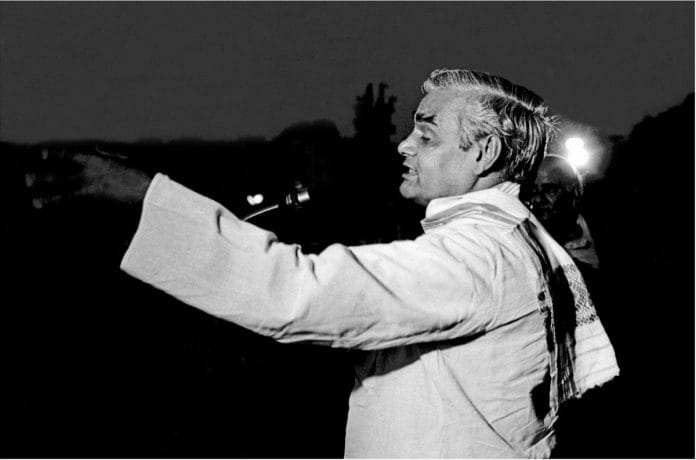



I am conscious of the great honour that you have extended to me by inviting me to address this august Chamber and, through it, the people of Iran. Your invitation reflects your affection for India and the enduring ties of friendship between our peoples. I bring you warm greetings from our Parliament.
Honourable members, I come to your great country to renew the strong civilizational links between India and Iran. We have known and interacted with each other throughout history. It has been a deep and abiding interaction. There has been an uninterrupted dialogue. Its tempo may have varied at times, but it was never broken. In our two countries, language and literature, art and architecture, philosophies and cultural traits all bear the enduring stamp of this continuing dialogue and interaction.
Our intertwined cultures illustrate the validity of the profound thinking behind President Khatami’s call for a “Dialogue among Civilisations”. The initiative emphasises that the security and prosperity of the world needs cooperative efforts and not confrontation or unilateral imposition of one’s will. And there can be no cooperation without a genuine dialogue, which seeks to understand and appreciate different points of view and to see the Truth in its manifold manifestations. The Indian tradition has always held that Samvad – a positive and peaceful exchange of views – is a fundamental pillar of civilized society; it also has to be the first pillar of civilized society; it also has to be the first pillar of a peaceful and just world.
So, in the words of the immortal Hafez: It is my desire to speak to you from the depth of my heart and I hope to listen to your heart’s desire.
Besides being ancient civilisational entities, India and Iran are also resurgent and confident nations today. We are both in the midst of far-reaching social and economic change, but our societies and political systems are strong and stable. The winds of globalisations, riding the storm of new technologies, cannot overwhelm us. We will not be swept away from our cultural moorings; we will maintain our personalities and identities.
Globalisation, the technology revolution, and international interdependence are inescapable realities. But it should not be an inevitable corollary that weaker countries get marginalized in the process or that the socioeconomic divide is replaced by the digital divide within and between countries. Tendencies to unilateralism in resolving economic issues have to be resisted. The imposition of tough measures for an accelerated liberalization of fragile economies can provoke an economic collapse or a social backlash. The operation of some technology-denial regimes has blocked even genuine developmental requirements of developing countries. Countries like India and Iran, which retain their independence of spirit and action need to jointly engage in the process of countering moves which could create a new international regime of economic discrimination.
Honourable members, we in India saw the Revolution under the invigorating leadership of Imam Khomeini as a defining event in Iran’s history. It was an expression of the will of the Iranian people. It was an assertion of their identity and of their quest for regeneration. India empathizes with your aspirations for a just and egalitarian society and polity.
In the midst of far reaching and fundamental change, India remains firmly committed to the basic principles of its constitution and polity – democracy, freedom, secularism, social justice, and equitable growth. The preservation and enlargement of individual freedoms and civil liberties is an axiom of our democratic tradition. We value our autonomy of action in our domestic and foreign policy. The goals of a just socio-economic system within the country and a peaceful and equitable world order have consistently guided our national policies.
Since its Independence in 1947, India has travelled a long way on the road to progress. We can take satisfaction at the growth of our infrastructure, the great strides we have taken in agriculture & industry, and in our advances in education, science and technology. We are acutely aware that colonialism and economic exploitation had ensured our backwardness mainly through a denial of the opportunity for scientific and technological advancement. Today, India is at the forefront of the knowledge revolution. We are determined that we will never again fall behind in scientific research and technological achievement. Our experience and skills in these areas are also available to our friends through technical co-operation programmes for peaceful socio-economic development. Of course, we know that much still remains to be done to fulfil the ideal of Mahatma Gandhi: to wipe every tear from every eye.
India is a land of many faiths. Our belief in secularism is rooted in a tradition which fundamentally respects man’s spiritual quest and his freedom to pursue it in the manner in which he chooses to do so. There may be some occasional aberrations, but neither the State nor civil society would ever weaken its bond with secular values, which are inherent in our civilisation and cultural inheritance.
We will also never allow any external force to cast a shadow on India’s secular fabric by seeking to damage our unity and territorial integrity. Islam has made a significant contribution to the development of our culture. We do not consider any religion foreign to us. For nearly a thousand years, Islam has been part and parcel of our national and social life. The mellifluous call of the Aizzan, the bells of our temples and churches, the invocation of the Guru Granth Saheb and the Dhammapadda all blend in a melodious symphonic offering to the Almighty.
Honourable members, my own parliamentary constituency is Lucknow, which is one of the holy centres of Shia tradition in India. Since the days of my youth, the Moharrum processions have made a profound impression on me. I was moved by the story of the supreme sacrifice of Imam Hussain at Karbala.
As India continues its engagement with the world on equal terms, it continues to seek a peaceful and stable world order, ensuring justice and prosperity for all. We continue to seek friendship and co-operation with all countries in our neighbourhood. In this quest, we have always been prepared to go the extra mile. Wherever there are differences and however strong or emotional these differences, they have to be addressed directly, peacefully, and through dialogue. Dialogue and violence cannot go hand in hand. We call upon those forces in our neighbourhood, which have promoted confrontation and pursued the path of violence to recognise the futility of their ways and to abandon them. On our part, we are aware of our responsibilities, and will always act with restraint.
Even as our region takes the road to socio-economic progress, dark forces of violence, terrorism and obscurantist ideologies have again emerged in our neighbourhood. Afghanistan has been at the crossroads of civilisations. It bears the imprint of the interaction of diverse cultures. It is tragic that an attempt is being made to obliterate its past through the destruction of its historic art, which is the heritage of all mankind. Those who are guilty of these acts are not of this day and age; they have lost reason and logic. These acts cannot be condoned as an expression of rage against an uncaring world. The mentality behind the forces that are responsible for this destruction and the nexus of these forces with violence and terror presents a challenge to all those societies that aspire to harmony and peace.
For the welfare of our peoples and for regional peace and security, India and Iran have to confront these challenges together. Again, we have this exhortation to bilateral action from Hafez: This calamity has adversely affected men’s thinking and distorted perceptions. Where are the views of Iranian and Indian philosophers?
On the firm foundations of our traditional affinities, with a proper awareness of the commonalties between India and Iran, the time has come to reinvigorate our relations in all areas – energy, education, culture, science & technology, economy & commerce, agriculture and industry. The possibilities are immense and we should harness them for the welfare of our people. Our mutual co-operation should also benefit our region. In our discussions yesterday, President Khatami and I renewed our commitment to accelerating the speed of our joint efforts. I am confident that we will have the support and goodwill of this esteemed House in this endeavour.
Thank you.
This is part of ThePrint’s Great Speeches series. It features speeches and debates that shaped modern India.
A political speech made for winning M7slims votes by politician Vajpayee I’d not a factual on- the-hround reality.
The right man. For all times, all seasons.