






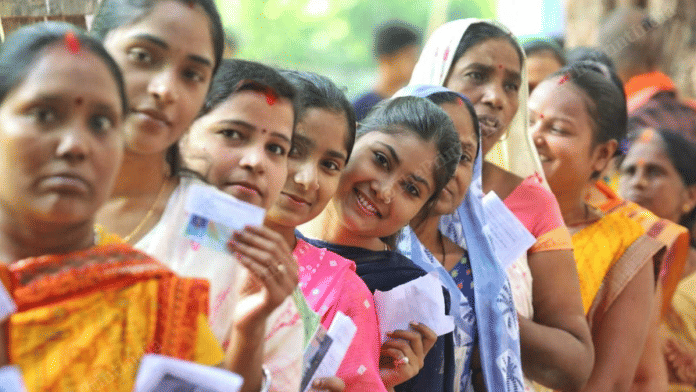



This year’s International Women’s Day was much like the others. It was full of speeches, talks, photo-ops, banners, and balloons—pink–coloured rhetoric. This year, the theme was “Rights. Justice. Action. For ALL Women and Girls”.
As per the United Nations, women worldwide hold only 64 per cent of the legal rights that men do. And if progress continues at the current pace, we’ll need another 286 years to close the legal protection gap. It’s a disturbing statistic.
Even today, the path to equal justice for women and girls remains uneven, marked by restrictive social norms, discriminatory legal frameworks, and a persistent pushback against gender equality.
Every generation of women inherits a different India. For the women of today, challenges inherited are offset by the promise of unprecedented opportunity. From classrooms and coding labs to startup hubs and sporting arenas to satellites in space, Indian women are stepping into roles that are reshaping the country. A case in point is Operation Sindoor, which demonstrated nari shakti (women’s power) through Col Sofiya Qureshi and Wing Commander Vyomika Singh. And the constitutional position of India’s Head of State is held by Droupadi Murmu, who belongs to the Santal community.
India’s progress in advancing women’s justice is visible across domains. We are pioneering gender budgeting, expanding legal protections, and creating one of the world’s largest networks of elected women leaders at the grassroots level. The country is embedding gender equality in the very fabric of its developmental framework. India is also positioning itself as a leader in advancing women’s empowerment among the emerging economies by expanding digital access for women and strengthening their representation in emerging industries.
Women-led development
India is gradually moving toward a model where development is not simply delivered to women, but is rather increasingly designed and driven by them. Indian women are decision-makers, innovators, and community leaders.
India has over 14 lakh elected women representatives in Panchayati Raj institutions, giving the country one of the largest networks of elected women leaders in the world. This phenomenal feat was achieved through the 73rd and 74th constitutional amendments, which mandated reservations for women in local governance, legally making them a part of the decision-making process. Institutional justice is therefore served through increased political participation.
The Gender Budget for FY26 reached a record Rs 5.01 lakh crore, displaying an 11.36 per cent increase from the previous year’s Rs 4.49 lakh crore. It now accounts for 9.37 per cent of the Union Budget, up from 8.86 per cent in FY25, with 53 ministries contributing to initiatives focusing on women’s health, education, and economic empowerment. The government is explicitly addressing women’s needs in health, safety, education, and economic participation.
India leads in the statistics for women in aviation. With 15 per cent of its total pilots being women, the country has three times the global average of approximately 5 per cent. Women are increasingly breaking the barriers in high-skill, traditionally male–dominated professions. They constitute about one-third of India’s technology workforce, placing the country among the leading nations with women–powered technologists.
The government has launched several microfinance initiatives to help women gain economic self-sufficiency. Over 10 crore women have benefited under the Deendayal Antyodaya Yojana – National Rural Livelihood Mission, which organises women under self-help groups. It is one of the world’s largest women-led community platforms, with a repayment rate of 98 per cent. Lakhpati Didi and Drone Didi are innovative schemes that seek not only to empower rural women but also to upskill and keep them abreast of modern technology.
The government’s Womaniya e-commerce portal scheme enables women entrepreneurs to supply directly to government buyers. Financial schemes such as the Pradhan Mantri Jan Dhan Yojana, Pradhan Mantri Mudra Yojana, and Stand-Up India are enabling women to join the journey of Viksit Bharat as equal partners.
The skillset women bring to the table is different and complementary—rather than contradictory—to that of men. Women often demonstrate strengths in areas such as emotional intelligence, collaboration, and resilience—skills that are increasingly valuable in complex, knowledge-driven economies.
Expanding access to upskilling and continuous learning opportunities for women, especially in digital technologies, leadership, and emerging industries, will be essential to ensure that the UN theme of ‘rights, justice, and action for all women’ is met. When women are empowered to apply their distinct skillset, experiences, and perspectives, institutions become more responsive to the needs of society as a whole. Harnessing these strengths is not only a matter of fairness but also a strategic asset in building robust systems that are just, equitable and fair, to achieve the broader goal of gender justice.
Also read: BJP’s stance on Vande Mataram is a big political paradox. Nagaland exposes it
Ancient roots
While the constitution grants equality before the law to all citizens, it offers special provisions for women. These ensure that women remain a special class by themselves and have access to special discrimination in their favour.
As the world reflects on the theme of justice for women and girls, India’s development journey underscores a powerful truth which can be traced back to its scriptures and culture:
Yatra nāryastu pūjyante ramante tatra devatāḥ |
Yatraitāstu na pūjyante sarvāstatrāphalāḥ kriyāḥ || (Manusmriti 3.56)
(Where women are honoured, there the gods rejoice;
Where they are not honoured, there all rites are fruitless)
This ancient Sanskrit phrase reminds us that respect for women has long been embedded in India’s cultural ethos. In the 21st century, this can be interpreted to mean that where women are offered education, skill development, access to technology, political representation, and safe public spaces, those societies and cultures flourish. I am proud to be associated with a government that focuses on women–led development.
Meenakashi Lekhi is a BJP leader, lawyer and social activist. Her X handle is @M_Lekhi. Views are personal.
(Edited by Prasanna Bachchhav)