






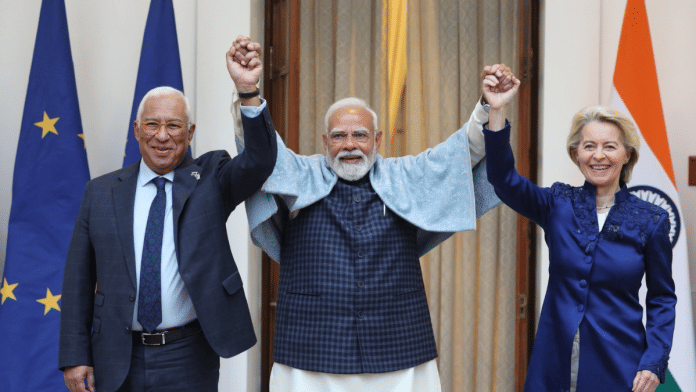



The Free Trade Agreement between India and the EU, reached at the recent summit, is more than a mere business achievement. It marks a shift in global governance, with two major pluralist democracies choosing cooperation rather than confrontation, and for the rule of law over unilateral action. The agreement was hailed by leaders as a transformational agreement that would open markets and reduce barriers, but the significance of the agreement is in the template for shared governance it seeks to establish.
The most obvious impact will be trade liberalisation, but the architecture of the agreement goes far beyond tariffs. By weaving together the regulatory chapters and the enforceable processes, it aims to lower the uncertainties for business while building shared expectations about labour, environment, and industry standards. This is important because, in today’s world, trade is less about shipping widgets at a lower price and more about trust: predictable rules on sustainability, conformity assessment, and corporate due diligence that shape long-term investment decisions. The India-EU agreement, in highlighting regulatory alignment, promises to rewire business relationships in a market worth €27 trillion.
Template for major economies
One of the first areas of joint governance is climate. Europe’s Carbon Border Adjustment Mechanism has been a cause of concern for exporters across the globe; the Indian negotiations secure specific commitments from the EU on transition and cooperation to prevent sudden trade disruptions. These commitments reflect a new reality: developed countries will no longer export costly climate instruments; they will pair them with capacity-building and transition timetables. This approach is ambitious and just, and can be a template for other major economies.
Digital governance is another domain where shared rules will have oversized consequences. The Trade and Technology Council and related India-EU dialogues already prioritise data flows, interoperability, semiconductors and cybersecurity. Harmonising approaches to data protection, algorithmic transparency, and cross-border data flow will enable collaborative innovation and the protection of privacy and security. In other words, shared digital standards will smooth the way for cloud computing, fintech, and healthtech companies and make cross-border R&D collaborations, from semiconductor manufacturing facilities to AI research labs, more feasible.
Security and strategic cooperation have quietly entered the mix of governance. The recent leaders’ summit deepened defence dialogues, with a focus on maritime security, critical technology supply chains, and resilience in the Indo-Pacific region. When economic agreements are combined with security partnerships, governments provide incentives for each other to contain geopolitical tensions through institutionalised cooperation, such as joint military exercises, shared maritime awareness, and defence-industrial track-two engagements, thus reducing the likelihood of trade tensions escalating into a strategic split.
Technology and standards cooperation will determine who will set the rules for the next industrial era. Whether it is green hydrogen certification, electric vehicle batteries, or semiconductor procurement, the India-EU platform seeks to co-create rules that will pre-empt the setting of unilateral standards by any particular bloc.
For Indian industry, this provides a way out of the supplier role and into the standards-partnership role—moving from adapting to piecemeal rules to shaping them, and seizing the higher-value parts of the global value chain. For Europe, it provides a way to diversify supply chains and enhance the credibility of decarbonisation technologies in the market.
Shared governance also applies to finance and public goods. The agreement and strategic roadmap that accompanies it foresees cooperation on sustainable finance, blended concessional financing, and joint investment vehicles that can underwrite low-carbon industrialisation in India and its neighbourhood. By leveraging regulatory influence together with development finance, India and the EU can help close the financing gap for climate-resilient infrastructure and develop cross-border investment frameworks that meet both sustainability criteria and development imperatives. This is governance that coordinates capital, standards, and policy incentives at scale.
At the normative level, the agreement reiterates multipolar multilateralism. In a world where institutions are under strain and norms are in dispute, India and the EU are making the point that major, like-minded partners can construct interoperable regulatory frameworks that balance national priorities with international cooperation. For emerging economies, this approach presents an alternative to forced binary choices: they can line up behind rule-based regimes that provide transition assistance, technology transfer, and capacity-building rather than being subject to unilateral market exclusion. In other words, shared governance becomes a diplomacy of inclusion as much as one of standards.
Also read: India’s love-hate relationship with foreign capital holds it back. What Budget 2026 hints at
A pragmatic blueprint
There are still practical hurdles to be cleared—legal review, ratification by EU member states, and the hard-nosed politics of reconciling different domestic constituencies—but the agreement establishes a hopeful institutional track record. If faithfully executed, it will not only increase trade but also institutionalise a style of managing complex transnational challenges through rule-based cooperation, mutual adjustment, and reciprocal capacity-building. That is the true export: a governance architecture that is suited to a multipolar, technology-driven century.
Finally, the India-EU partnership illustrates the following general truth: in today’s world of rapid technological change and climate imperatives, sovereignty does not mean acting alone. It increasingly means co-shaping rules and pooling resources to build the capacities to live up to them. The India-EU deal, ambitious in scope and collaborative in spirit, offers a pragmatic blueprint—an invitation to other states to move from transactional relations to co-created governance that is durable, equitable, and forward-looking. May the trade agreement become a template of peace, prosperity, and partnership over conflict, crunch, and competition.
Meenakashi Lekhi is a BJP leader, lawyer and social activist. Her X handle is @M_Lekhi. Views are personal.
(Edited by Ratan Priya)
Expecting socialist India to become a developed free-market economy will certainly end in disappointment. Our DNA is socialism, poverty, and corruption. Even Adam Smith can’t remove the curse of socialism on our country.