






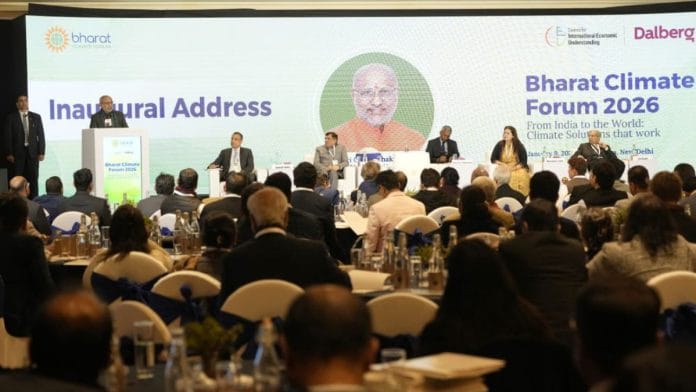



The Bharat Climate Forum 2026: From India to the World-Climate Solutions that work convened on 9 January to convert climate ambition into concrete industrial and diplomatic outcomes. The Forum-co-anchored by the Council for International Economic Understanding and Dalberg Advisors, brought together senior policymakers, industry leaders, financiers, researchers and civil society to build actionable blueprints for “Make-in-India” climate solutions with global reach.
The event was honoured by the presence of the Vice-President of India, C P Radhakrishnan, whose inaugural address underscored the national imperative of climate action and the moral duty to protect our common home. The Forum included ministerial leadership—Manohar Lal Khattar, Union Minister for Power and Housing & Urban Affairs and Pralhad Venkatesh Joshi, Union Minister for New & Renewable Energy, alongside leading private-sector CEOs, development financiers and technical experts. Their participation signalled that India is aligning high-level political will with industrial strategy.
Bharat Climate Forum (BCF) 2026 was convened because India faces a dual challenge: to meet ambitious climate goals while accelerating industrialisation, job creation and resilient development. The Forum’s mandate was practical—to identify how climate policy can be embedded into manufacturing strategy, finance instruments and regional partnerships so that decarbonisation becomes an engine of equitable growth rather than a cost centre. In short, BCF was designed to move nations from declarations to deliverables: factories, apprenticeships, pilot corridors and transparent MRV (measurement, reporting and verification) systems that produce measurable emissions reductions and socio-economic returns.
Historically, geopolitics turned on finite hydrocarbons—access to oil shaped alliances and fuelled conflict. Today, an alternative is possible: Technology can convert scarcity into abundance. India’s strategy is to deploy innovation, scale manufacturing and diplomatic reach to make green technologies affordable and widely available. This is not merely an economic calculation; it is a strategic pivot from competition over scarcity to cooperation for shared resilience.
This strategic pivot is rooted in a civilisational ethic—vasudhaiva kutumbakam—the conviction that the world is one family and that progress must be shared. India’s approach to climate partnerships is therefore defined by two commitments: First, to scale domestic manufacturing, so, clean technology is cost-competitive globally; second, to structure cooperation so that the Global South receives technologies and finance on terms that enable rapid, just transitions.
India’s strengths
Three concrete strengths make India a natural partner for global climate collaboration:
- Manufacturing scale and cost discipline: India already produces components at a large scale for solar and other clean technologies; targeted public-private investment can expand this to electrolysers, balance-of-system components and battery recycling at competitive costs.
- Services, digital systems and engineering capacity: India’s IT and engineering sectors can deliver smart grid management, MRV (Measurement, Reporting, and Verification) platforms and O&M (Operations & Maintenance) services that ensure plants run efficiently and transparently.
- Diplomatic convening and market access for the Global South: India’s soft power and partnerships across Africa, South and Southeast Asia enable the export of tested, low-cost solutions that reflect development priorities.
Together, these strengths mean India can manufacture hardware and operate the systems that deliver measurable climate outcomes. At BCF, India advanced a compact set of mechanisms designed for rapid implementation:
- Make-in-climate pilots: Blended-finance manufacturing facilities that combine concessional capital, sovereign guarantees and private investment to underwrite new electrolyser and module lines.
- Green Tech Corridors: Demonstration clusters that integrate renewables, storage, green fuels and low-embodied-carbon construction into investible packages with agreed MRV and local inclusion targets.
- Green procurement compact: A buyer coalition (governments, DFIs, large corporates) committing to preferential procurement for certified climate goods manufactured under fair labour and environmental standards.
- Standards and fast-track certification: Mutual recognition of testing and certification to remove regulatory friction and speed cross-border supply chains.
- Skills and fellowship programmes: Joint training for technicians, regulators and entrepreneurs to ensure projects are buildable, operable and locally staffed.
Also read: Climate crisis in India is being normalised. Country’s poor are paying the price
Green Tech Corridor matters
These instruments are deliberately pragmatic: Pilots create early demand and data, blended finance derisks factories, procurement scales markets, standards unlock trade, and skills ensure sustainable operations.
The idea of a Green Tech Corridor matters because it bundles generation, storage, industry and logistics into a coherent investment opportunity. When paired with Indian manufacturing and training programmes, corridors become replication templates for partner countries. This fulfils India’s Global South vision—exporting not charity, but affordable, high-impact industrial capacity that supports resilient development.
The vice-president’s presence at BCF 2026 was more than ceremonial. It signalled the seriousness with which India approaches climate stewardship. High-level ministerial participation reinforced that climate policy is now central to economic and diplomatic strategy, not an ancillary agenda. This political coherence is essential if pilots are to scale into national industrial strategies and bilateral partnerships.
BCF 2026’s success depends on conversion—from talk to procurement orders, from frameworks to factories. I therefore call on partners present at the Forum to commit to a time-bounded pilot package: Fund two blended-finance manufacturing facilities, launch one green tech corridor demonstration, and stand up a shared MRV registry within 12 months.
These are modest, measurable first steps that will produce jobs, build local capacity and lower the cost of the global energy transition. The twenty-first century’s defining strategic choice is whether we will fight over scarcity or cooperate to create abundance. India chooses cooperation to manufacture at scale, share technology, and ensure the Global South secures a fair transition. Grounded in vasudhaiva kutumbakam, our climate diplomacy seeks not only to protect Mother Earth but to do so in ways that uplift people, create dignified livelihoods and stabilise international relations.
BCF 2026 was a practical expression of that vision; its value will be judged by the factories built, the technicians trained, the megawatts commissioned, and the lives improved.
Meenakashi Lekhi is a BJP leader, lawyer and social activist. Her X handle is @M_Lekhi. Views are personal.
(Edited by Saptak Datta)