






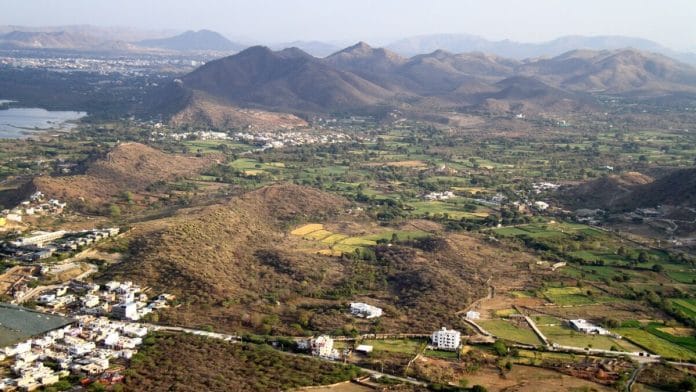



The Union government’s recent press note promising “no new mining leases” and an expanded protected zone in the Aravallis is a retreat—welcome, but overdue. The issue had already leapt out of policy files into public anger across Rajasthan and Haryana. Delhi’s winter smog has turned every ecological argument into a lived crisis.
In plain terms, a permissive narrative met the limits of public tolerance. The climbdown may cool tempers, but it does not by itself secure the hills.
Press notes do not alter incentives; they only alter posture. If the underlying economic logic remains “quarry first, repair later”, the Aravallis will return to the same treadmill of legal skirmishes, technical committees, porous enforcement, and periodic crackdowns that arrive after the damage.
How we got here
It is fashionable to blame the Supreme Court’s contentious 21 November judgment for “starting” the fire. But courts respond to the policy space governments create. When the government adopts a cautiously permissive posture—treating regulated mining as reasonable—judicial outcomes will end up constructing frameworks for “managed extraction” rather than slamming the door shut.
After the judgment, the politics shifted. The backlash was not merely partisan: it was civic, local, and visual. People who live near the belt and breathe NCR air understand that the Aravallis are a key ecological buffer. The erosion of the ridge already shows up as dust, heat, and water stress in the NCR. That is why the press note looks like a surrender.
Yet, if we stop at the satisfaction of having forced a retreat, we will have won a news cycle and lost the landscape.
Also read: AQI and Aravalli showed a glimpse of what TV news could do. Then Bangladesh lynching happened
An economic pivot
The Aravallis are among the oldest mountain ranges on Earth, but their relevance is not museum-like. They stabilise soils, slow desertification, moderate dust, support biodiversity, and help groundwater recharge across a broad region.
If we keep describing the hills chiefly as a source of aggregates for construction, the extraction logic will keep reappearing through legal mining, illegal mining, or “exceptions” dressed up as necessity. Conservation has to be more than moral pleading; it must have a durable economic backbone. That is the pivot we need: from a mining (economy?) to a renewal plan that creates livelihoods while also protecting the hills.
Controlled eco-tourism is the most practical starting point. It aligns incentives rather than merely preaching restraint. Done badly, it has the risk of becoming mass tourism, speculative construction, and ecological vandalism in green packaging. Done well, it can turn protection into income and integrate local communities as the first line of stewardship.
Rajasthan already knows how to curate places without turning every asset into a concrete marketplace. India already runs regulated visitation in sensitive landscapes. The Aravallis have a structural advantage most eco-destinations do not: proximity to Delhi, airport connectivity, and a vast urban demand for nature experiences that will only intensify as climate stress rises.
The question is not whether people will come. The question is whether we will cap, channel, and civilise that economic pressure—or allow it to repeat the hill-station disaster we have seen unfold throughout the year.
Tragedy of the community land
Large parts of the Aravalli belt are government-owned, panchayat-controlled, or under state jurisdiction, alongside forest and commons-like tracts, with private holdings interspersed. This invites the tragedy of the commons—nobody feels accountable while everybody extracts. We must treat community lands as public trust property and convert “common land” into “common benefit”.
This requires simple, enforceable rules such as capped access to sensitive zones, transparent fees, and ring-fenced revenue that flows visibly back to local institutions for conservation-linked livelihoods. When villagers can see that a protected ridge, a restored waterbody, or a maintained trail funds village income and local work, protection will come to be seen as economically rational. When the only visible money is from trucks, extraction will be seen as necessary, if not rational.
Where land is privately owned—especially agricultural and allied holdings—the renewal plan must be constitutionally respectful. Owners should not be divested of their right to manage their land and livelihoods in the name of conservation.
In many places, private stewardship is a practical defence against misuse. The right approach then becomes consent-based participation: farm stays, guided nature walks, local produce experiences, and craft and cuisine circuits. These are low-impact activities that supplement income without coercion or diluting the right to agriculture and allied work.
A credible plan must draw a clear line. Public/commons lands can host regulated trails and community-run facilities, while private lands may participate by choice. For this to work, the government must offer benefits that make stewardship worthwhile.
Also read: ISRO’s BlueBird launch is a new phase in India-US space ties—denial to cooperation
Put ecology first
The Aravallis do not need grand highways and concrete “tourism infrastructure” that permanently escalates pressure. They need light-footprint design, such as walking trails, cycling routes, birding circuits, geology and heritage walks, and small interpretation centres.
Instead of large hotels, accommodation should be offered in homesteads and small, locally owned eco-lodges with strict design rules, water discipline, and waste management. Most importantly, eco-tourism must fund ecological repair. This includes native vegetation revival, water harvesting, corridor protection, and continuous monitoring.
Since the Aravallis straddle states and bureaucratic silos, a renewal plan needs a coordinating spine. An Aravalli eco-trust could supply that spine. This body must feature representatives from local communities, ecologists, tourism professionals, civil society, and government. And its legitimacy must come from transparency. It must publish eco-zoning maps, set visitor caps by zone and season, ensure licensing standards for operators, and create a public dashboard showing visitor numbers, revenue collected, conservation spending, and compliance actions.
The more visible the data, the less room there is for capture by lobbies that will inevitably seek to convert eco-tourism into a backdoor construction boom.
The government’s press note is a political truce, not a restoration plan. But if we pivot now from extraction to controlled eco-tourism and restoration, the truce can become a healing compact.
KBS Sidhu is a former IAS officer who retired as Special Chief Secretary, Punjab. He tweets @kbssidhu1961. Views are personal.
(Edited by Prasanna Bachchhav)
There was no retreat. There was no mining license given at all.
It was a social media mass hysteria based on misinformation.
Sustainable Management Plan for Mining is being drafted. Wait for that. Critical minerals required for the country must be mined. Otherwise, how will we compete against Chinese rare earth dominance?