






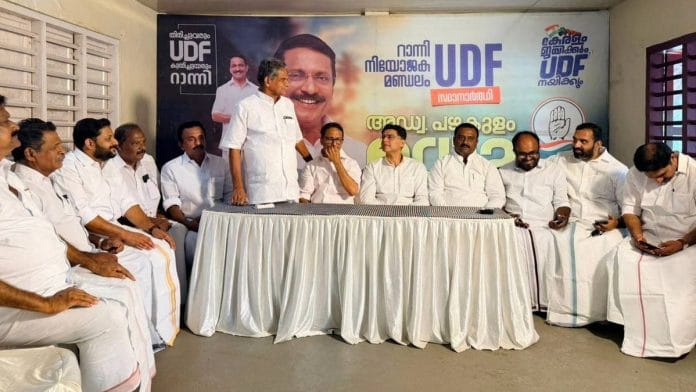



Driving across the National Highway in Kerala, one would imagine that the Congress-led United Democratic Front (UDF) is completely out of the picture in the forthcoming assembly election. Most of the giant billboards display Chief Minister Pinarayi Vijayan smiling away with the caption, “Who else but the LDF?” There are Bharatiya Janata Party (BJP) hoardings interspersed with the Left billboards, but the UDF’s presence in the sky is limited to VD Satheesan’s jaded ‘Puthu Yuga Yatra’ from February.
Also Read: BJP’s Kerala conundrum—courting Christians isn’t working out
UDF’s election to lose
Like schoolboys making perpetual excuses, Congress leaders throw up their hands, citing lack of “resources”. However, this exposes poor planning that became evident during the prolonged candidate selection process and eleventh-hour seat-sharing among UDF constituents. Blaming the Election Commission for scheduling the election sooner, and the media for fuelling such speculation, Congress is playing victim as usual. Nevertheless, the asymmetric nature of the contest ends right there.
This is an election for the UDF to lose.
And the Congress has never had its nose so far ahead in an election since 2001, when the UDF won 100 out of 140 seats in the state assembly. This advantage stems not only from the twin-term anti-incumbency against Vijayan, but also from the UDF’s victory in the local body polls held in December. In Kerala’s political history, local body polls have acted as a bellwether since their introduction in 1995. This was the case even in 2020, which foreshadowed the Left retaining power in 2021.
However, it is never beyond the Congress to grab defeat from the jaws of victory.
Plus, the LDF’s massive public relations overdrive can certainly have a psychological impact on the electorate — even if a section of voters would have made up their minds well in advance.
So, it’s important to identify the political undercurrents at play.
Political messaging
Undercurrents are hidden and subtle, and are usually detected post-poll.
By nature, vote consolidation also leads to reverse consolidation. One of the biggest talking points in the election is minorities teaming up behind the UDF. For those who came in late, the UDF is the traditional vehicle for the sizeable Muslim and Christian minorities in the state, whereas the Communist Party of India-Marxist (CPI-M) is the ‘Hindu party’ of sorts.
Lately, the CPI-M-led Left Democratic Front (LDF) has been courting minorities, especially the Muslim community, to compensate for the loss of some of its Hindu base to the BJP. The LDF’s spectacular pro-incumbency mandate in 2021 was driven by such a shift, when the UDF failed to keep its flock together. But having doubled down on pro-Palestine rhetoric and the Citizenship Amendment Act (CAA) to diminishing returns in the 2024 Lok Sabha polls, the Left took a U-turn in its political messaging.
By enlisting the support of community outfits such as the Sree Narayana Dharma Paripalana (SNDP) Yogam and the Nair Service Society (NSS), and constantly hammering away at the Jamaat-e-Islami’s dalliance with the UDF, the Left has been stoking majoritarian sentiments ever since. This yielded results in the local body polls itself, notwithstanding the loss to the UDF. The LDF managed to retain a section of its Hindu base that voted for the BJP in the preceding Lok Sabha polls.
The Left managed this swing despite the Sabarimala gold theft scandal putting it on the mat. The Hindu vote shift was most visible in districts such as Thiruvananthapuram and Thrissur, and to some extent in Palakkad and Alappuzha. This has bolstered the Left’s confidence to shore up its Hindu base further, even to the extent of deploying ‘soft Hindutva’.
Kerala brand of secularism
While it may come as a surprise to a pan-Indian reader, Kerala’s ‘secular polity’ has an underbelly which isn’t as rosy as it looks from the outside. The state’s election history is dotted with instances of religious messaging and caste sentiments influencing outcomes. In many cases, these were detected post-poll because of the subtle political messaging at play. EMS Namboodiripad was a master in such manoeuvres.
For a long time, Kerala’s politics was divided into the Left and anti-Left blocs, which has slowly undergone a change with the BJP’s arrival. The Left bloc never managed to outpace the anti-Left bloc, and so the Marxists always needed to court vote banks outside their base to alternate in power. The circumstances of the first Communist Party government’s dismissal in 1959 following the ‘Vimochana Samaram’ (Liberation Struggle) have since come under scrutiny, but there is a prelude to it. Before the state of Kerala came into being in November 1956, it was a Congress government led by Panampally Govinda Menon that ruled the Travancore-Cochin state.
Yet, when the first Kerala assembly election was held in 1957, the state was under President’s Rule. It was Menon’s clash with the NSS that led to the withdrawal of support of six legislators, resulting in its collapse. In fact, NSS general secretary Mannath Padmanabhan had been railing against the “Syrian Christian domination” within Congress ahead of the election. Padmanabhan worked closely with then Communist Party of India (CPI) state secretary MN Govindan Nair to scout for candidates, as recounted in Communist ideologue Thoppil Bhasi’s memoirs.
Voting patterns of communities
This pattern of the Left subtly stoking majority and minority sentiments in elections can be witnessed throughout Kerala’s political history, although Congress has also resorted to it occasionally — albeit in more glaring circumstances like the ‘Vimochana Samaram’.
Marxist dog whistles became a pattern beginning with the 1987 assembly election, another instance when the Left famously deployed ‘soft Hindutva’, even if couched as “principle-based politics”. By the 1990s, with changes in demography, the Left began stoking minority sentiments at will. Today, people might find it hard to believe that Saddam Hussein was used as a mascot by the Kerala Marxists in three different elections, spanning two decades.
The voting patterns of different communities also vary. The Muslim vote bank is deemed to be much more sentimental, susceptible to switching even on global developments, whereas the Hindu vote bank is influenced by more subtle messaging. The Christian bloc, by far, is considered swing voters. Of course, there is political voting as well.
While the electorate is easy to swing in south and central Kerala, voting is much more political in Malabar, where there are 60 seats. By virtue of Marxist strongholds in Kannur and Palakkad, the Left remains confident of a 50 per cent strike rate in Malabar in the most adverse circumstances. That often leaves the rest of the state as the political theatre where elections are won or lost.
Also Read: Congress 1st Kerala list out, but suspense lingers over Kannur & Konni, seats eyed by heavyweights
BJP’s emergence
The BJP’s emergence as a potent third force has altered many equations. In fact, Kerala’s politics is no longer bipolar, even if the UDF and the LDF may still claim it is. Having reached the threshold of 20 per cent in the 2024 Lok Sabha polls, it can no longer be dismissed as inconsequential. In a third of the 140 assembly segments in 2026, the BJP’s vote share is likely to decide the winner and loser.
Congress has already made allegations of a “deal” between the Left and the BJP. Technically, even if there was no ‘deal’ or understanding between two parties, candidate selection itself can influence voters a great deal for seamless vote transfer. With the UDF consolidating minority communities behind it, along with the soft Hindutva deployed by the Left, it is plausible that there will be some kind of transfer between the LDF and NDA voters—at the cost of the UDF.
The imprudent flexing of muscles by ally Indian Union Muslim League (IUML) during Oommen Chandy’s tenure (over a fifth ministerial position) is still invoked by sections of the Hindu electorate as a reason for their aversion to the UDF. Will the ‘Hindu’ voter shift loyalty to the LDF wherever the BJP has no chance of winning? Or will the massive anti-incumbency against Vijayan obliterate such a shift?
These political undercurrents will only become evident post-poll.
Anand Kochukudy is a Kerala-based journalist and columnist. He tweets @AnandKochukudy. Views are personal.
(Edited by Asavari Singh)