






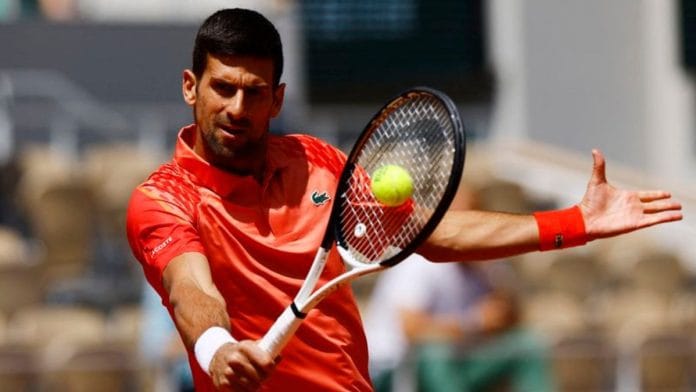



Novak Djokovic is a tennis genius, the most successful player in the history of the Majors. And that, when the list also includes his one time nemeses Swiss ace Roger Federer and Spanish legend Rafael Nadal, says something. But the story of his Grand Slam dominance is also threaded with moments when fortune quietly tipped the scales—matches shortened, paths lightened, and entire threats removed before he had to face them.
This week at Melbourne 2026, Lorenzo Musetti had Djokovic teetering on the edge of a quarter-final exit. Two sets to love up and brimming with shot‑making bravado, the Italian had completely outplayed the ten‑time champion, leaving him flat‑footed and emotionally adrift on a court he has long ruled. Djokovic later admitted he felt he was on his “way home”.
Then Musetti’s right leg gave way. A medical timeout, tape, treatment and the sudden realisation that he could no longer push off into his forehand or chase the very balls that had been carving Djokovic open. He soldiered on briefly, but at 1–3 in the third set, still two sets ahead but physically broken, Musetti walked to the net and retired, leaving Djokovic through to yet another Australian Open semifinal.
The scoreboard will forever show progress. But the memory of fans at Rod Laver and the millions watching the live stream will recall a match that was slipping away until the opponent’s body intervened.
It was not an isolated tableau. Particularly for his Italian opponent. At Roland Garros 2021, Musetti had led Djokovic by two sets before fading physically and retiring in the fifth, another instance where Djokovic advanced when an opponent who had him pinned in danger could not finish the job.
But Musetti can perhaps take heart from the fact that he has hardly been the only one to suffer the Novak Curse.
New York 2016—the US Open of walkovers
If there is one fortnight that crystallises how luck can accumulate around a champion, it is the 2016 US Open. Djokovic’s title defense there became a case study in how far you can go at a major when opponents keep disappearing.
After a tough four set victory in the first round against J Janowicz, the Serbian advanced further in the tournament. The next three games defined how luck has always favoured Djoker in major Grand Slam tournaments.
Second round: Jiří Veselý withdrew before taking the court because of a left forearm injury, handing Djokovic a walkover into the third round.
Third round: Mikhail Youzhny lasted just six games before retiring with a left hamstring injury, with Djokovic leading 4–2 in the first set.
Quarterfinal: Jo‑Wilfried Tsonga, a perennial threat on hard courts, retired after two sets due to a left knee problem, with Djokovic ahead 6–3, 6–2.
Across rounds two, three and the quarterfinal, Djokovic advanced three times without having to complete a full match, playing barely more than a single set of real tennis in what should have been the grind of the middle stages. Contemporary reports suggested he had been “gifted” a third pass of the event when Tsonga retired, after the Veselý walkover and Youzhny retirement had already lightened his load.
He still had to negotiate a full semifinal against Gaël Monfils and lost the final to Stan Wawrinka, but the physical bill for reaching the last weekend was dramatically discounted. In a best‑of‑five set world where fatigue compounds the effects of extra effort, those “short shifts” matter.
Also read: F1 2026 is doubling down on hybrid vehicles. It’s not ‘yesterday’s technology’ anymore
Walkovers and retirements
The 2016 US Open is vivid, but it is not unique. Over the span of his 23-year career, Djokovic has benefited more than any man in history from opponents unable to play or complete Grand Slam matches against him.
By the 2024 US Open, ESPN noted that Djokovic had advanced via opponent retirements or walkovers 16 times at Majors, the most of any male player in the Open Era. This week at the Rod Laver arena, that number had increased to 18. Some of these came in early rounds; some came, as in 2016, in clusters that effectively turned what should have been best‑of‑five obstacles into one‑set skirmishes or days off.
This is simply the statistical footprint of a long and largely durable career intersecting with the fragility of those across the net. But when you stack Musetti’s two retirements from winning positions, Veselý’s withdrawal, Youzhny and Tsonga’s mid‑match exits, and a long list of other shortened encounters, an undeniable pattern emerges. Novak Djokovic, time and again in his Grand Slam career, has repeatedly found the draw physically thinning out in front of him.
When Lady Luck smiled at Roland Garros
There is another, more macro layer to this good fortune. It is the times Djokovic has won or been strongly positioned at Roland Garros when Rafael Nadal, the immovable object of Paris, was nowhere to be seen at the business end of the tournament.
In 2016, Nadal withdrew from the French Open before his third‑round match because of a serious left wrist injury, ending his campaign after two routine wins. His departure removed the man who had been Djokovic’s primary roadblock on clay. Djokovic went on to win his first Roland Garros title that year, completing the career Grand Slam.
In 2023, Nadal pulled out of the French Open entirely with a lingering hip injury, missing Roland Garros for the first time since his debut in 2005. The tournament started without both Nadal and Federer, and Djokovic entered with a clear chance to claim a record 23rd major in their absence. It is something analysts and former players explicitly framed as a huge opening for him. Two weeks later, he did just that, lifting his third French Open trophy and moving past Nadal in the Majors tally.
Again, none of this implies he could not have beaten Nadal. He has, in Paris and everywhere else. But there is one cold, undeniable truth—his two landmark French Open victories that reshaped the GOAT conversation came in years when Nadal could not complete, or even start, a full campaign.
Also read: Mustafizur’s removal from KKR isn’t the same as boycotting match with Pakistan
Genius also needs luck
Djokovic has built his greatness on extraordinary resilience, meticulous preparation and a competitive edge that has broken countless opponents who were perfectly healthy when they started. You do not win 24 Majors by accident.
Yet it is equally true that the margins that separate legends are not only drawn in winners and passing shots. They are also drawn in taped wrists, torn hips, hamstrings that won’t cooperate, and withdrawal forms signed in locker rooms.
In that quieter, less glamorous ledger walkovers in New York, retirements in Melbourne and Paris, French Opens contested without Nadal, Djokovic has, more often than most, found fortune standing loyally in his corner.
Maybe that should not surprise us. In a world where wealth begets wealth, perhaps it’s entirely appropriate that champions attract the luck that begets championships. This weekend at Melbourne Park will demonstrate whether history repeats itself for Novak Djokovic.
Anindya Dutta is a sports columnist and author of ‘Wizards: The Story of Indian Spin Bowling’ and ‘Advantage India: The Story of Indian Tennis’. He tweets @Cric_Writer. Views are personal.
(Edited by Saptak Datta)