






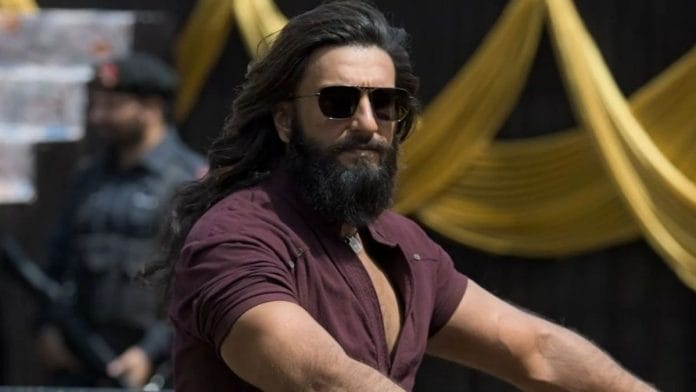



Armed to the teeth and burning with fury, Jaskirat, Ranveer Singh’s character in Dhurandhar, storms down from the haveli to the outhouse, dropping men one by one, asking only one thing: “Meri behen kithe hai?” or “Where is my sister?” In that relentless question lies the same spirit as Bhima standing over Dushasana in the Mahabharata, demanding, “Why did you drag Draupadi by the hair?”
Neither is truly asking. Both are delivering judgment. Both are vengeance in motion.
Some stories return, altered in costume but not in essence. They move from scripture to theatre, from folklore to cinema, from ancient battlegrounds to modern states of terror, and yet carry the same emotional and moral tremors. The same tired flex of power, loyalty and greed endures, along with the same old dilemma that once confronted Arjuna: to fight, or not to fight.
The two-part series of Dhurandhar feels like such a return. Beneath their political conflict, violence, and espionage lies an older architecture: the tragic loyalty of the Mahabharata, the inward crisis of Hamlet, the inheritance and corruption of The Godfather, the haunted heroism of Greek mythology, the cyclical wisdom of Lalleshwari, and the unmistakable logic of epic destiny.
What gives Dhurandhar its force is not merely plot, but the fact that it understands what the great epics understood long before cinema did: evil is rarely fought by the untouched. It is fought by those already entangled in love, debt, memory, grief, and dangerous forms of belonging.
At the centre of this drama stands Hamza, or rather Jaskirat-becoming-Hamza, one of those rare modern protagonists who can only be understood fully when placed beside the great tragic men of literature and epic. He is, at different stages, Karna, Arjuna, Hamlet, Michael Corleone, and in flashes, Achilles, Orestes, Odysseus, and Heracles, yet reducible to none of them.
His journey is not just from innocence to violence, but from personal hurt to ethical purpose. And that transformation comes at a cost so intimate that it becomes the true subject of the story.
The Karna grief & Arjuna lesson
The deepest and most immediate parallel is with the Mahabharata, because Dhurandhar is animated by that epic’s central tension: the collision between loyalty and dharma. In the Mahabharata, Karna is among the most heartbreaking figures precisely because he is not evil in any simple sense. He is noble, humiliated, gifted, wounded, and starved of recognition.
Duryodhana gives him what the world denied him—honour, position, fraternity, a place in history—and Karna repays this with an almost unbearable loyalty. That loyalty is moving, but it is also fatal. Karna knows the moral ground beneath Duryodhana is rotten; he stays anyway. His tragedy is not that he cannot tell right from wrong. It is that gratitude becomes stronger than conscience.
This is where Hamza’s bond with Rehman Dakait becomes so emotionally intricate. Rehman is not merely a villain standing across from the hero. He is a benefactor, a patron, an architect of identity, almost a dark father. He gives Hamza stature, shape, purpose, and belonging. To reject him is not merely to oppose wrongdoing. It is to turn against the hand that once lifted you. That emotional structure is profoundly Mahabharatic.
Like Karna with Duryodhana, Hamza is bound not only by ideology or circumstance, but by debt. And debt of this sort is never clean. It wounds even when it dignifies.
But Rehman is not the final throne. He is not Hastinapur itself. He is one general in a much larger war, one keeper of violence in a system whose deeper sovereign is Bade Shahab. This changes the scale of Hamza’s task. He is not only required to defeat men; he must dismantle the centre of evil. In epic terms, this is the difference between winning a duel and breaking an order of adharma.
Rehman’s killings, manipulations, and betrayals matter because they are steps toward that larger citadel. Everything on the battlefield is only movement toward the real objective: not revenge upon one figure, but the destruction of the source that keeps reproducing terror.
This is why Muridke begins to acquire the weight of a modern Hastinapur. What begins in Punjab with the rescue of his sister and the fight for the dignity of his mother ends not as a private vendetta but as a march toward the seat of organised evil. The arc expands exactly as epic arcs do. A wound in the household becomes a war for the moral order.
A son’s rage becomes history’s necessity. The battlefield is never only about those immediately present on it; it is about the structure they serve. And that structure, in Dhurandhar, culminates in Bade Shahab.
This is also where Hamza becomes more fully Arjuna in Part 2. At first, the engine of his violence is personal. The violation of his family does not leave him. It replays in his mind again and again, like an inner Kurukshetra. He fights first as a wounded son and brother, and in that phase, he resembles Achilles in his rage and Orestes in his blood-burdened compulsion. But he does not remain there.
As he grows, his violence undergoes a moral transformation. The pain remains, but its purpose widens. He begins to understand that the evil he is fighting is larger than his own biography. It threatens society, humanity, order, and justice itself. His war ceases to be about answering one injury and becomes about preventing a civilisation from continuing to kneel before the machinery of terror.
That is why Ajay Sanyal matters so much. Through his life lessons and through the philosophy of the Bhagavad Gita, Hamza is taught that pain may ignite action, but it cannot be allowed to author it forever. Personal grief may open the warrior, but dharma must guide the weapon. This is the Arjuna lesson: act not because your hurt is endless, but because the larger order demands restoration. Hamza’s evolution lies in learning that his rage is only the spark. Justice is the fire.
Also read: Dhurandhar shows Bollywood has a new box office mix—controversy, nationalism & spectacle
Mahabharatic scope
One of the film’s most arresting images captures this transformation with extraordinary symbolic power: the chakri firecracker lighting up behind Jaskirat. It functions almost as a cinematic invocation of the Sudarshan Chakra—the divine weapon unleashed when every other recourse has failed, the final instrument of order, the force that cannot be casually recalled once it has been released.
In that moment, Jaskirat is no longer merely reacting. He is being unleashed. The symbol matters because it suggests irreversibility. Once he steps into this final role, he cannot return untouched. He is no longer only the injured son of Punjab. He becomes the moving edge of justice aimed at the heart of a larger darkness.
And that darkness is precisely why Bade Shahab is so important in the architecture of the story. If Rehman is the father-like corrupter who must be severed, Bade Shahab is the entrenched sovereign of disorder who must be dismantled. Rehman is emotional entanglement; Bade Shahab is systemic evil. Rehman is the intimate knot; Bade Shahab is the throne that produces endless knots. One must be killed because the bond itself has become immoral. The other must be brought down because, as long as he stands, evil retains a centre from which it can endlessly regenerate.
This gives Dhurandhar a profoundly Mahabharatic scope. The Mahabharata never treats evil as merely individual wickedness. It is structural, dynastic, and institutional. Duryodhana matters, yes—but so does the court that sustains him, the silence that protects him, the throne that legitimises him. Likewise, Hamza’s journey cannot end with one man’s death. The real work is to dismantle the order that lets men like Rehman thrive under the shadow of Bade Shahab.
That is also why the story resonates with Hamlet and The Godfather. Hamlet’s Denmark is rotten not because of one murder alone, but because corruption has seeped into the state itself. Michael Corleone’s tragedy lies not only in individual violence but in becoming part of an empire that reproduces violence as inheritance. Dhurandhar understands this same truth: evil survives because it is organised. To fight it, one must go beyond personal retaliation and strike at its architecture.
Greek mythology also helps illuminate Hamza’s labour. Achilles gives him rage, Orestes gives him blood-memory, Odysseus gives him divided identity, and Heracles gives him the burden of labour—the necessity of undertaking impossible tasks against monstrous forces. Hamza resembles Heracles most powerfully here: not because he is invincible, but because he is tasked not with one clean victory, but with confronting a chain of evils, each one only a passage toward the larger beast.
Rehman is one labour. Bade Shahab is the greater one.
Yalina, meanwhile, continues to give the story its emotional truth. She is not peripheral to this architecture; she is the measure of its human cost. If Hamza must move from private grief to public justice, Yalina reminds us what is being left behind in that enlargement. She is the tenderness that history interrupts, the memory that refuses to be militarised. Through her, the audience sees that dismantling evil may be necessary, but necessity does not erase loss. It only makes loss more dignified and more devastating.
Also read: Dhurandhar success made Aditya Dhar unpopular. Wife Yami Gautam is also being snubbed
Epics retold in the 21st century
This is what makes the final arc of Hamza so powerful. He begins by trying to save a sister and defend a mother’s dignity. He moves through the poisoned intimacy of Rehman Dakait. He enters the battlefield carrying both personal rage and moral education. He is marked by the chakri, the Sudarshan-like sign of irretrievable unleashing. And he arrives finally at the larger truth: that one does not end evil by merely surviving it or avenging it.
One ends it by dismantling its centre. Bade Shahab, therefore, is not just another antagonist. He is the final proof that Hamza’s journey is not about revenge but about order.
Placed beside Lalleshwari’s vakh, the arc becomes even more resonant:
asi aasy tu asi asav,
asidor kar patuvath,
shivas sori na zyon tu marun,
ravas sori na atugath.
(We existed in the past; we shall exist in the future.
It is we who came and went through the aeons.
Shiva must create and destroy perpetually.
Forever, the sun must rise and set.)
Creation and destruction are inseparable here. Jaskirat must be destroyed for Hamza to be born. Rehman must be destroyed to sever false loyalty. Bade Shahab must be dismantled so that evil loses its organising principle. This is not random violence. It is the hard cosmic logic of restoring balance when the world has tilted too far into disorder.
In the end, Dhurandhar achieves something rare. It takes the emotional density of the Mahabharata, the inward fracture of Hamlet, the dynastic corruption of The Godfather, the heroic burden of Greek myth, and the spiritual rhythm of Lalleshwari and fuses them into one modern warrior’s story.
Hamza is Karna in his debt, Arjuna in his awakening, Hamlet in his consciousness, Michael Corleone in his proximity to power, Achilles in his rage, Odysseus in his split identity, Orestes in his blood-duty, and Heracles in his labour. But he becomes himself fully at the point where he understands that the war is not won by killing one man. It is won only when the centre of evil itself is dismantled.
That is the true epic lesson of Dhurandhar: the hardest battles are not merely against enemies in front of us, but against the structures behind them, the thrones above them, the systems that keep birthing them. And the hero’s final task is not only to strike. It is to end the place from which the darkness keeps returning.
Sunayana Kachroo is a US-based Film producer-writer and poet. Her website is www.sunayanakachroo.com. She tweets at @KachrooSunayana. Views are personal.
(Edited by Saptak Datta)