









Diving operations in the Indian Navy often unfold far from public view. Below the waterline, where sunlight fades and the pressure rises, routine assumptions disappear. What remains is preparation, teamwork, and the steady discipline that guides every naval diver. In October 2023, during a mission off the coast of Tuticorin, I was reminded of how these principles shape every decision we make underwater.
The task before us was specific yet deeply significant: the recovery of a trapped fisherman from the sunken Indian fishing boat Suja Mol.
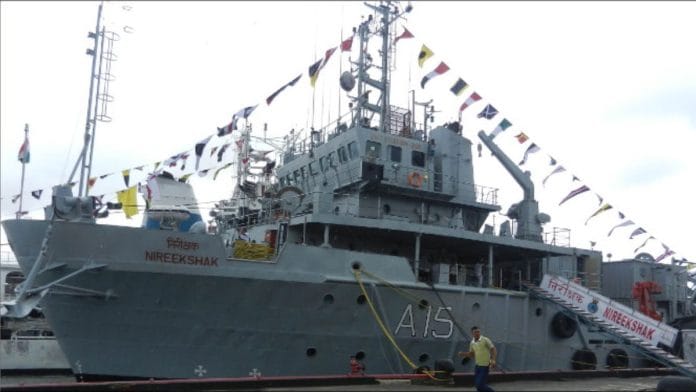
INS Nireekshak, at that time, was the only ship in the Indian Navy capable of undertaking deep-diving operations using specialised techniques such as saturation diving and HELIOX diving. These are inherently dangerous tasks due to increased atmospheric pressure, low visibility, and unfamiliar environments. In addition to these operational challenges, divers must contend with gas-related and physiological risks such as oxygen toxicity, nitrogen narcosis, and High-Pressure Neurological Syndrome (HPNS). Together, these factors make underwater operations more complicated to plan and execute.
When the incident occurred off Tuticorin, Nireekshak was returning from a foreign deployment. The ship was diverted mid-passage to undertake the mission. Initial reports indicated that a fishing vessel had sunk at a depth of 60 metres and that three fishermen were believed to be trapped inside. By the time we arrived at the location, three days had already passed, making it evident that the operation would be challenging both technically and operationally. The diving system onboard Nireekshak is state-of-the-art and fully capable, even when pushed to the extremities of its designed capacity.
Dive preparations
Given the depth of the wreck at 60 metres, we decided to employ HELIOX diving instead of saturation diving, largely because the task was time sensitive. Saturation diving is a meticulously planned operation that requires days of preparation and often weeks to execute. With lives unaccounted for and the need to commence operations immediately, HELIOX diving was the only viable option.
Despite the strenuous and exhausting nature of the preceding deployment, the diving team assembled without delay. The crew quickly began preparing the system, working efficiently even with limited information about the exact condition of the wreck and the underwater environment. The first set of divers was deployed using a stage capable of lowering two divers together. Their task was to assess the condition of the sunken vessel, evaluate the extent of structural damage, and identify the possibility of locating the missing fishermen within the wreck. The bodies of the other two fishermen were recovered on the surface itself.
A wreck waiting in silence
Our initial investigation revealed a vessel resting in an uneasy position. The fishing boat had capsized violently, leaving the upper deck severely damaged. Portions of the wreck were compressed inward, creating unpredictable pockets and narrow chambers. Silt swirled at the slightest movement, reducing visibility to almost nothing.
Two successive sets of divers attempted to enter the structure. Both teams operated with precision, but the conditions underground were unforgiving. The wreck’s internal layout had shifted, leaving confined passages choked with debris.
After the two attempts, it was clear that the mission required a different approach. The complexity of the wreck, coupled with limited space, meant the diver would need to be fully confident operating solo in an unstable structure. As the senior-most qualified diver on board, I stepped up.
A descent into narrow margins
Deep diving is not a test of how daring you are. It is a test of composure. Before the descent, I reviewed the brief once again, checked every component of my equipment, and ensured that all safety protocols were clearly understood by the team on the surface. My buddy diver and I were lowered gradually using the ship’s diving platform to the planned depth. The diving stage was positioned roughly 15 metres away from the wreck. As I moved along the hull, the severe tilt of the boat created disorienting angles that complicated orientation and access.
Entering the confined sections was physically demanding. Loose fragments of wood and metal shifted with even the slightest touch. In those moments, familiarity with diving systems and an intuitive understanding of environmental cues made all the difference.
Navigating through collapsed compartments required patience, calmness and persistence. Deep inside a compressed pocket formed during the capsize, I finally located the fisherman’s body. I initially attempted to reach him with my hands, but the KM-17 diving helmet restricted the flexibility needed to manoeuvre in such tight spaces. At that moment, I shifted to Plan B.
During preparations, I had deliberately included a two-metre boat hook as a contingency tool for retrieving objects beyond arm’s reach. However, it was tied to the diving stage, and I now had to swim all the way back to retrieve it before reapproaching the wreck. In a HELIOX dive, time is limited: I had only 25 minutes.
By the time I returned to the boat for the second attempt, merely five minutes remained. I moved quickly to a slightly larger opening in the wreck and used the boat hook to probe the dark, confined space. I pushed myself to extend as far as I possibly could and on the final attempt, the hook caught onto the fisherman’s clothes. Bracing myself carefully, I anchored my legs on either side of the opening to maintain balance, and using my hands, I guided it gently out of the wreck.
Although I was exhausted and out of breath, the sight of the body slowly rising upward into the dark expanse gave me a moment of quiet satisfaction. Only a minute remained before I was due for extraction and ascent. I quickly gathered the tools around me, secured everything, and swam back to the diving stage.
Once I was safely inside the diving stage, the team commenced a controlled ascent back to the surface. The recovery marked the completion of a mission that demanded technical skill, physical effort, emotional steadiness, and clarity of mind—qualities essential for deep-sea operations carried out under the most unforgiving conditions.
For those who serve in diving roles, operations like this extend beyond the technical. Recoveries carry a human weight. They offer closure to families waiting ashore and affirm the Navy’s commitment to responding, regardless of difficulty. Every deep-sea mission comes with inherent risks, particularly when conducted around unstable wrecks.
Also read: India’s naval advancements will fuel its Indian Ocean ambitions. Focus on 5 key areas
Leadership, teamwork and responsibility
Equipment limitations, unpredictable underwater environments and the constant need for situational assessment define the nature of this work. Yet it is precisely these challenges that highlight the importance of training, preparation and teamwork. During this operation, the ship’s diving team displayed the undaunting spirit of professionalism that characterises naval diving operations across the fleet. From managing gas mixtures to monitoring dive parameters, the coordination on Nireekshak ensured that every risk was mitigated to the extent possible.
Although I undertook the final dive, the mission succeeded because of the collective effort of every individual involved. Naval diving is built on trust. The diver underwater is always supported by a team above who watches the clock, monitors the systems, and prepares for contingencies. Their competence creates the confidence that allows operations at extreme depths.
The wider lesson from this experience extends beyond a single mission. As India’s maritime responsibilities grow, the need for continuing development of specialist capabilities becomes even more relevant. Deep-sea operations are not simply technical achievements; they are essential components of the national maritime construct.
Lt Cdr Hardeep Singh, NM, was commissioned in the Indian Navy in 2015. He is a qualified Clearance Diver Officer and has undertaken extensive diving operations of various complexities. The officer was awarded NM (G) for the diving operation conducted from onboard INS Nireekshak. Views are personal.
(Edited by Ratan Priya)
Your words took me along to those murky depths. My thanks to you and the INS Nireekshak team for your diligence and service.