






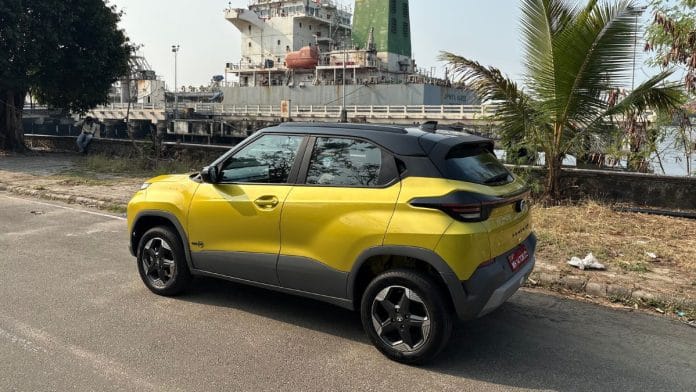



A record 45.5 lakh passenger vehicles were sold in India in 2025. But electric passenger vehicles, despite all the hype, accounted for just about four per cent — 1.76 lakh — of the overall sales. This was a jump from the 2.4 per cent market share they commanded in 2024, but given the amount of mindspace electric vehicles take up, these numbers seemed ordinary to say the least.
But here is the funny thing. As Shailesh Chandra, Managing Director of Tata Motors Passenger Vehicles, who also shared the statistics above, pointed out, the average selling price of a passenger vehicle in India has been rising consistently and has now touched around Rs 12 lakh. When you go above this average price, electric vehicles account for almost ten per cent of the sales. Below this average, electric vehicles make up just about 1.5 per cent of the sales.
The two best-selling electric vehicles in India in 2025 — the Tata Nexon EV and the MG Windsor — both have mid-specification variants that cost around Rs 15-16 lakh. The brilliant Mahindra ‘born-electric’ SUVs start at around Rs 20 lakh. I firmly believe that if you live in a major metropolitan area and have access to your own or a community charger, buying an electric vehicle is almost a no-brainer. I used a Kia Carens Clavis EV through the winter in Delhi and it was utterly brilliant, but the HTX+ specification I used costs Rs 24.5 lakh ex-showroom.
So, while buying an electric vehicle could be a no-brainer, it is only the case if you can afford one. And when it comes to ‘affordable’ electric vehicles, there are some simple issues. Either the cars feel too cheap or they don’t have ‘enough’ range. Personally, I love the MG Comet EV, but yes, micro-cars meant for short commutes aren’t for everybody. And when you think of Tata Motors, the only other manufacturer in this space, the range question keeps on popping up.
The ‘ideal’ range
Now, how much range on an electric vehicle is enough? This is not an easy question to answer. But according to Anand Kulkarni, Chief Products Officer and Head of HV Programs and Customer Service, Tata Passenger Electric Mobility Ltd, it was estimated that the number is around 330-350 kilometres. “Many people drive between places such as Pune and Kolhapur or Delhi and Chandigarh and these are all drives of around 250 kilometres. Which, while enough on many electric vehicles today, was not ‘comfortable’ for owners,” he said.
And that is a point one has to agree on. Even while driving an internal combustion engine vehicle down a long highway, it is not a comfortable feeling when the reserve fuel warning comes on, unless you are very close to your destination. While driving back from Chandigarh recently on the Clavis EV, I did top-up charge at Murthal even though I could have made it home. It is the ‘what if?’ factor. What if I get stuck in an awful traffic jam? What if I need to use the car immediately after reaching home? So always having a little bit of reserve gives you some peace of mind.
So, that is what Tata Motors is trying to address with the facelift of the Tata Punch EV. While there are subtle design changes to the vehicle both inside and outside, the big change is the fact that the carmaker has managed to fit a 40 kWh battery inside the vehicle now. It is an upgrade of 10 kilowatt hours, which, when coupled with a slightly more efficient motor, now delivers a C75, or real-world range of 330-350 kilometres — unsurprisingly the same range that Kulkarni claimed was ‘ideal’.
And while Tata continues to offer a 30 kWh battery with the entry-level Smart+ Punch EV, the 40 kWh battery variant is available for Rs 10.89 lakh ex-showroom, just a Rs 60,000 premium over the smaller battery pack. The Punch EV is trying to tick both the range and affordability boxes.
Also read: Why Hyundai Creta is still the king of Indian roads after 11 years—brand value to looks
A punchy car
I travelled to Kochi, the largest city of Kerala, now renamed to Keralam, to drive the vehicle. And the Rs 12.89 lakh ex-showroom top specification ‘Empowered+ S’ variant, which had all the works, including a large touchscreen, wireless smartphone connectivity and fast USB-C chargers, impressed me.
The Punch EV has always been, apologies for the pun, a ‘punchy’ vehicle, and far more engaging to drive than its internal combustion engine variants, given its quick acceleration. And while no small SUV like this pretends to be a performance vehicle, whenever you need power, the Punch EV delivers. It is stable around the corners and handles potholes pretty well, but the earlier avatar could do this as well. But what about the range?
So, on standard, regular driving, when not looking to maximise range, both on the highways outside Kochi and through the rush-hour traffic on Marine Drive and back through the city, I got around 7.6 kilometres per unit. All this while listening to music, using the fast charger for my phone, and with the air-conditioner on. And the car was on ‘City’ mode during the drive. This would translate to at least 300 kilometres of range. Had I soft pedaled and driven on ‘Eco’ mode, I am confident that I would have achieved 325-335 kilometres of range.
Interestingly, another change that the carmaker has made comes in handy when you have to travel longer distances — the Punch EV now supports 1.5C fast charging. In simple terms, the Punch can accept a charger with a charging speed 1.5 times that of the battery pack size, ergo 60 kilowatts. Most new chargers being installed across India by charging point operators such as Statiq are 120 kilowatts with dual charging guns, which is 60 kilowatts each. Kulkarni told me that the Punch EV can charge from 20 to 80 per cent in 26 minutes with such a charger.
“So you should be easily able to go on a 500 kilometre drive with a single charging and meal pitstop and there are now enough charging points on most major highways in India,” he said.
Does the Punch EV lack anything? Well, the rear seats are still not the most comfortable and the luggage space is limited. It is a 3.8-metre long SUV after all. And the new Punch also doesn’t come with Advanced Driver Assistance Systems (ADAS), although I suspect these will come in a future iteration. But this vehicle has a singular purpose — offering good range while being light on the pocket.
Will this work in improving electric vehicle adoption? That remains to be seen. One reason for the overall increased electric vehicle adoption in India last year was that there were many more models from many more manufacturers available. The ‘affordable’ EV segment only has Tata Motors (the Tiago, Tigor, and Punch) and the MG Comet for the time being. Perhaps once more carmakers enter the sub-Rs 12 lakh electric vehicle segment, mass adoption of EVs could truly take off.
Kushan Mitra is an automotive journalist based in New Delhi. He tweets @kushanmitra. Views are personal.
(Edited by Aamaan Alam Khan)
I think this is the first time the author has written about the need for affordable automobiles. He always used to get carried away by expensive wheels. I want a five lakh car with a range of 500 km. But I very well know that it cannot happen in socialist India.