





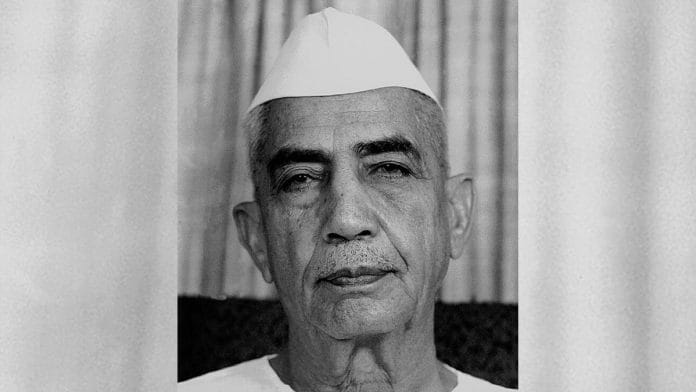



Since 2001, India has celebrated former Prime Minister Chaudhary Charan Singh’s birthday on 23 December as Rashtriya Kisan Divas to acknowledge the farmers’ contribution to food security and nation–building. Last year, the country’s highest honour, Bharat Ratna, was conferred upon Charan Singh posthumously.
This is a day to reflect upon the success story of Indian agriculture. When India became independent, its grain production was a paltry 50 million tonnes (MT) for a population of 340 million, with the most productive irrigated lands left behind in West Punjab (now in Pakistan). The country was dependent on the United States Public Law (US-PL) 480 for grain imports in the first two decades of Independence. It was a ‘ship-to-mouth’ existence.
Cereal production has now grown to over 350 MT, and the growth in high-value agriculture—horticulture crops, dairy, poultry, animal proteins, and fisheries—has been even more spectacular. The primary issue today is not of production, but logistics, value addition, and export markets.
As with economic transitions elsewhere, the share of agriculture—both in GDP and employment—has seen a decline in India as well. But the importance of the sector is not to be seen in terms of GDP percentages alone. To paraphrase the Arthashastra, ‘The primary duty of the sovereign is to ensure a full granary for the citizens.’ And this is not possible without a prosperous farmer.
Charan Singh and the smallholder farmer
India’s march to self-sufficiency in food is directly linked to Charan Singh’s strong belief in the capability of smallholder agriculture to address the issue of food security. However, not much is known about his stiff opposition to the proposed farm collectivisation resolution adopted in the 1959 Congress session at Nagpur. In the session, he crossed swords with none other than his own party helmsman and Prime Minister Jawaharlal Nehru on the issue of ‘collective farms’ in the name of co-operative farming. Nehru and the Planning Commission were hell–bent on introducing the collectivisation model adopted by the Communist Party of the Soviet Union and the Communist Party of China.
A contemporary witness to the proceedings, former President Giani Zail Singh recorded:
“[Charan Singh] vigorously opposed the Collective Farming proposal brought by Panditji. I was spellbound by Chaudhary Saheb’s hour-long fluent speech. Panditji listened carefully to Chaudhary Saheb powerful speech, and even smiled. In the pandal, there was all round clapping when Panditji moved the resolution, but after Chaudhary Saheb’s speech it seemed as if the tables had been turned. Panditji replied to Chaudhary Saheb, and though not agreeing with Panditji, we had to support him because such was the force of his personality then. I know for sure that had I been in Panditji’s place, I would not have been able to argue the case put forth by Chaudhary Saheb.” (The Great Conciliator, 2025)
After Nehru’s resolution was accepted, leaders such as C Rajagopalachari, Minoo Masani, NG Ranga, KM Munshi and Homi Mody quit the Congress to form the Swatantra Party. Although Charan Singh did not join them, he took the principled decision of resigning from the Uttar Pradesh cabinet, where he held important portfolios of revenue and irrigation.
The other great farmers’ leader, Pratap Singh Kairon, then CM of Punjab, took a more pragmatic stand. While paying lip service to the resolution, he continued to strengthen the hands of the middle peasantry in Punjab. He established the Punjab Agricultural University (PAU) in Ludhiana in 1962. Along with the Pantnagar University in Uttar Pradesh (now in Uttarakhand), PAU was one of the first agricultural universities established on the pattern of the American land-grant universities. Kairon had lived and worked on American farms to supplement his earnings as a student of economics at the University of California, Berkeley and of political science at the University of Michigan.
Also read: Atomic energy can be used for peaceful purposes, to the immense advantage of humanity: Nehru
Joint Farming X-rayed
For the record, Charan Singh was equally opposed to the philosophy of the Swatantra Party which was pro–Zamindar, pro–private sector, pro–free enterprise, and included some of the prominent Maharajas, including those of Patiala and Jaipur. It must be mentioned that until the abolition of privy purses, the royals had retained their titles and privileges, and exercised considerable political influence, especially within the territories of their erstwhile kingdoms.
Immediately after his resignation, Charan Singh penned his thoughts in a 336–page book, Joint Farming X-rayed: The Problem and Its Solution. Before discussing the key propositions of the text, it is important to understand the context. The 1950s were a period of intense ideological debate between the Soviets, who were in favour of the collectivisation of farms, and the US, which believed in individual farmers taking the lead.
Nehru was enamoured of the USSR model, and proposed co-operative farming as the panacea to India’s food problems. While the Americans were promoting land–grant universities, the USSR was trying to establish large farms: they held the view that it was impossible for small farmers to ever match the scale envisaged in the large farms. A letter by Soviet representatives to then food and agriculture minister C Subramaniam read:
“You think you can achieve these results with your farmers with [such] small farms. Even the bigger farmer has only 6 to 8 hectares, or at most 12 hectares, and they are mostly illiterate. How are you going to persuade these farmers to adopt new technology? if you are really serious about introducing the new technology, this is the occasion to collectivize the lands in these farms, and select proper managers. It would be easy for you to train about 2-25 high level agricultural managers to take charge of these collective farms and use these farmers for the purpose of providing labour there. You can give them their share, whatever you like, but collectivization is the only answer to the introduction of new technology, otherwise you cannot achieve results.” (The Great Conciliator)
In Joint Farming X-rayed, Charan Singh argued against these and similar arguments by marshalling facts from the FAO, USDA, and independent newspapers. He showed that collective farming had failed everywhere, with the exception of the kibbutz in Israel. Even in Israel, after the first few settler-kibbutz (collective farms with no individual rights), farmers preferred to organise themselves into moshavs, where individual farmers held their land rights but pooled resources for agriculture inputs and marketing their produce.
Charan Singh showed that agricultural production had actually come down in the USSR, even though the Stalin regime tried its best to hide the famine–like conditions. Incidentally, these were the years when Mao’s ‘Great Leap Forward’, which included collectivising farmlands and killing all sparrows, saw the nation’s food chain disrupted, leading to a famine which claimed 36 million lives from 1958 to 1962.
In many ways, Charan Singh saved India from the perils of uncritical adaptation of Soviet, Chinese, Hungarian, and Romanian models.
This is the first article in a three-part series on smallholder agriculture.
Sanjeev Chopra is a former IAS officer and Festival Director of Valley of Words. Until recently, he was director, Lal Bahadur Shastri National Academy of Administration. He tweets @ChopraSanjeev. Views are personal.
(Edited by Prasanna Bachchhav)