





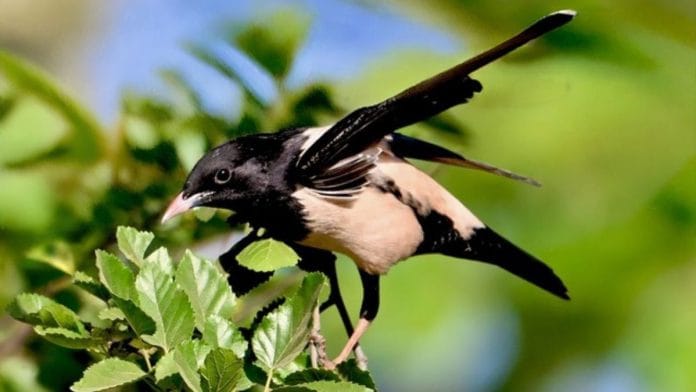



They let out crackles with an undertone of a hiss, and they do that in flocks. It’s unmistakable sound—not a chirp, not a cry. When you hear them, you know what to look for—a blush pink and dull black bird, the size of a sleek Mynah. It’s the Rosy Starling.
No other bird looks or sounds like it. This starling looks like it was plunged upside down into a vat of printer’s ink. Its slicked back head and neck are entirely matte black. It’s back, breast and belly are a pale blush pink, set in contrast to its black wings and tail. Sometimes, if the sun falls on it at the perfect angle, these wings reveal themselves as iridescent purple.
If you see this bird in India, you will remember it as the most blush pink creature you’ve ever seen in the skies. Every year, lakhs of these birds fly in from the Central Asian region to the Indian subcontinent just before winter. This is their non-breeding season, so they look relatively demure, like their 1815 Latin name, Pastor roseus. Indeed, the bird itself was called a Rosy Pastor, before its name was changed to Rosy Starling.
Wait till you see it in its breeding grounds in Central Asia. I have to confess, I haven’t, but I’ve seen photographs. Suddenly, the black portions turn glossy, the pink thickens into a more vibrant tone, and the male develops a wild-looking crest. The males morph into birds on a long dating spree. But when a pair is formed, it stays together for the rest of the season. The one thing they need in plenty is insects like grasshoppers—this is their diet.
Short supplies can even force them to abandon their nests. This worries me, as climate change and a global collapse of insect population can shift this bird’s fortunes from one that is abundant—4 to 16 lakh adults—to one that is plummeting in numbers, states Birdlife.
In India, Pastor roseus can be seen from the Northern Peninsular to even in the South, like Kerala. It is even seen in Sri Lanka. However, the most amazing photographs of its murmurations are from Ahmedabad and nearby areas in Gujarat.
From India to Mongolia to Czech Republic
This is a phenomenon when some bird species, like starlings, fly in huge flocks, making dramatic patterns in the sky. You may have seen videos of starlings in Rome, for example, flying like aeroplanes in a show, twisting and changing shape like acrobats. Rosy starlings do something similar, but they aren’t that well known for it.
According to a study by Venu Divin and Jitesh Jhawar of Ahmedabad University, there are 12 kinds of formations within these birds, including a cop-out category, and Singleton, where only one bird is present, among others.
While these formations are typically used to describe the collective movement of thousands of birds to evade predators or communicate, the Singleton category is indeed used to denote instances where only a single bird is observed, serving as a baseline or “null” formation within their classification system, the study states.
If you miss the show in Western India, you may see another show in Delhi. It’s less dramatic, but it’s more moving. As the birds prepare to go back to their breeding grounds in the first week of April, just before the summer, they begin to gather in and around Delhi. By early April, birders report huge flocks of these birds, diving into India Gate’s tall trees, just to roost.
If you sit near the war memorial on one such day, you can see flocks of 20 birds to 200, preparing for the night. By the second week of April, they disappear. They have gone home in massive numbers. Delhi is often portrayed as a sad, polluted city that people are running away from. For one week or so, those in the capital get the opportunity to watch quite the other trend: the start of a mass migration, as birds gather here to take cover in each other’s presence.
I take great joy in the fact that most of the birds chose India as their wintering, non-breeding rest and recovery grounds every year. But they don’t belong to India alone. Records remind us they can be seen summering in Turkey, Mongolia, China, Kazakhstan, Ukraine, Russia, Bulgaria, Italy, the Balkans, the Czech Republic, and even Hungary.
If you are leaving for a destination abroad anytime soon, check on the University of Cornell’s e-bird lists if you might see a Rosy Starling there too?
Bharati Chaturvedi is an avid birder. She is the founder of the environmental non-profit organisation, Chintan India. She tweets at @Bharati09. Views are personal.
(Edited by Saptak Datta)