






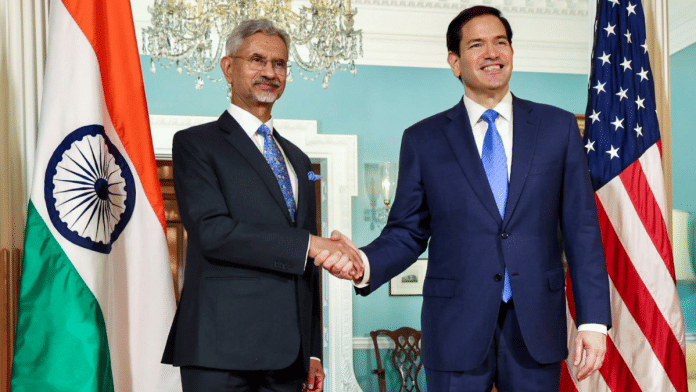



Those of us who live far from Europe should normally have very little interest in a Security Conference held in Munich, Germany. As occasional tourists, we associate Munich with good beer, the location of Hitler’s failed putsch and being close to the BMW factories. But Munich has willy-nilly entered into our debates, discussions and even concerns. Two years in a row, senior American politicians have delivered unusual and remarkable speeches in Munich. Last year, it was US Vice President JD Vance. This year, it was US Secretary of State and National Security Advisor Marco Rubio. One wonders why these speeches are considered important and whether they have any relevance for us who live in distant India.
Vance’s speech was basically a lecture to the Europeans to move to a more robust Right-wing political space and abandon their insipid Leftism. He warned them that their real enemy was not anyone outside, but their own obsessions with wokeism, political correctness and the cancel culture. The most poignant moment in Vance’s speech was when he talked about a man who was arrested merely for peacefully praying near an abortion clinic. The maniacal need to protect politically correct stances in Europe was his target. Apparently, prayers are prohibited within 150 meters of an abortion clinic. Does that mean that if a person lives close to an abortion clinic, she cannot stand in her garden and pray? It looks as if that is exactly what Britain’s woke law means. I kept wondering. Indic traditions tell us that Abhimanyu, as a foetus, was capable of listening and understanding, and he learned lessons about warfare. Clearly, our ancients felt that foetuses of some maturity were conscious and intelligent. The pregnant Subhadra probably spoke to the foetus and prayed for the foetus. I, for one, felt a tinge of sympathy for Vance’s position.
Vance’s lecture stemmed from a concern deeply embedded in his Christian religion. This is where one sees a continuity between Vance’s speech and Rubio’s, a connection which the standard Leftist Western media have missed. Rubio mentioned Christianity several times in his speech. His principal argument was that Christian traditions united Europe and America in a common West. He almost deliberately and consciously ignored the non-Christian populations of both continents. Interestingly, he even dropped the fashionable adjective “Judeo-Christian” and stuck to plain “Christian”.
Rubio went much beyond the political concerns regarding free speech that bothered Vance. Rubio went so far as to praise the West’s five-hundred-year era of global conquest. He was unhappy about the retreat of Western imperialism after 1945. This must have been music to the ears of British, French, Portuguese and Dutch Right-wingers in the audience who probably regret the loss of empire. Rubio talked about missionaries in a positive way. He was all praise for Spain’s “gift” of Christianity to the Americas. He never used the word “conquistadores”. But he made it clear that he was proud to be a descendant of Spanish conquistadores. I found his whole approach very fascinating. It was diametrically opposed to the ideas of history in Western academia for the last fifty years, which have been critical of the Western assault on non-Western societies. Quite frankly, I was surprised that Rubio was willing to say all this in a brazen manner.
When talking specifically about the US, Rubio was not in the least bit shy of paying tribute not just to whites, but to specific ethnic groups among the whites. He talked about the English, the Scots-Irish, the Germans, the Dutch, the Scandinavians and the Spanish. Absent even among Europeans were Eastern Europeans, Russians, Jews and so on. And of course, African Americans and Asians did not figure in his speech as he was talking only about the European-American link through the so-called “Western Christian” civilisation and culture.
So how are Indians to react to the speeches of Vance and Rubio? We can, of course, take the standard approach—that what they are preaching is nothing but a retreat to Western colonialism, imperialism and neo-colonialism. We can loudly and even angrily criticise these speeches from that perspective. But this writer believes that we would simply fall into the oft-repeated trap of ending up getting portrayed as “hysterical natives” who are simply incapable of understanding the greatness of Western civilisation. I believe that there is a subtler way of trying to understand the new American approach to civilisational issues and to deal with this approach in a creative way of our own.
Also read: Cultural artillery, Christianity, education: How the British & missionaries Westernised Khasis
Rejecting a ‘global’ civilisation
Oddly enough, the person we should first engage with is the Russian philosopher, Aleksandr Dugin. Now I earnestly beseech my readers to totally and emphatically reject all the rubbish propaganda emanating from the BBC/NYT/Guardian/Der Spiegel/Le Monde cabal that Dugin is a fascist reactionary. These dim-witted idiots are unable to see what we should embrace: Dugin is an important, even a seminal philosopher.
Among the many things that Dugin says, one has struck me as crucial. The West has believed for some time that theirs is the “global civilisation” and that the rest of the world has no alternative but to embrace that culture and eventually become “Western”. This is a variation of the now-discredited Fukuyama thesis. Dugin rejects this idea wholeheartedly. For him, the West is just another civilisation. The mere fact that the West has been dominant for five centuries does not mean that the rest of us have no choice but to become Western. We have agency as inheritors of civilisations of our own, and we can choose to accept some gifts from the West, while rejecting others.
Dugin sees the Russian civilisation, backed by the traditions of the Russian Orthodox religious culture, as being central to the core identity of his people. He rejects the facile liberalism and fashionable leftism of the West, and of course, he completely rejects its woke avatar. At one level, one can make the case that Dugin is a worthy inheritor of the Slavophile positions of Dostoyevsky and the later Gogol. But I believe that in his insights, Dugin is more universal than these historic Russian greats. Dugin understands the fundamental plurality of human civilisations. This whole idea of a homogenous “global” civilisation, which is, for all practical purposes, Western, is, in Dugin’s opinion, a bit of a joke and an attempt to impose intellectual dominance after Western European physical empires have disappeared.
Also read: Missionaries saw Hindu gods as monsters & representations of Satan: Manu Pillai
Not a Christian country
Now, to bring it back to India. We need to educate our American friends a little bit. Rubio is all praise for missionaries. We need to tell him something about missionaries in India. First things first: Despite the obvious success of Western imperialism in India, unlike Latin America or large parts of Africa, Christianity failed to take over Indians in large numbers.
The Portuguese in Goa forcibly converted many and created a group of Roman Catholics. They even brought the Inquisition into India and burned people in Old Goa, at a spot quite near the present Bom Jesus Basilica. But on balance, they failed. The Jews of Cochin, who the Portuguese mercilessly persecuted, survived. Most enlightened Goan Christians today are very equivocal about their traditions. The Portuguese forced them to take on surnames like Braganza and Pinto. Oddly enough, many of today’s Goan Christians choose Indic first names like Ajit, Rahul, Kamini and Gitanjali for their children.
The Roman Catholic presence was not on account of any strong support from the British Raj. It has survived by adaptation. A few years ago, I visited Velankanni in Tamil Nadu, where there is a shrine dedicated to the Virgin Mary. I found that visiting pilgrims went in for tonsure of their heads. In fact, the first tonsures of their children are routinely done in Velankanni. The processions of the statues of the Virgin Mary taken out of the streets are identical to the processions of the images of Meenakshi and other deities. Velankanni looks and acts like another Indic pilgrimage centre, like Tirupati or Palani. Dugin is just the kind of person who would ask the question: “Which civilisation prevailed in the encounter?” Dugin probably already knew about Roberto De Nobili, who some centuries ago, and Anthony De Mello in the twentieth century, who became Indic yogis for all practical purposes. Perhaps the Indic civilisation “converted” them without even consciously trying to do so.
The East India Company, in its early days, discouraged missionaries. Their folks were merchants, not obsessed with proving the superiority of Western Christian civilisation. But in the first half of the nineteenth century, Britain was flooded with Christian evangelicals who arm-twisted the Company to first allow and then support Protestant missionaries. An interesting personality in the nineteenth-century Christian evangelical movement in Britain was William Wilberforce. He campaigned for the abolition of slavery, and he succeeded in his campaign. He also campaigned to “convert” all Indian heathens to Protestant Christianity. If Wilberforce is up there in the skies today, he should know that, sadly, he failed in his second campaign. Christians are a small minority in today’s India, an outcome so far removed from the Americas.
The interesting thing to note is that Indians of all persuasions exercised agency and reacted to missionary activity. When it became obvious that lower caste persons were easy conversion targets, intelligent upper caste persons started movements against the caste system. Many lower caste leaders like Narayana Guru figured out ways to assert their position without the need to convert. Ambedkar did convert—but alas for Wilberforce, not to Christianity. The case that I find most interesting is when two Parsi boys who were attending a missionary school in Mumbai (then Bombay) converted to Christianity, there was a furore among the Zoroastrians of that city. The Parsis resisted conversion with fervour. This proves that Dugin is correct. Inheritors of civilisations have agency. And while Rubio can be proud of missionaries, others may have different and unpredictable responses to their activities.
I have deliberately left out a reference to Syrian Christians, who are an ancient indigenous group that actually resisted the Portuguese missionaries who targeted them. They remain to this day children of the Indic soil. Today, the most active converters are the spiritual descendants of Wilberforce—evangelicals, Pentecostals, “believers”, and so on. Many of them are supported financially by Rubio’s country. They do not accept Indian customs, like the Velankanni pilgrims. By their aggressive tactics, they do generate localised hostility. We have to see if, over time, they succeed. As a betting man, I see the odds stacked against them.
The question needs to be asked. Why did British rule and the support for missionaries for about a hundred and fifty years not make India a Christian country? The answer is to be found in Dugin’s writings. Civilisations have resilience. They can adapt without changing fundamentals. Peter the Great changed Russia, but Peter the Great could not change Russia!! Where the Romanoff monarch failed, Vladimir Lenin had an even lesser chance. Russia remains. And despite Wilberforce’s attempts, India remains.
So strangely, I am one of those who do not subscribe to the fashionable Leftist trope of attacking Rubio as an unvarnished imperialist, colonialist, neo-colonialist and so on. It is fine with me if Rubio is proud of missionaries and conquistadores as the exemplars of Western civilisation. I quite understand Rubio’s lament about the “withdrawal” of the West after 1945. I might feel just as he does if I were in his place.
But I am not in his place. Just like Rubio is proud of the West, despite its warts, so are we proud of our civilisation, despite our shortcomings. And we are realistic. We do have substantial minorities who may have a tangential adherence to other civilisations. So does Russia. But its civilisation is defined by Dostoyevsky, Turgenev, Lermontov, Pushkin, Tolstoy, Tchaikovsky, Rachmaninov, Eisenstein, Pasternak and Solzhenitsyn apart from Ivan, Peter, Nevsky and Catherine (who was actually of German origin!). We, too, have our traditions and our heroes. We understand Rubio’s lament about the West inflicting self-defeating wounds on itself. Fortunately, or unfortunately, we have been through ups and downs in history over several millennia and are not condemned to remember only five centuries of dominance. We are willing to learn from others. But we are what we are. And we are not upset when Rubio talks up his civilisation, even if his statements have elements of religious supremacism and ethnic pride. These are normal for civilisations to have, even if other civilisations are not aggressive missionary converters, as Rubio’s civilisation has been in his own words.
Nowhere in the speeches of Vance or Rubio did I see any attempt to suggest that “other” (i.e. non-western) civilisations should accept their edicts. We can, and we will live with that. We wish them luck in defending and reviving their civilisation. We are less vocal, but we are confident that we can defend ours. And Dugin is confident that the Russians can defend theirs. The equilibrium is established!
Jaithirth ‘Jerry’ Rao is a retired entrepreneur who lives in Lonavala. He has published three books: ‘Notes from an Indian Conservative’, ‘The Indian Conservative’, and ‘Economist Gandhi’. Views are personal.
(Edited by Theres Sudeep)
What if Bharat simply amended its Constitution to prohibit organised religious conversion? Not a debate about democracy or dictatorship — but a straightforward assertion of a civilisation’s right to preserve itself culturally, spiritually, and linguistically from alien, externally-driven projects.
Abrahamic religions spread historically through war, military conquest, missionary indoctrination, and ideological pressure. In doing so, they committed cultural genocide across entire regions that were living perfectly coherent lives on their own terms. That is historical record, not prejudice.
Hindus have no equivalent history of conversion ‘in the western sense’. Ramakrishna Mission and Arya Samaj are not conversion machines — they are reform and consolidation movements, and their very existence is a deterrent to predatory proselytization, not a mirror of it.
Had this been addressed cleanly at the founding in 1947, much of the reactive identity politics we see today may never have taken root. The illiberal responses we now witness are downstream consequences of a wound that was never treated.
Many countries restrict proselytization without being considered uncivilised. Bharat has every right — and arguably the responsibility — to do the same. The real question to Bharat’s citizens is: how long will you wait?
Wait for the next census. You might get a shock.
To be fair to history, Muslim, then Mughal, rule did not make India an Islamic country. Nor will the slightly higher rates of reproduction for Muslims, as compared to Hindus, in India in future.