









Shahi Tharoor’s fears have not come true. Nor have the Modi government’s. The Bangladesh Nationalist Party, under chairman Tarique Rahman, has won the 13th National Parliamentary Election that took place on 12 February. And one is reminded of the fear that gave sleepless nights to Delhi’s strategic circles ever since Bangladesh’s largest Islamist party, the Bangladesh Jamaat-e-Islami, started winning students’ body polls across universities late last year.
On 11 September, after the Jamaat students’ wing won the Dhaka University polls, Tharoor wondered aloud how the results would play out in the upcoming general elections. “This may have registered as barely a blip on most Indian minds, but it is a worrying portent of things to come,” he wrote.
Late in the evening on 12 February, as the Bangladesh Nationalist Party (BNP) surged way ahead of the Jamaat-led 11-party coalition to mark a decisive win, those in India saw a chance to reset ties.
Islamist threat averted, for now
Delhi had more than one reason to worry. To start with, the Jamaat had supported Pakistan during the 1971 War of Independence. And the Islamist party has spoken in favour of implementing Sharia law. Speaking in New York in September 2025, Jamaat deputy chief Syed Abdullah Muhammad Taher promised a holy war with five million Bangladeshi youth if India “dared to intervene” in Bangladesh’s internal affairs. Key reasons for Delhi’s souring ties with Dhaka had been India’s security concerns and the Muhammad Yunus-led interim government’s inability to curb, or complicity in, the rise of radicalism in Bangladeshi society and politics. It affected not only the country’s law and order situation adversely, but also threatened to spill over into India.
Soon after the fall of the Sheikh Hasina regime on 5 August 2024, the Dhaka Tribune reported that the Jamaat held a meeting with the country’s top Qawmi scholars, where participants voiced optimism about establishing a country based on Islamic rules under the leadership of Jamaat chief Dr Shafiqur Rahman. “We should forget all our past differences and should not give any political party a chance,” said Shariat Mufti Abu Zafar Qasemi, Ameer of the Bangladesh Khilafat Andolan, calling for unity among all Islamist forces in the country.
Veena Sikri, former High Commissioner of India to Bangladesh, told ThePrint that the Jamaat-e-Islami played a significant role in the events leading to the interim government’s appointment in August 2024. “The Jamaat continued to exert considerable influence over the Yunus government, which was reflected in the government’s decision-making processes,” Sikri said.
What worried Delhi further was the US administration’s growing closeness to the Jamaat. In a report on 24 January 2026, the Economic Times wrote that American efforts to woo the radical Islamist party ahead of elections have raised eyebrows in diplomatic circles and among Bangladesh experts.
This came after The Washington Post obtained and reported on audio recordings of a US diplomat in Dhaka who described how Washington wants to engage with the Jamaat-e-Islami.
Also read: DAP is going from Make in India to Owned by India. AMCA is the first test for success
Beyond a strained past
The fall of the Sheikh Hasina government accompanied a sharp rise in anti-India sentiment in Bangladesh. The fact that India has given shelter to Hasina has not gone down well in Bangladesh’s civil society and political parties. While the two countries were close strategic allies during Hasina’s regime, Delhi-Dhaka ties rapidly deteriorated after her ouster.
Things may not change overnight. For one, the 2001-06 period, when the Jamaat was a coalition partner in a BNP-led government, was one of the worst for the India–Bangladesh relationship. Sikri, who was in Bangladesh from 2003 to 2006, told ThePrint that Bangladeshi territory was being used by Pakistan-based terrorist groups against India, and that the country became a safe haven for insurgents in the Northeast.
“Tarique (Rahman) was a key figure in that government. He held no formal position but wielded immense power, with zero accountability. The Indian security establishment will not easily forget his alleged role in the 2004 Chittagong arms haul case, part of an alleged conspiracy with the United Liberation Front of Asom (ULFA) to cause mayhem in India’s north-east,” read a Frontline report.
Delhi is willing to put the past behind. Prime Minister Narendra Modi expressed condolences after former BNP chairperson Begum Khaleda Zia’s death.
Deeply saddened to learn about the passing away of former Prime Minister and BNP Chairperson Begum Khaleda Zia in Dhaka.
Our sincerest condolences to her family and all the people of Bangladesh. May the Almighty grant her family the fortitude to bear this tragic loss.
As the… pic.twitter.com/BLg6K52vak
— Narendra Modi (@narendramodi) December 30, 2025
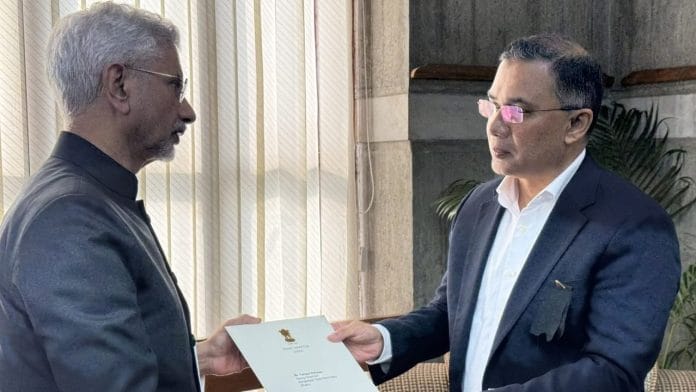
External affairs minister S Jaishankar, who represented India at Zia’s funeral, met her son Tarique and handed him a letter of condolence from Modi. Jaishankar’s Dhaka visit to offer condolences in person came amid frosty ties with the Yunus administration.
Now, with the BNP coming to power and the Jamaat decisively defeated, India and Bangladesh can hope to begin again.
Deep Halder is an author and a contributing editor at ThePrint. He tweets @deepscribble. Views are personal.
(Edited by Prasanna Bachchhav)
Wrong. India is not willing to forget the past. Ot behooves upon Bangladesh to clean itself up. They have built a bad resume and there is no way to spin it. Bharat’s interests are always paramount and prime.