








How long might the war in Iran go on? In what ways is India affected or vulnerable, now or later? What are India’s options?
The question of when and how the war might end depends, in part, on the objectives of those who initiated the war—the United States and Israel. It also, in part, depends on Iran’s response and its military and political capacities. While the war objectives of Israel have been clear and consistent, the US position remains trapped in multiple rationales.
Iran’s revolutionary theocratic regime has been hugely oppressive toward its own citizens and externally aggressive, especially toward Israel. The former is not Israel’s primary concern; the latter is. Ideally, Israel would like to see the elimination of Iran’s regime, or at the very least, a radical emasculation of its military strength and that of its proxies, especially Hezbollah in Lebanon and Hamas in Gaza. Both proxies were severely wounded after 7 October 2023, and the expectation in some quarters was that they would not be able to rise again. But it is clear that in Lebanon, Hezbollah, though weakened, has risen.
Israel’s approach to Iran, which is not an Arab country, is not the same as its approach to the Palestinians. Not only for Israeli PM Benjamin Netanyahu and Right-wing politicians, but also for a fairly large part of Israeli society, the Palestinians in Gaza had become “subhuman” after 7 October 2023—and therefore worthy of violent extermination. History and theory tell us that such attitudes create conditions for mass exterminations and genocides.
On Iran, a distinction is often drawn in Israeli discourse between the regime and society. While the regime is “evil” and must be eliminated, the Iranians, friends of Israel before the 1979 Iranian Revolution, are viewed as belonging to a civilisation of long standing. What was done to Gaza cannot be entertained as a strategy towards Iran. For Israel, regime change rather than societal destruction would be the prime objective in Iran.
The US has given multiple reasons for why it invaded Iran: To bring about a regime change; to destroy the military capability of Iran, especially its missile making and launching capacity; to prevent weapons-grade uranium enrichment and the acquisition of nuclear weapons; to destroy Iran’s proxies in the Arab world; to liberate the oppressed citizenry; to strike Iran hard before it struck America and its assets in the region. Given the multiple formulations, many would argue that it is Israel’s war, and the US is basically a co-sponsor and a co-initiator.
Be that as it may, the problem of rationale multiplicity is, in principle, resolvable. One can logically argue that regime change is the principal American objective, and the other objectives are ancillary. Should the larger objective be achieved, other aims would automatically be served. In other words, if regime change takes place, nuclear ambitions are likely to be disowned by the new rulers, missile making would be de-emphasised, proxies would be weakened, and the oppressive grip over the citizenry would be relaxed.
The problem is that regime change may not be possible, or may take simply too long. Decapitations of leadership are not equal to regime change in a polity which is deeply institutionalised. After the 1979 revolution, Iran constitutionally established a theocratic regime, with the clerics exercising authority over the elected government. More importantly, a large Islamic Revolutionary Guard Corps (IRGC) was created to defend the revolution. New leadership can keep emerging through well-established processes if the existing leadership is externally removed. The system itself would not collapse under external coercion—at least in the short run.
Also read: Exploiting Iran’s ethnic fault lines can solve one problem for US-Israel—and create several more
The cost of war
Moreover, Iran can easily and significantly raise the costs of attempted regime change. This is already beginning to happen.
First, air defence systems that intercept missiles are very expensive. The more missiles are launched, the higher the costs of missile defence, and this can’t go on indefinitely. If the war prolongs, these costs would not be inconsequential. Some missiles will also manage to penetrate air defences and reach their targets—oil depots, water desalination plants, electricity stations, artificial intelligence data centres and even hotels and malls. Iran is already doing this in the Gulf countries, whose economies are taking hits. This can become even bigger.
Second, drones have changed the nature of modern warfare. Compared to missiles, they are much cheaper to produce and launch. And as Ukraine has shown, they can keep a war going, even if there is a great asymmetry between military rivals. If missile launchers and production sites are attacked, which Israel and US military operations appear to be successfully managing to do, drones aimed at US allies, such as the UAE and Qatar, can be used as a mode of defence. No one knows yet how to completely obliterate drone-making.
Third, and perhaps most important, the Strait of Hormuz can be effectively closed by Iran. It has already happened. Iran directly produces only 5 per cent of the world’s oil. But 20 per cent of the latter, as well as nearly 20 per cent of the world’s gas, goes through the Strait of Hormuz. Oil prices have already crossed $100 a barrel. According to Daniel Yergin, a leading energy expert, “the world is looking at the biggest disruption in oil production in history as well as a resounding shock to global gas markets. The key question for global energy markets now is the duration of this explosive war”.
It is clearly in the interests of Iran to increase the costs of war through the use of drones and through its control of the ”maritime chokepoint” of the Strait of Hormuz, and it has the capacity to do so. A relatively cheap Venezuelan-style victory is not possible. As American political scientist Robert Pape shows in his book, Bombing to Win: Air Power and Coercion in War, air strikes have never led to regime change. For that, the US may have to put boots on the ground, an option that will be resisted by President Trump’s MAGA base. The Iran conflict, thus, has all the makings of an imbroglio, a quagmire, which does not allow any easy way out.
Also read: Iran conflict reaches Indian Ocean. India’s balancing act gets harder
Where does India stand?
What are India’s options? If oil prices go through a big spike and Russian oil imports, though temporarily allowed, remain uncertain due to trade negotiations with the US, India’s economy would undoubtedly be hurt. It will be doubly hurt by a decline in remittances from Indians in the Gulf region. A quick ending of the war is in India’s interest.
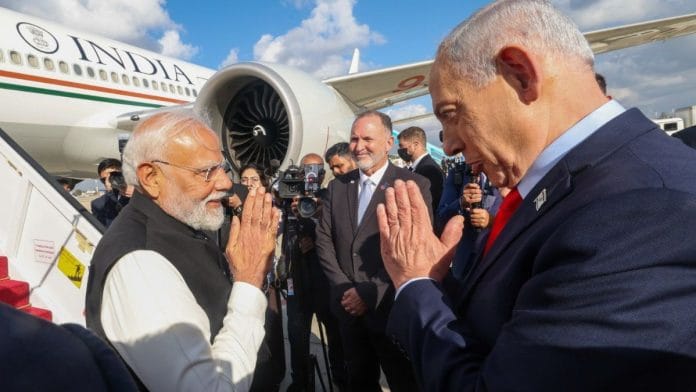
But can India make that possible? India under Modi has no influence over the US. And while it has come close to Israel, it is wholly unclear whether it can influence Israel either. India’s dependence on Israel for defence technology and weaponry has grown enormously. Prime Minister Modi would undoubtedly prioritise Israel over Iran, going against the conventional tropes of Indian foreign policy. He has been unable to comment on the war, let alone criticise it.
To conclude, India is currently a taker in world politics, not a maker. Yet again, it must come to terms with the fact that it is a middle power, not a vishwaguru. It will become a bigger military and economic power in the next 10-15 years. But it is not there yet.
Ashutosh Varshney is Sol Goldman Professor of International Studies and the Social Sciences and Professor of Political Science at Brown University. Views are personal.
(Edited by Theres Sudeep)
India should reconsider whom they consider as allies ..both Israel and Iran together cannot be allies. It’s impossible juggling. There should be some conviction in foreign policy rather than a please everyone attitude.
In the case pakistan is the call girl of usa and china
The only influence India has over Israel is sleeping with Israel because Israel is the “fatherland”.
Why did we have to suffer such a stupid guy as the leader of this country. I guess we get what we deserve.
Who are u to think that I am stupid?. . Go and take rest ..take some medicine for madness..
Many PIOs who moved to the US in the 1990s still seem to view India through the lens of that era, yet often position themselves as authorities on the country today. This article appears to be a patchwork of information easily found online, with the final paragraphs seemingly inserted to serve the publisher’s agenda.
Did Palestine ever support India regarding it’s territory of JK? Ever Mr.Warshney? No.
So, rest now.
Not supporting any politics but this article is absolute stupidity and through the use of standard vocabulary it indirectly pinpoints that India is a loser and has no voice .I would like to say India doesn’t need to be vishwaguru for usa or Israel as it is none of our business to stop usa or Israel from making wars .It is their wish to drag the war or not and suffer the consequences of it whether it be good or bad .I prefer India staying silent as we don’t have any role in this war .Let Israel- usa or Iran fight like pigs or goat and let there be bloodshed.We ain’t dig our nose into it.
You think you’re any less stupid than this article?
This is what happens when you try to do trade with two opposing nations in full force, you take the fall from both sides, 100%. Yes stay silent and keep losing on both ends.
India’s foreign policy approach to West Asia has changed. I2U2 was an explicit statement. Difficult now to make the case that it is perfectly aligned with our economic interests in the region. 2. Is Israel really such an indispensable, irreplaceable source of some of the weapons India buys from it.