






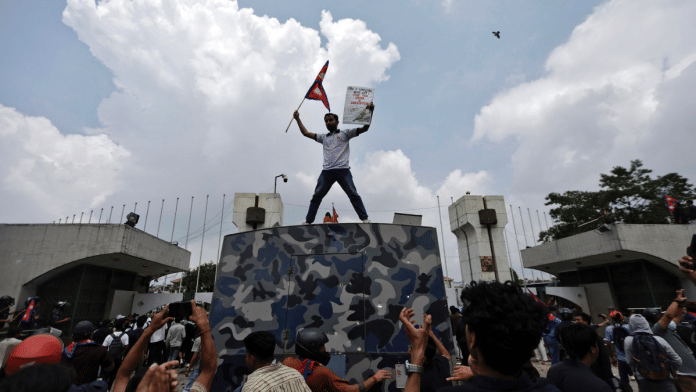



The BBC may have just created the biggest political buzz with its latest documentary—Shot Like Enemies: Inside Nepal’s Gen Z uprising—on Thursday, 26 February, both in English and Nepali. The documentary largely investigates day one of Gen Z protests—8 September—and provides a detailed overview—killings of young protestors and arson of the government and private buildings, including the parliament, private homes of the politicians, and businesses.
The makers of the documentary claim to have accessed the classified Nepal police log detailing minute-by-minute entries, including instructions such as “Curfew already in place. No further need to obtain permission. Deploy necessary force.” Without naming politicians and government officials, it reflects brutal police actions and the chain of command. The documentary also draws on thousands of videos recorded by protesters during those days and attempts to connect the dots on whether the police fire resulted in loss of life.
As Nepal heads into snap polls on 5 March, the BBC documentary raises a question that goes beyond what it investigated—why now?
Bested by BBC
Before the BBC released its report, the interim administration of Sushila Karki had established the Gauri Bahadur Karki Commission for investigation. It questioned former Home Minister Ramesh Lekhak, but the commission’s term was reportedly extended to possibly maintain peace and avoid its influence on elections.
Meanwhile, the Gen Z representatives have said the report is ready for release. Fears are being raised if the report will ever see the light after a new government is formed. It’s crucial for justice and transparency, especially for families affected.
In this climate, the BBC enquiry has turned heads—it could potentially impact the elections, mainly hurt parties such as KP Oli’s Communist Party of Nepal-Unified Marxist Leninist (CPN-UML) and the Nepali Congress, which led the coalition government during the youth movement in September 2025. It eventually lost power amid mounting pressure.
The Election Commission reportedly wrote to the Press Council of Nepal on Thursday, urging the removal of a BBC documentary, citing concerns that it could influence the electoral process. But will that be enough to control a digitally available documentary anywhere in the world? Very unlikely.
What can be done?
Well, everybody knows that the government failed to control the protests, and the police actions were deadly. But it could indirectly jeopardise Oli’s and other traditional parties’ chances, especially in a highly youth-centric election. The young people were instrumental in toppling the Oli-led elected government. Now, with just one week left to the elections, in a smartphone-savvy world, its influence could be debated in the youth’s favour.
Interestingly, when traditional political contenders—Nepali Congress, CPN-UML, Nepal Communist Party (NCP)—are seen as one unit responsible for underdevelopment, poor governance, unemployment, corruption, and political instability since the advent of democracy in Nepal in 2008—something that the documentary also hints at in parts—their electoral prospects could be affected if the film finds an appeal across the age group and party lines.
Meanwhile, the newbie Rastriya Swatantra Party (RSP) could benefit, as it holds no political baggage of traditional parties. However, its founder, Rabi Lamichhane, has been accused of corporate fraud. RSP, by inducting Kathmandu’s former Mayor Balendra Shah, also known as Balen, is now aiming to attract the first-time and young voters. Balen is also the party’s prime ministerial face and is contesting from Jhapa-5 constituency, which has traditionally been held by former Prime Minister KP Oli.
Also read: Gen Zs have taken down the Nepal regime. Here’s why this will never happen in India
Trending on X
Since the BBC documentary was released, it has generated social media buzz, suggesting its impact on the masses.
“BBC should apologise for releasing the Nepal protest report just ahead of national elections as it seeks to influence the political narrative and the poll outcome!” and suggested that, “Only proper investigation can reveal the truths. We should rather push for the release of the Karki Ayog report,” a former Nepali diplomat criticised the BBC in a tweet.
Another user wrote (originally in Nepali), “Who are the accusations against in that Karki Commission’s report, why the government is not making the report public? That report should have come out before the election, and based on which the public could also have decided who to vote for. Who are they trying to protect? Let’s not encourage impunity.”
A freelance journalist asked (in Nepali), “Why is our government delaying the release of an official report even after foreign media have managed to investigate and publicly release a documentary after so many months?”
Besides the criticism, others asked why no Nepalese media could do what the BBC did. A senior journalist wrote (in Nepali) on X, “I knew the country was dependent on others, but I didn’t realise it was so dependent that we even have to import the report of the movement itself.”
Another X user from Nepal had an interesting take, asking, “BBC now names who ordered bullets fired at Nepal’s Gen Z, but drops the story from London days before elections – turning an open wound into campaign ammo and raising serious ethical questions.”
“In a country full of conspiracy theorists, this late hit from abroad will feed every tale of foreign meddling. When there is exposure without consequences and timing without responsibility, journalism stops being neutral and starts laundering the very system it claims to indict…”
Moving forward, while the BBC documentary has certainly made the headlines, it is not the complete account that the Karki Commission may include. The BBC has largely covered protests in Kathmandu, but a detailed account of events in other parts of Nepal would ensure greater transparency.
However, it will be interesting to see whether youth-centric demands in the forthcoming elections, now doubly backed by the BBC’s investigation, could change Nepal’s political fate.
Rishi Gupta is a Commentator on Global Affairs. Views Personal.
(Edited by Ratan Priya)