






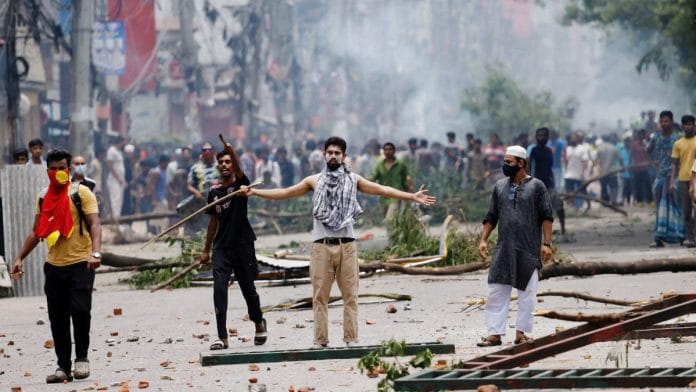



Bangladesh’s July revolution is beginning to resemble a tragedy devouring its own. What started as a students’ revolution against corruption and authoritarianism is now corroding the very ideals on which the country was formed.
Abu Sayed’s death at the hands of the police during the 2024 students’ uprising had turned the movement bloodier. And the recent killing of yet another young leader from the revolution, Osman Hadi, has taken it further—triggering attacks on media offices and cultural centres, stoking rampant anti-India rage, and revived calls for azadi in Kashmir.
As tragic as these deaths are, the fallen “heroes” of the revolution have been deified in today’s Bangladesh. Their Islamist agendas, so far hidden under the garb of a fight for democracy, have a disturbingly large number of takers among the country’s youth.
The rot has also exposed itself politically. The National Citizens Party (NCP), which came out of the students’ movement, finds itself thoroughly discredited. It has been accused of sexual harassment, extortion, and electoral tie-up with the largest Islamist party in Bangladesh, Jamaat-e-Islami.
Death of a dream?
On 28 December, Neela Israfil, a prominent face of the students’ uprising against Sheikh Hasina and a former member of the NCP, put up a Facebook post saying Hasina was right and that politics is “pure geometry”. Israfil went on to say that those around her are all Razakars, or children and grandchildren of Razakars. “Names change, parties change, generations update, but the vector remains constant. Power narratives rotate, (but) axis of betrayal (doesn’t move). So yes, this is not abuse, this is historical continuity expressed through political geometry,” Israfel wrote.
Israfil had formally announced her resignation from the NCP in July, alleging the party fosters a culture of impunity and silence in the face of injustice, particularly in matters of gender-based harassment.
“I am choosing morality, not corrupt politics,” Israfil wrote in her post. “NCP is a political party where criminals are not tried, where silence is maintained on behalf of the criminal, even after a woman is harassed. I cannot stay in that place for even a moment.”
Now, as many as thirty founding members of the party have threatened to resign en masse if the NCP joins hands with the Jamaat.
“In their letter to the party convener, the members cited Jamaat-e-Islami’s political history, particularly its anti-independence role during the 1971 Liberation War and complicity in genocide, as fundamentally contradicting Bangladesh’s democratic spirit and the party’s values,” Dhaka Tribune reported on 27 December.
The letter criticised the Jamaat and its student wing, Shibir, for engaging in “divisive politics since the July uprising, including espionage within other parties, character assassination of NCP’s women members, and the rising threat of religion-based social fascism.”
Reuters confirmed in a report that the NCP has formed an alliance with Jamaat-e-Islami. “Since last year’s uprising, the National Citizen Party (NCP) has cast itself as a centrist, reformist alternative to nepotism and two-party dominance, but as the election nears, it is struggling to turn street power into voter support,” the report said.
But even before the official alliance with the Jamaat, the students’ party had lost popularity in Bangladesh. “That irony is now manifesting in the public sphere as multiple individuals associated with Bangladesh’s recent anti-government student platforms—particularly the Anti-Discrimination Student Movement (SAD), Bangladesh Ganatantrik Chhatra Sangsad (BGCS), and the political camp National Citizen Party (NCP)—face serious allegations of extortion, impersonation, and criminal misuse of power,” HM Nazmul wrote in Daily Star on 31 July.
While the unravelling of the only political party that came out of the July uprising is concerning, what is more so is the deification of individuals like Abu Sayed and Osman Hadi in a country now torn apart by lawlessness, communal violence and anti-India sentiments.
Also read: Tarique Rahman has a dark past in Bangladesh politics. His job is to fix that image first
Worshipping false heroes
On 16 July 2024, 23-year-old Abu Sayed was among the angry student-protesters who had taken on the police in front of Rangpur’s Begum Rokeya University. He was part of the Students Against Discrimination movement, which began with protests against the Supreme Court’s decision to reinstate a 30 per cent quota for descendants of freedom fighters, and escalated into a demand for the dismissal of the Sheikh Hasina government.
Abu Sayed stood ahead of other protesters and dared the police to shoot him, arms outstretched. Videos of what happened next, captured by multiple media outlets, would show police officers firing rubber bullets at him, injuring him.
As Sayed fell to the ground, fellow protesters rushed him to the Rangpur Medical College Hospital. Doctors on duty declared him dead on arrival.
Sayed’s picture with his arms outstretched fired up the students’ movement against Hasina’s hard power, and crossed borders to find resonance among students, artistes and celebrities. “Life will remember you, brother. With power comes responsibility, a truth often forgotten and overridden today. Shame on you, Governance. In absolute solidarity with the Bangladeshi student community,” Tollywood music director Indraadip Dasgupta said.
A month after Sayed’s death, while researching for my new book Inshallah Bangladesh: The Story of an Unfinished Revolution, I met a now-retired senior intelligence official who said that Sayed’s Facebook posts revealed a deep sense of mission.
“He drew strength from Islamic history, jihad and martyrdom. He was a fan of Jamaat-e-Islami’s preacher-leader Moulana Delwar Hossain Sayeedi, a convicted war criminal from 1971. In 2013, the International Crimes Tribunal in Bangladesh found Sayeedi guilty on eight out of twenty counts, which included murder, rape, and religious persecution,” the official said.
Bangladeshi diplomat Mohammad Harun Al Rashid told ThePrint that Sayed was trained to take a bullet for an Islamist cause. “He became a hero overnight and his posters showing him daring the police, arms outstretched, were put up everywhere. But he was a jihadist trained by the Jamaat. There are others like him who have taken refuge in the NCP. Scarier is the new cult of Osman Hadi,” Rashid said.
Moral collapse in Bangladesh
On 12 December, Sharif Osman Bin Hadi, a prominent face of the students’ uprising and co-founder of the political outfit Inqilab Moncho, was shot in the head in Dhaka after leaving a mosque. The Dhaka Metropolitan Police claimed the attack was conducted by assailants on a motorcycle. Hadi was declared dead on 18 December.
After his death, Hadi’s supporters set fire to buildings that house two of Bangladesh’s top-line newspapers, Prothom Alo and Daily Star, vandalised the historic cultural centre Chhayanaut, and rallied in anti-India protests.
“What has Hadi’s death got to do with India? Why are his supporters calling for Azaadi in Kashmir? What has Bangladesh got to do with India’s internal politics? Everything, if you had carefully tracked the rise of Hadi,” Bangladeshi political columnist SM Faiyaz Hossain said. Hossain added that Hadi was a passionate orator and spoke of “people’s issues” but underneath he was a “Jamaat-backed voice who successfully managed to turn anarchy, misogyny and communal hate into ideology”.
For Bangladeshi-Swedish political commentator Priyanka Ahlberg, the celebration of figures like Abu Sayed and Osman Hadi reflects a profound moral collapse in Bangladeshi society. “When terrorism is repackaged as heroism, history is rewritten to excuse brutality,” she said.
The 2024 students’ uprising in Bangladesh was sold to the world as a Gen Z revolution that toppled anarchy. What it did instead was push Bangladesh back to its 1947 East Pakistan origin, endanger the lives of minorities and empower Islamists through the deification of men like Sayed and Hadi. The Bangladesh Jamaat-e-Islami, which has always batted for a country run by Sharia law, could not have been happier.
Deep Halder is an author and a contributing editor at ThePrint. He tweets @deepscribble. Views are personal.
(Edited by Ratan Priya)
Idiots like you are surprised , maybe not, deep down every person with a bit of intelligence (if you are not foreign funded brown sepoy) know that from the start this so call revolution or this garbage was for Islamic cause. It was a jihad. And it will happen in West Bengal if the government don’t change. Sooner or later . And I am not very afraid of this though I am a Bengali Hindu. Because after seeing all of this if in West Bengal we don’t change government. And cannot see that current government love for this type of force that are active in Bangladesh right now. Then this idiot Bengali Hindus have no right to live. They should be killed with most brutal way for the stupidity. So as a Bengali Hindu I don’t have any fear . Are we clever enough to pass this crisis ? If not we should die. Because nothing is more sinner then stupidity of a ethnicity who can see can listen but cannot make decision.( And a community that already experience this type of genocide in Bangladesh with many time like in 1971 and letter on)