









We are now twenty-eight days into the Iran war. Some accounts I follow on social media raised how, by this point in the 2003 Iraq War, American forces had already reached a decisive point. They had dismantled the Iraqi military, captured Baghdad, ousted Saddam Hussein and secured the final regime stronghold in Saddam’s hometown, Tikrit in northern Iraq.
In the second Gulf War, Iraq, for all practical purposes, had fallen. However, in the third Gulf War, Iran has been fighting back an economic war on adversaries that have a low tolerance for pain, showcasing ruthless endurance, typical of hardened regimes—a rueful point recently made by Iranian-origin scholar Karim Sajadpour in his piece for the Atlantic.
But comparisons, while tempting, are misleading. Iraq was all about a full-scale ground invasion—an overwhelming projection of American military power under the George Bush administration. By contrast, Operation Epic Fury (in collaboration with Israel’s Operation Roaring Lion) is about multiple axes of war—a conventional military air campaign, decapitating the Iranian Regime and an asymmetrical response from Iran primarily aimed at rising economic costs with hybrid means, and quite successfully so.
The objectives may echo past wars, but the modus operandi—and the looming economic crises —are far more complex.
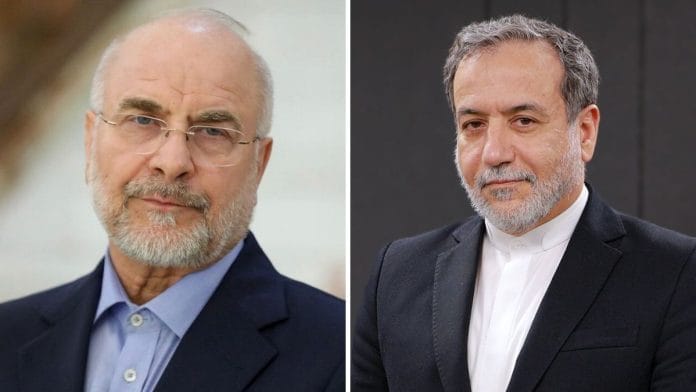
And yet, amid this uncertainty, two names have steadily gained traction: the well-known Abbas Araghchi, the seasoned foreign minister of Iran, and the less-known Mohammad Bagher Ghalibaf, the Speaker of Iran’s parliament, Majlis.
Both, notably, are said to have been removed from US and Israeli targeting lists for the ‘time being’—an extraordinary distinction considering how the Islamic Revolutionary Guard Corps (IRGC) top brass, including the Supreme Leader, have been assassinated and continue being so.
As I am writing this piece, reports have emerged on the killing of the IRGC naval commander in Bandar Abbas, and speculation on three battalions of US Marines landings on Kharg or Larak islands remain rife. The two interlocutors, Ghalibaf and Araghchi, were reportedly in Islamabad two days ago to relay Iranian conditions to the US.
Ghalibaf is more influential and powerful in the Iranian system due to his long experience as a war veteran and roots within the IRGC. Araghchi, on the other hand, is the face of Iranian international diplomacy, while Ghalibaf remains the de facto leader of Iran today.
Making of a hardliner
To understand Ghalibaf’s importance, one must begin with his past, which, like that of many powerful figures in Iran, is firmly rooted in the 1980-88 Iran-Iraq War.
He was just 18 when he volunteered to fight in the Iran-Iraq War. Rising rapidly through the ranks, he later commanded the 21st Imam Reza Brigade and then the Nasr Division in Khorasan. His ascent was not merely institutional—it had other ingredients. His brother, Hassan Ghalibaf, was killed during the Karbala-4 operation during the eight-year war. Such sacrifices helped his standing among Iran’s war generation.
It is crucial to understand that in the IRGC ecosystem, legitimacy is often forged in the crucible of the Iran-Iraq War.
By 1997, Ghalibaf had been appointed commander of the IRGC Air Force, a position that reinforced both his operational competence and institutional trust. Interestingly, he also trained as a commercial pilot, often travelling to Paris to maintain his license by flying at the French simulators.
Also read: Iran war is sure to bring recession in US—common man in India will also suffer
The heavyweight who would not be president
Yet, for all his military career, Ghalibaf’s political journey has been marked by a certain frustration. He ran for president four times, only to see others racing past him.
He first ran in 2005, finishing fourth. In 2013, he came closer, finishing second behind Hassan Rouhani, whose reformist appeal resonated with a public jaded with the hardline policies of Mahmoud Ahmadinejad.
In 2017, Ghalibaf ran again but withdrew in favour of Ebrahim Raisi, showing both pragmatism and alignment with the conservative establishment. His most recent attempt, in 2024, again failed to carry him past the first round.
Instead, he recalibrated and made sure he always held power.
From 2005 to 2017, he served as Mayor of Tehran, building administrative credentials and what can be called a populist base. Then, in 2020, he became Speaker of the Majlis—the first former IRGC commander to lead one of Iran’s three branches of government. Here, do not interpret Iran’s system as a classical separation of powers; this role posited him at the intersection of military, political, and economic influence.
And later, even if he could not be president, he would become something arguably more enduring: a power broker, especially for President Masoud Pezeshkian.
Ghalibaf is not widely described as personable or, let’s say, a refined conversationist. Compared to figures like Ali Larijani, he is often seen as brusque, even abrasive. Yet this very quality may enhance his credibility within the IRGC’s hardline culture.
He is, in many ways, the embodiment of Iran’s militarised political order: a war veteran, a real insider, a power broker and a populist politician. Crucially, he has never been a reformist. His ideological consistency makes him a figure the IRGC can trust.
And that also makes him a credible candidate for US President Donald Trump.
Also read: Iran crisis is another reason for India to harden defence manufacturing hubs
Why is the US watching?
The decision by the US to reportedly spare Ghalibaf from targeting has sparked intense speculation. Several factors may explain this.
First, ambition. Ghalibaf has long sought the presidency. In a moment of unprecedented national crisis, he may see an opportunity to shape Iran’s future—and perhaps finally claim the leadership role that has eluded him for decades. For Washington, this ambition can be shaped as a point of leverage.
Second, vulnerability. Throughout his career, Ghalibaf has faced multiple allegations of corruption. While none have decisively ended his career, they contribute to a perception of political cunning—and there is reason to believe that Ghalibaf would want to dwarf these allegations. Something external actors may seek to exploit.
Third, pragmatism with IRGC characteristics. Despite his hardline credentials, Ghalibaf has occasionally criticised Iran’s economic mismanagement. Videos of him addressing domestic economic challenges have circulated lately, with a degree of awareness about the system’s weaknesses.
Fourth, connections. He is believed to have working, in fact, good relationships with now key figures such as Mojtaba Khamenei, the current Supreme Leader of Iran, and the rest of the IRGC mosaic. This significantly enhances his relevance across the board.
Finally, geopolitics. Ghalibaf has consistently supported closer ties with Russia, China and Pakistan.
Also read: Why Pakistan and Saudi Arabia can’t stay out of the Iran-US war
The Pakistan channel
For New Delhi, perhaps an interesting dimension of Ghalibaf’s current role is his reported involvement in backchannel activities with the US via Pakistan. Pakistan has offered itself as a mediator between the US and Iran due to its own stakes with several actors and an ill-conceived security treaty with Saudi Arabia that Islamabad doesn’t want to invoke.
For Iran, the only two places that it would have agreed to any kind of talks under prevailing conditions (which means after making an enemy out of everybody in the Gulf—including erstwhile hosts such as Qatar, Oman and UAE)—would be either Pakistan or Armenia.
Since Armenia doesn’t have stakes to mediate, but Pakistan has, the inference is obvious.
Ghalibaf is also believed to have played a role in conveying/relaying Iran’s five-point proposal to Washington through Islamabad, although he has repeatedly declined any direct talks or negotiations with the American side.
The US, on its part, has relayed a 15-point plan to the Iranians. And needless to say, the ‘15 vs 5’ equation has been incommensurable so far.
Coming back, Galibaf’s and Araghchi’s visit to Pakistan on March 24, reportedly aboard an Iranian Air Force RJ 85 aircraft, happened after getting a go from the US and Israel. These interlinkages reinforce that he and Araghchi are indeed picked up as potential negotiators for some talks at some stage, even if not now.
Ghalibaf is the one who matters and is accepted within the IRGC mosaic, but lacks a sophisticated understanding of geopolitics—a role that Araghchi will be expected to assist him with.
It is often difficult to find a concluding statement for an unprecedented war that is unfolding faster than analysts can make sense of. I grapple with the same challenge.
We will return to Ghalibaf and Araghchi’s roles as potential negotiators, most likely once again in Pakistan, hoping they will survive until then, because all evidences suggest the war is going to intensify.
Swasti Rao is a Consulting Editor (International and Strategic Affairs) at ThePrint. She tweets @swasrao. Views are personal.
(Edited by Saptak Datta)