






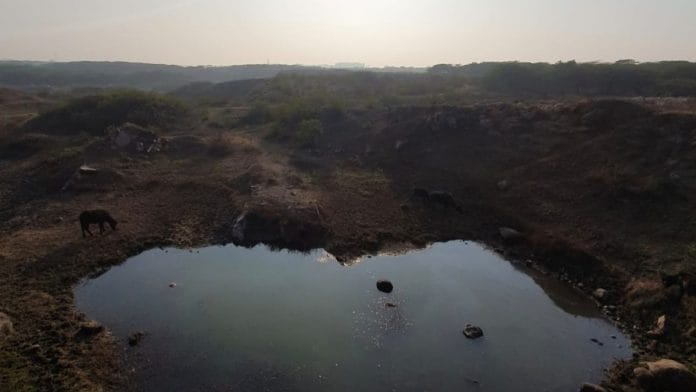



The Aravalli hills have been in the news ever since the Supreme Court of India adopted a narrow definition of the hills based on the 100-metre elevation threshold. This move excluded over 90 per cent of the Aravalli hills from protection. There was worry that the eventual collapse of the ‘green wall’ of the north and western India would accelerate the movement of sand dunes toward the national capital, New Delhi.
In the wake of such danger, the Supreme Court, in February, put a stay on all mining activities in the Aravalli region and ordered that the status quo should be maintained. Chief Justice Surya Kant didn’t mince words when he said, “We say stop mining in Aravalli, and you stop”. The Chief Justice also remarked that the Supreme Court is also located in the Aravalli Hills.
The hills, spread across 700km across northwestern India, are among the country’s oldest geological formations. Negligence toward the ranges is a great threat to the ecology of the nation, and their conservation becomes imperative.
What is also imperative is the protection of its archaeological and historical significance, the exploration of which has barely begun. While the Supreme Court directs the concerned authorities to create uniform criteria to safeguard the Aravallis, on the ground, young archaeologists are gathering evidence to fill the gap in research, educating locals and making attempts to protect the disappearing heritage of the Aravallis.
Also read: We celebrate Harappa excavation—and dismiss Keeladi, Sinauli archaeological digs as politics
Archaeological significance
The Aravallis are one of the oldest mountain ranges in the world, with their origin dating back to the Proterozoic era, about 3.2 billion years ago. They were formed by the folding of the Earth’s crust, resulting from tectonic activities during Precambrian times. The hills act as a vast green wall against the expansion of the Thar Desert into eastern Rajasthan and beyond.
Due to their ecological significance, the hills were a haven for pre- and protohistoric settlements. The Aravallis played a significant role in shaping the tapestry of early human history, not only from a security point of view but also as a treasure trove of rich minerals and resources, such as copper, zinc and lead. These metals shaped early human settlements dating back to the 3rd millennium BCE.
One of the key resources, which was pivotal in the beginning of the Copper and Bronze ages of the subcontinent, was copper. In the Aravalli range, Khetri mines in the Jhunjhunu district of Rajasthan are ancient copper mines, which were exploited by the early Chalcolithic (Copper Age) settlements.
Chalcolithic archaeological complex of Ganeshwar-Jodhpura (c. 3000-1500 BCE), located close to Khetri mines, was the region’s metallurgy centre, supplying copper to the Harappan trade network. Moreover, in the southeastern region of Rajasthan, in the present-day Udaipur, the ancient chalcolithic city of Ahar was located closer to the Zawar mines. The city was an important metallurgy centre. Evidence of early zinc smelting technology has been reported by archaeologist Jeevan Kharakwal, which consolidates the relationship between humans and the landscape.
These findings, along with a large number of archaeological sites in the Aravalli belt, particularly in Rajasthan, have demonstrated that the Aravalli region played a major role in metallurgical innovation and technological specialisation in pre- and protohistoric India.
But when Chief Justice Kant remarked that the Supreme Court is also on the Aravallis, it brought focus on a lesser-known, unexplored and largely ignored region of the Aravallis, which is significant to the history of Delhi and its surrounding regions.
Also read: Imbalance persists in ASI’s modus operandi. Bengal, Bihar demand more attention
Delhi’s forgotten archaeological frontier
In the early 2000s, archaeologist Mudit Trivedi discovered Palaeolithic (Old Stone Age) tools on the Jawaharlal Nehru University (JNU) campus. Spread across nearly 1500 acres, the university lies within a rocky ridge landscape that forms the northernmost extension of the Aravalli range, part of the broader Aravalli-Delhi ridge ecological corridor. Surveying the campus, Trivedi documented numerous Palaeolithic tools as well as microliths, suggesting prehistoric human activity across these rugged terrains thousands of years ago.
The discovery was both remarkable and oddly familiar. Decades earlier, in 1956, anthropologist Surajit Sinha had reported prehistoric stone tools near the gates of Delhi University. Just like JNU, the wider landscape around Delhi University is closely linked to the Delhi Ridge, the northern extension of the Aravallis. The ridge runs to the west of the North Campus of the University, passing through areas like Kamla Nagar and Civil Lines, while the university itself sits on the Yamuna’s alluvial plains.
Subsequently, from the 1970s to the 1990s, surveys undertaken by archaeologists led to the discovery of more localities. Further south along the same ridge corridor, a chance discovery by AK Sharma in 1986 led to the identification of the historic village of Anangpur, in the Faridabad district of Haryana. In 1991-92, the site was excavated by archaeologists AK Sharma and SB Ota. The excavation revealed stone tool deposits ascribed to the Acheulian period or older. This is the only Palaeolithic site that was systematically excavated in the region.
In the late 1990s, historian and archaeologist Nayanjot Lahiri and others reported 50 new sites in the Ballabgarh region of Faridabad, spanning from the Late Harappan/Painted Grey Ware to the Medieval period. These studies brought to light the archaeology of not only Delhi but NCR region.
In 2021, a 5,00,000-year-old tool-making workshop was found in the Mangar Bani forests near Faridabad. This was a workshop where stone tools were crafted, and prehistoric humans lived. In the same year, in the same region of Aravalli near Faridabad, caves were reported which were nestled amid a maze of quartzite rocks. These caves exhibited rock art, which is yet to be dated.
Also read: Why this Indian archaeologist renamed the Indus Valley Civilisation
Heritage for the people
Recent work by young archaeologists has further expanded our understanding of the Aravalli landscape around Delhi. Archaeologist Shalaish Baisla, who has been surveying this area since 2020, has recently found more evidence of older settlements in the area around the villages of Kot and Mangar in Faridabad. He found stone tools, petroglyphs and stone carvings ranging from the Lower Palaeolithic to the Upper Palaeolithic period. At the same time, his ongoing research has highlighted a growing crisis of disappearing sites, many of which have remained undocumented and are increasingly threatened by quarrying, construction and rapid urban expansion.
Concern about this disappearing heritage led Baisla and his colleagues to launch a research-driven initiative—Vanyāravali Foundation. It’s dedicated to the study and safeguarding of the intertwined natural and cultural heritage of the Aravalli range, beginning with the fragile landscapes of Delhi-NCR.
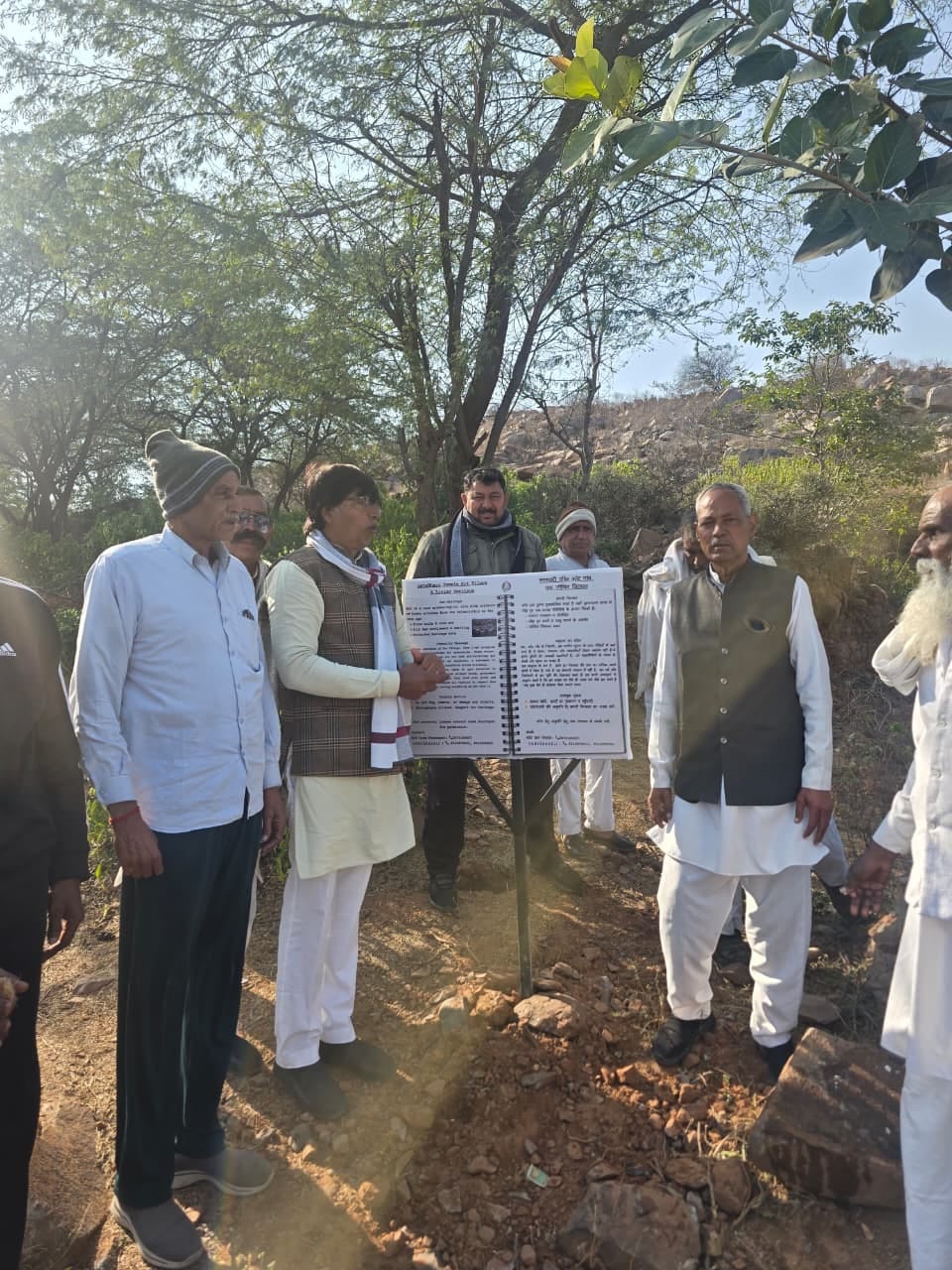
The initiative builds upon pioneering surveys by Tejbir Mavi and other local enthusiasts. Their fieldwork first identified many of the region’s most significant prehistoric sites. Through systematic field surveys, Vanyāravali has documented dozens of unreported prehistoric localities—Palaeolithic tool scatters, rock shelters, petroglyphs, and Iron Age metallurgical remains—while simultaneously working with local communities to foster stewardship over the heritage in their own villages.
In a region threatened by development pressure, illegal mining and policy changes, such initiatives advocate the need for salvage archaeology and local participation.
As the legal debate continues over how the Aravalli hills should be defined and protected, the emerging archaeological evidence from the Delhi-Faridabad region offers a powerful reminder of what truly is at stake. The scattered prehistoric tools, rock paintings, the buried settlements, and the medieval forts reveal that the Aravallis are more than an ecological barrier. They are a deep historical landscape. The work of local communities and young archaeologists through initiatives such as Vanyāravali Foundation shows that safeguarding this legacy cannot rest upon policy alone. Civilisational heritage is at risk; it is the duty of society to commit to preserving one of the oldest cultural landscapes of the country.
Disha Ahluwalia is an archaeologist and research fellow at the Indian Council Of Historical Research. Views are personal. She tweets @ahluwaliadisha.
(Edited by Theres Sudeep)