






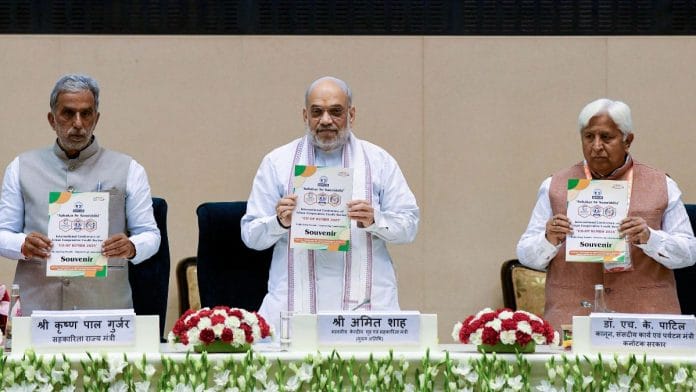



When Amit Shah, the powerful Union Home Minister, is also the Minister for Co-operation, a 47 per cent increase in budgetary allocations for the sector should come as no surprise. The 2026-27 outlay has gone up from Rs 1,187 crore in the last fiscal to Rs 1,745 crore this year. But is this sufficient to give a fillip to India’s co-operative model?
The Union Budget 2026-27 includes a capital outlay of Rs 300 crore for the establishment of the Tribhuvan Co-operative University at Anand in Gujarat. Other highlights include Rs 500 crore to the National Co-operative Development Corporation (NCDC) for strengthening the co-operative sector, including sugar mills, and Rs 450 crore for promoting exports from the sector. This will benefit co-operatives like Nafed as they look to establish a global footprint with newer millet-based ready-to-eat products.
Another significant head is the allocation of Rs 364 crore for the computerisation of 67,930 functional Primary Agricultural Credit Societies (PACS) across the country. This is roughly two-fifths of the 1.01 lakh registered PACS, which implies that the remaining 28,000 have become dysfunctional or unviable.
But here is the larger question. PACS may have started with the objective of providing affordable credit, but that was in a bygone era when the network of scheduled commercial banks (SCBs) was limited to urban areas, and there was no concept of priority-sector lending. Now that every state, district, and block has regular mechanisms to monitor the flow of rural credit, especially for agriculture, agricultural lending is neither the unique preserve nor USP of the co-operative sector.
This brings us to an even more salient question. Can PACS compete with SCBs, which offer not just crop loans through the Kisan Credit Card, but every other transaction that a farmer may need, from tractors to housing, to education loans?
Also Read: The real White Revolution—Shastri’s NDDB built a farmers-first economy that still works
Rethinking agriculture credit
The decline in the co-operative sector’s share of agricultural lending is quite pronounced.
Researchers Ashok Gulati and Ritika Juneja showed in their 2019 paper, ‘Agricultural credit system in India: Evolution, effectiveness and innovations’, that in FY 2016-17, commercial banks were the main source of formal finance to farmers. These accounted for 75 per cent of loans outstanding to farmers in 2017, followed by co-operative s at 13 per cent, and regional rural banks (RRBs) at 12 per cent.
What is more disturbing for the co-operative sector is the emerging pattern. The Reserve Bank of India’s ‘Report on Trend and Progress of Banking in India 2024-25’ cites data from NABARD showing that while the RRB share showed only a marginal dip from 12 per cent to 11 per cent, the co-operative share fell from 13 per cent to a single-digit number of 9 per cent.
“[D]ue to increasing reach of commercial banks via technology, branch expansion and business correspondents, the share of RCCs [rural credit co-operatives] in total agriculture credit has moderated over the years,” the RBI report said.
Having argued that banks can do a better job of providing credit for agriculture, what should co-operatives do? Well, there are other areas in which a bank does not enjoy the same edge. These are equally critical to enhancing productivity in agriculture, horticulture, and dairying: agriculture equipment hubs (custom hiring centres), soil and seed testing labs, fertiliser outlets, biogas plants, primary-level centres for aggregation, assaying, and weighing and arrangement of fodder and cattle feed.
Therefore, the argument is that if PACS have to compete, the only option is to offer Credit Plus services.
Deep dive into the data: one size will not fit all
The Ministry must also take a look at the state-wise data with regard to co-operatives. Amit Shah stated on the floor of the House that, as per the National Co-operative Database (NCD) portal on 15 November 2025, there were 6.56 lakh functional co-operative societies, as against 1.39 lakh that were non-functional, and another 48,537 under liquidation.
Of the functional societies, Maharashtra and Gujarat led the country with about 2.17 lakh and 78,215 societies, respectively. The other leading states were Telangana at 48,186 and Karnataka at 40,231.
In other words, these four states alone account for nearly 60 per cent of the functional and viable societies. The figure from Uttar Pradesh is alarming, to say the least. India’s most populous state, with an agricultural GDP of close to 27 per cent (about 10 percentage points higher than the national share for agriculture), has only 22,731 functional co-operative societies out of 40,665 total registered entities.
Ear to the ground: marginal farmers and co-operatives
On 23 December, Kisan Day, the Forum of Enterprises for Equitable Development (FEED) released its annual report on the state of marginal farmers. It looked at engagement with PACS and service delivery experiences of marginal farmers across six states with distinct geographies, cropping patterns, and co-operative legacies: Andhra Pradesh, Bihar, Himachal Pradesh, Maharashtra, Tripura, and Uttarakhand.
While each state offered its own set of positive and not-so-positive exemplars, two critical findings stood out. First, the engagement gap remains stark. Despite the ubiquity of the co-operative network, field surveys revealed that less than one-fourth of the surveyed marginal farmers were active members of agricultural co-operative s.
But on the positive side, the report also showed that nearly 45 per cent of marginal farmers who successfully joined co-operative s reported an increase in household income, and over 42 per cent reported improved crop yields.
Also Read: Charan Singh exposed failures of Soviet collective farming. And saved Indian agriculture
5 steps to ‘Sahkar Se Samriddhi’
There are five more suggestions for the relatively new Ministry of Co-operation.
First, while it is good to handhold co-operatives in the initial years, and provide policy and financial support, I will emphasise: they have to be mentored, not monitored.
Fixing arbitrary targets — whether toward membership or leadership positions — will take out the ‘co-operative spirit’ and make the co-operative an agency of the state. It will still perform a useful, sometimes critical service, especially if the service is not available elsewhere, but this will defeat the purpose of self-help and mutual help, which is the founding principle of co-operatives as laid down by the International Co-operative Alliance (ICA), to which the National Co-operative Union of India (NCUI), the apex body of co-operative s in India, is a member.
The second relates to reforms in the co-operative election process. Voting has to be restricted to those who cross the transaction bar — in other words, in a milk producers’ co-operative society, voting will be restricted to those who pour a minimum quantity of milk regularly, rather than those who have a share but are not active in the domain of the society. This is to ensure that it remains a ‘user-based’ co-operative. Ideally, the weight of the vote should be based on the percentage of transaction, though perhaps this is too radical a suggestion at this stage.
The third relates to a clear understanding that a co-operative is not a panchayat, and that only those who have a stake in the commodity or service in question should be encouraged to join.
Fourth, the success of a co-operative is not to be measured in terms of the number of societies registered, or memberships therein, but in the volume of business, and whether it is making a difference to the lives, livelihoods, and incomes of the key stakeholders.
Last, but not least, let the liquidation process be smoother and easier. In fact, we may move to the concept of deemed liquidation. If elections have not been held, and audited reports have not been submitted for two consecutive years, the society should be deemed to have been deregistered.
An internal stock-taking is indeed the need of the hour if we want co-operatives to fulfil the objectives which the Co-operation Ministry desires. The enhanced budget helps, but the preliminary first steps mentioned above have to be taken before the tagline Sahkar Se Samriddhi (from co-operation to prosperity) becomes a reality.
Disclosure: The columnist is the Honorary Chairman of FEED and held the post of Managing Director NAFED from 2010 to 2013.
Sanjeev Chopra is a former IAS officer and Festival Director of Valley of Words. Until recently, he was director, Lal Bahadur Shastri National Academy of Administration. He tweets @ChopraSanjeev. Views are personal.
(Edited by Asavari Singh)