








New Delhi: India’s goal is not to strike a “balanced position” between the Arab states and Iran in the West Asian war, but to protect its deeper equities for its interest, foreign policy analyst C. Raja Mohan said Monday.
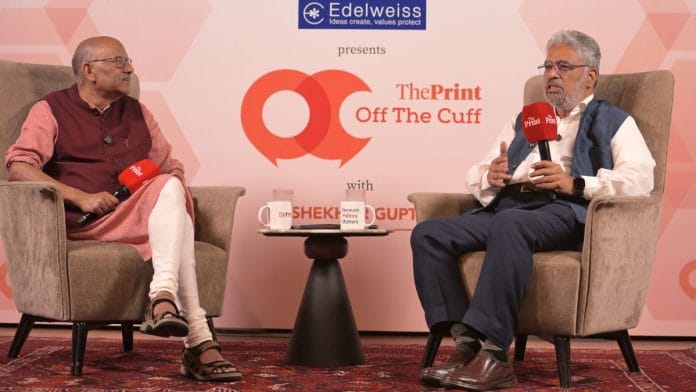
Speaking at ThePrint’s Off the Cuff event at the Quorum Club in Mumbai, Mohan argued that India’s relationship with the Gulf Arab states had grown too consequential to treat Iran as an equivalent partner. The asymmetry was stark, he said: nearly 10 million Indians live across the six Gulf Cooperation Council (GCC) states—the UAE, Saudi Arabia, Bahrain, Oman, Qatar and Kuwait—against barely 10,000 in Iran. Oil flows and remittances compound the imbalance further.
“Today the clear recognition of India’s interest has seen India take a position—I don’t [think] that doesn’t mean you don’t talk to Iran, you have to talk and get your ships out — but the core interest, if you weigh them on a scale, if you put Iran on one side, Iran has barely 10,000 Indians, if you put the other side the Gulf Arabs, there’s no equivalence between the two,” Mohan said in conversation with ThePrint’s Editor-in-Chief Shekhar Gupta.
For India, he said, the relationship with the Arab Gulf has become “so deep, that protecting those equities” is key to India’s interests in the region.
The war, which began on 28 February when the US and Israel jointly struck Iranian positions and killed Supreme Leader Ayatollah Ali Khamenei, has drawn GCC states into the thick of the fighting. Over 80 percent of Iran’s long-range missile and drone launches have targeted GCC member-states, while the remaining were aimed at Israel. The UAE has borne the heaviest toll, intercepting or absorbing more than 2,200 Iranian launches over the past five weeks.
For India, the conflict has triggered acute fears of energy disruption. Qatar accounts for roughly 40 percent of India’s liquefied natural gas (LNG) imports, and an Iranian strike on QatarEnergy’s Ras Laffan production complex—carried out weeks ago — is expected to affect approximately 17 percent of Doha’s global LNG exports.
The Strait of Hormuz has been effectively closed since the war began. India has been negotiating passage with Tehran; around four tankers carrying liquefied petroleum gas (LPG) have been cleared so far, while 20 more remain stranded.
The UAE’s centrality to India goes beyond energy corridors. It is India’s second-largest export market globally.
Mohan Monday credited Prime Minister Narendra Modi with reorienting India’s Gulf relationships through sustained personal diplomacy—and argued the shift reflected a broader strategic correction.
“Today the personal equation Prime Minister Modi has built with MBS [Mohammad bin Salman, Crown Prince of Saudi Arabia] with MBZ [Mohammad bin Zayed Al Nahyan, President of the UAE] and all the phone calls he’s been making to the Gulf Arab leaders is the reflection of the economic stakes that go up to 10 million Indians… as I said, the biggest trading partners… I think it’s a different relationship here,” he said.
“When Modi went to UAE in 2015, [it was the] first time in 32 years [by a Prime Minister of India]. So you had actually, for all the talk about Arab solidarity, there was a neglect of these countries because they didn’t fit into your worldview… which is what Mr. Modi has seen,” he added.
Mohan also pointed to India’s growing appetite for “mini-lateral” diplomacy as evidence of a deeper recalibration. From I2U2 — the grouping of Israel, India, the UAE and the United States — to the India-Middle East-Europe Economic Corridor (IMEC), New Delhi has shown “willingness to work with different states in the region”.
The change in policy reflects the change in India’s “interests”, he added.
(Edited by Prerna Madan)
Also Read: Strait of Hormuz is Iran’s trump card. Why has US superiority not secured the seas?