





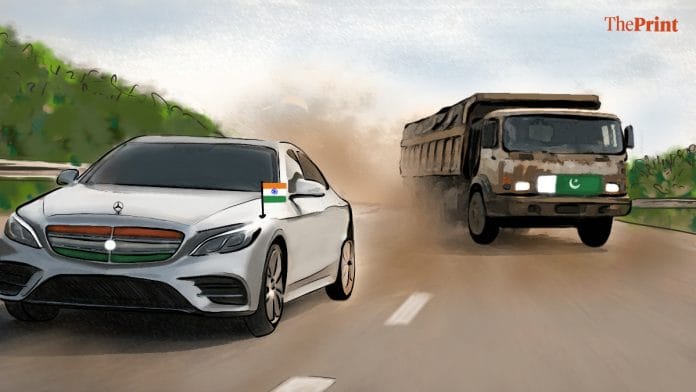



The risks in using this headline are enormous, from being accused of indulging in click-bait journalism to being asked to see a shrink. I’d plead, you hear me out.
Of course it can be nobody’s case that Pakistan has colonised India. In no field, be it military power, economy, culture and soft power, or global image can it ever catch up with India. That train left the station in 1983, around the time it chose the policy of bleeding India through a thousand cuts. This was Zia’s Pakistan on its Afghan jihad high and troubles in our Punjab were rising. This set Pakistan on a course of irreversible decline.
It got steeper in subsequent decades. Today, at about 55 percent of India’s per capita GDP it sees the gap rising every quarter. A population a little over one fifth of India’s has about one-tenth its GDP. On literacy, life expectancy, higher education, an enormous negative gap has built up for Pakistan, and it is expanding.
Lately there’s been some excitement over Pakistan’s stock market being among the fastest growing in the world while India’s has stalled for almost 18 months. This is a fact. Lift the Pakistani social media hood and look underneath. The total market cap of Karachi Stock Exchange (KSE), after this relentless 18-month boom, is about $70 billion. That’s exactly 1.35 percent of NSE despite its long stall.
Today, seven Indian companies are individually valued more than KSE. Reliance is three and a half times, HDFC, Bharti and TCS nearly double or more. Go downwards a little, and 14 companies are valued above $50 billion. Its trade with the US is less than a tenth of India’s. Its imports from China, its most valuable ally, patron, protector and the largest trading partner is just about $16 billion including 85 percent of its armament imports. India’s imports from China are $116 billion and it includes no armaments, thank you. On almost any economic indicator Pakistan is worse than its GDP being one-tenth of India’s. Look at aviation. Two of Pakistan’s biggest airlines (PIA and Airblue) together have 44 aircraft, whereas Indigo and Air India have about 700 and adding one a week. That’s about 16 times Pakistan’s.
The neighbours are today batting in completely different leagues. The prospects of ‘trillions of dollars worth of critical minerals,’ or ‘humongous oil reserves’ are just fantasy. At this point it is also fuelled by the self-anointed Field Marshal’s reading of the scriptures and his interpretation that since Pakistan is only the second nation formed on the Islamic kalma after Medina, it must also have oil and minerals underneath its soil like the Saudis. As Ghalib said, dil ke khush rakhne ka Ghalib yeh khayal achcha hai (it’s a useful thought to console yourselves).
In short, Pakistan not only has zero chance of catching up with India, but will only see the gap rising. At various points in time its leaders will offer its people the same snake oil in different bottles: critical minerals, hydrocarbons, gold, and the latest, the Amazon of JF-17s for the Islamic world and its non-state warlords. The hard fact is, that the only area where Pakistan can narrow the gap with India is population. Its growth on this count is about twice as much as India’s. Is this what you want?
Also Read: Asim Munir & Pakistan’s Failed Marshal Doctrine
The Pakistani elites, including Munir, know they’ve been left behind. That dumper truck versus the ‘shiny’ Mercedes statement reflects that. He can never win a war, or even a skirmish. He only has one power: the power to slow India down, and to fuel big-power anxieties over the nuclear Subcontinent.
It is this negative leverage that India has to learn to counter. Begin by looking at the big picture. Have we, over the past decade, allowed Pakistan to take a much bigger space in our minds than it deserves? A much larger weight in our politics than is prudent? Have we unnecessarily created space in our polarised politics for an economically and strategically defeated Pakistan?
Since January 2016, when Narendra Modi’s peace overture was destroyed by the Pathankot airbase terror attack, the BJP’s politics has become increasingly dependent on Hindu-Muslim polarisation. There is no arguing that ‘sab ka saath, sab ka vikas’ works with welfare distribution and nobody is denied any benefits because of identity. But, the sentimental appeal is limited to the Hindu voter. And for that, the threat from Pakistan must always be there.
How it complicates our strategic interest and positioning is evident in the way the game is playing out with Bangladesh. That India was denied a friend in Sheikh Hasina Wazed shouldn’t mean that India won’t have any friends there. Whatever the Jamaat, and even Muhammad Yunus might think of Pakistan, Bangladesh is surrounded by India on three sides, an essential, much bigger neighbour with indispensable linkages.
Polarised politics, especially with West Bengal and Assam polls coming up, means that the relationship with Bangladesh will only worsen before India—inevitably—begins repairs with the newly elected government there. Even if the new government is friendly with Pakistan it is too far and has no resources. Bangladesh will need India’s goodwill to put its own polity and economy together. Chinese weapons? Hasina also mostly bought weapons from China. So there’s no difference.
Also Read: How Pakistan thinks: Army for hire, ideology of convenience
It’s in this big picture that we need to reflect on the Mustafizur Rahman (IPL) issue. Some people these days get triggered at the mention of soft power. But cricket is India’s hard power, given how important the game is in the Subcontinent.
Think about this: is our hosting and patronising the Afghan cricket team an expression of soft, or hard power? Will you read it in isolation of the troubles the current Afghan government is giving the Pakistanis? That’s why not shaking hands with the Pakistanis even while you play them and limiting that ‘anger’ only to cricket, or blackballing the solitary Bangladeshi picked by an IPL franchise opens up more space for Pakistan in India’s neighbourhood. Is that loss of soft or hard power? It hands over our strategic policy to social media.
This is no hasty generalisation. In the same period that the no hand-shaking, take-no-trophies-from-a-Pakistani issue reared its head, we played the junior Sultan of Johor Cup league match in Malaysia (14 October, 2025) where the players not only shook hands, but also high-fived before a 3-3 draw. Of course India went to the final not Pakistan.
Were the hockey boys any less patriotic? Did the government pull out the red card? Nothing. It is only because its social media base didn’t take notice. Who cares about hockey? Like a champion heavyweight fighter, a big power fights as much through its footwork as with the power of its punches. Pakistan needs to constrain India’s space. India cannot fall into that trap.
For the moment the Pakistanis seem a bit chastened. But at some point Munir would do something to slow us down. At the very least giving a rude brush on the side of us, the shiny Mercedes, with his dumper truck. For India to deny that, it must rebuild its ties in the neighbourhood, stabilise ties with China, and keep internal social cohesion. And finally, begin spending big on defence.
Pakistan has a broken economy. Bait it with a new arms race. And that will push it back further. Sounds like beggar-my-neighbour? What else to do with a neighbour whose only game is to try and slow you down.
We must deny Pakistan an undeserved place in our politics, and in our minds. That’s what the headline says: Pakistan se Azaadi.
Also Read: India doesn’t give walkovers to Pakistan in war. Here’s why it shouldn’t do it in cricket either
Fully agree with your analyses. The bjpee is vitiating our social atmosphere for gaining electoral victories by using Pakistan – real or false flag attacks have been allowed to happen within the country. Bad mouthing Pakistan has gone on to such an extent that even our popular actors like Shahrukh and Salman are branded as Pakistani – the Hindu is under threat and danger line has gone on for too long. Time to get sane again.
The problem is not mentality or mindspace; it is the relentless interference. They thrive on creating nuisances, each one carefully designed to drain attention of an administration already operating at full stretch. Stability unnerves them. Tourism in J&K provokes them. Any figure of authority becomes a target. The response from the noisy neighbour is reflexive and petulant. Preparing for long-term progress while tolerating such a chronic affliction is a fool’s exercise. No one runs a marathon with an infected wound gnawing at their shoulders.
The ones who need to suffer are both East and West Pakistan, and the Aman ki Asha brigade. I hope the writer got the clue.
Finally, Mr.Shekhar Gupta seems to have decided to pivot off of his “Pakistan” centric news analysis, commentary etc. Thank you Mr.Shekhar – we need your insight on other domestic and international matters.
You are confusing your own interests with those of the country. You are also out of touch with sentiments on the ground.
Given your interest in secularism and national security, I was expecting a NI on the Anjel Chakma incident. Not only is it racist, it is also anti-national. Racism exists everywhere but both Central and Uttarakhand governments should have shown that they consider this completely unacceptable. How about bulldozing the properties of the perpetrators?
Why should India guard its NE borders from China if this is how people of the NE are treated in the rest of India?
But seems like your “secularism “ is reserved only for your friends like Owaisi.
Baat karne mein kya harj hai. A decade long hiatus. Talks not for the purpose of finding “ solutions “ for intractable problems like Kashmir but managing the relationship to reduce, almost eliminate, the possibility of war. It remains fused to China, whom India cannot possibly ignore. The recent Mutual Defence Agreement with Saudi Arabia, in some ways the leader of the Muslim world. Other countries India values, UAE, Malaysia, Indonesia, Turkey not so much, standing by its side. Now it’s improbable warmth towards Bangladesh. It must be conceded that India has been unable to “ isolate Pakistan diplomatically “.
Pakistan will NEVER rise to Indias level.But there is a 70% chance thar under this government India might just FALL to Pakistans level.The glass is either half full or half empty….SAME SAME
I agree with you 200%!
We can’t ‘grow’ by looking at those ‘below’ us. Growing up, we were never told – think of the child who is far far behind in your class. We were told exactly the opposite.
If we have to grow, we have to compare ourselves with China (rapid infra and industrialisation), Japan (phoenix from WW2), South Korea (ditto from the Korean war).
Yet, Pakistan is like the mosquito which keeps coming and buzzing in your ear and disallowing you from sleeping. It HAS to be swatted. Until then, we may well have to hold it in our psyche.
Its you who dont let us 🙂
Only issue in implementing this is BJP of Modi era would do anything to win domestic elections.
No sacrifice is too big for Bengal.
RSS deliberately made a system of choosing ppl without family to ensure lesser lust for power.
But they ended up with Modi – most power hungry or atleast equal to Indira.