





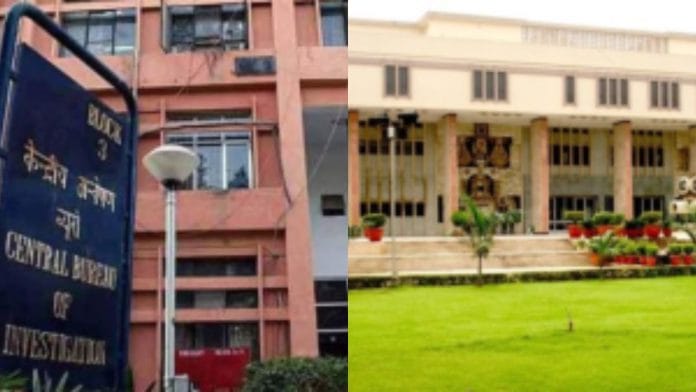



New Delhi: Holding that the Central Bureau of Investigation (CBI) cannot use its summoning powers to force an accused to “create evidence”, the Delhi High Court has dismissed a petition filed by the CBI that sought to compel a retired judge, I. M. Quddusi, to provide personal details such as mobile numbers and bank account information under Section 91 of the Code of Criminal Procedure (Cr.P.C.).
Essentially, Section 91 allows the prosecuting agency to issue a summons or a written order to any person in possession of a document or “thing” believed to be necessary or desirable for the purposes of an investigation, inquiry, trial, or other proceeding.
The high court upheld a trial court’s decision which set aside the CBI’s notice, emphasising the protection afforded under the fundamental rights to an accused against incriminating himself or herself.
Justice Ishrat Masroor Quddusi retired from the Odisha High Court as its Chief Justice. Prior to that, he was a judge at the Allahabad High Court and Chhattisgarh High Court.
In 2019, after his retirement, the CBI registered a criminal conspiracy and corruption case against him and five private persons. The FIR alleged that a criminal conspiracy was hatched by the accused to obtain a order from Justice Shri Narayan Shukla (judge at the Allahabad High Court’s Lucknow Bench) in favour of M/s. Prasad Educational Trust, whose college was barred by the Ministry of Health and Family Welfare.
Charges against Quddusi included criminal conspiracy under Section 120-B of the IPC and various sections of the Prevention of Corruption Act, 1988. In this case, he was allegedly involved in “managing the matter and delivering illegal gratification” to the Allahabad High Court judge to influence the outcome.
The CBI’s stand
The case against him proceeded to a Special CBI Court in New Delhi, which delivered an order on 1 April 2021. The Special Judge (CBI) set aside the investigative notice issued by the agency, ruling that the power to compel the production of documents under the law “does not apply to an accused person” and that the notice was “bad in law and violative of Article 20 (3) of the Constitution.
The CBI challenged the Special Judge’s order in the Delhi High Court on the grounds that the information requested by them—details of mobile numbers, bank accounts, and domestic staff used in 2017—was necessary for a “fair investigation” into the conspiracy.
The agency also argued that the special judge failed to appreciate a “nuanced legal position” and ignored a 1961 larger bench decision in State of Bombay v. Kathi Kalu Oghad’ which suggested that the protection against being a witness does not include the “mechanical process of producing non-incriminating documents”.
The CBI also contended that the documents sought were “non-incriminating” and often public in nature. They argued that the fundamental right of an accused must be balanced against the “practical necessity of efficient and effective investigation into crime”.
The agency claimed that the requested information did not amount to “conveying information based upon (the) personal knowledge” and therefore should not be protected under Article 20(3) of the Constitution.
CBI’s notice unsustainable: Delhi HC
Justice Neena Bansal Krishna of the Delhi High Court in her judgment disagreed with the CBI’s approach, ruling that Section 91 cannot be used to force an accused to create new evidence. The court noted that the CBI’s notice was essentially a “questionnaire” disguised as a demand for documents.
Justice Neena Bansal Krishna observed, “Section 91 is a provision for compelling the production of evidence that already exists; it is not a provision to compel an accused to create evidence or draft a memorandum of facts, for the convenience of the investigating agency.”
Further, she said: “This is not a demand for the mere production of a physical object already identified by the police (like a weapon or stolen property). It is a demand for the accused to apply his mind, search his memory, and compile information based on his personal knowledge.”
Justice Krishna noted that by “providing a list of drivers employed, the accused (ex-judge) is making a testimonial statement acknowledging an employer-employee relationship, which could be a vital link in the chain of conspiracy alleged by the CBI. Compelling the accused to provide this information is forcing him to create evidence against himself, which is strictly prohibited…as it would be contrary to the protection against self-incrimination.”
The judgment clarified that while Section 91 allows for the production of existing, tangible things, it does not mandate the “creation of a document” or require an accused to “apply their mind to their memory” to generate a statement for the police. The court held that by issuing such a notice, the CBI was attempting to “bypass the interrogation process” and convert a voluntary oral examination into a mandatory order.
Thus, the notice under Section 91 is “legally unsustainable” not only because of the constitutional bar affirmed in the Shyamlal Mohanlal Choksi v the state of Gujarat verdict, but also because it “sought to extract information rather than secure existing documents, which is beyond the scope of S. 91 CrPC”, the high court said.
Shyamlal Mohanlal Choksi precedent
A central reason for the quashing of the notice was the binding precedent set in 1965 by the verdict in the Shyamlal Mohanlal Choksi case, where the Gujarat High Court held that Section 91 does not apply to an accused person.
The court found that compelling the accused to list their “drivers employed” or “bank accounts held” would constitute a “testimonial statement” because it acknowledges relationships and facts that could be vital to the prosecution’s conspiracy theory.
The court warned against letting investigators “slide down the easy path of producing by compulsion, evidence… from an accused person” rather than conducting a diligent search for independent evidence.
Importantly, the judgment also noted that “the protection under Section 91 does not handicap the investigation” as the CBI has ample alternative powers to obtain this information without violating constitutional rights, such as searching for documents under Section 165 Cr.P.C. or obtaining bank details via the Bankers’ Books Evidence Act or even securing call records directly from service providers.
(Edited by Viny Mishra)
Also read: What’s the link between ‘lurking fear’ in courts & bail that SC said in granting relief to MP judge