





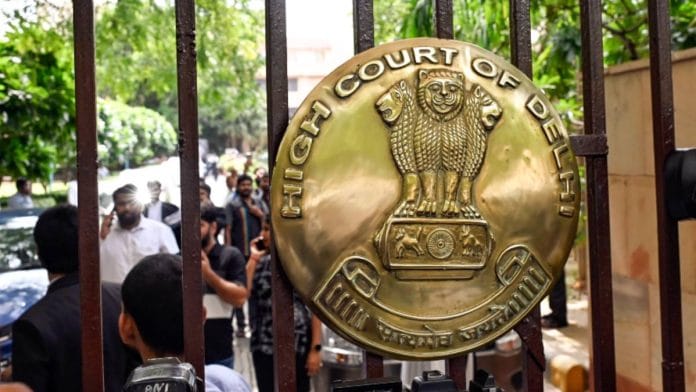



New Delhi: Quoting the renowned 18th century Urdu poet Mir Hasan, the Delhi High Court on Friday set free a man who was posted with the prestigious President’s Bodyguard and was convicted in 2003 for raping a young girl and committing robbery.
Releasing the convict on remission owing to his “good conduct and hard work” in prison where he spent 25 years, a bench of Justice Neena Bansal Krishna noted, “The passage of time is relentless and moments once lost, do not return.”
The court pointed out that the prisoner’s record reflected a “consistent history of being an asset to the prison administration”.
“The factors such as commendations, vocational growth, and clean parole records are the structured indicators of reformation,” the court held in its 59-page ruling.
In its 30 January decision, which came on the convict’s plea that challenged the Delhi government’s sentence review board’s February 2024 decision to reject his remission application, the court also pointed out that prolonged incarceration, without a meaningful reassessment of reform, turns punishment into retribution.
The convict Harpreet Singh’s remission plea had been consistently rejected 11 times, since 2016.
Saying that the primary objective of punishment is to reform the prisoner and prevent similar incidents in future, the court pointed out that Singh had spent 25 years in incarceration, during which he earned many certificates recognising his excellent service in jail.
“Continued incarceration after 25 years of documented reform serves no preventive purpose; instead turns the punishment into a purely retributive exercise,” the court said, adding that the Supreme Court has termed such a phenomenon “savage justice” and likened it to crushing the life force of an individual without further benefit to society.
The bench noted that in Singh’s case, where his report card spanned more than two decades of institutional discipline, vocational growth, spiritual practices and successful community re-entry tests, his active contribution to the prison’s ecosystem should have been a primary indicator of a shift in his behavioural pattern.
Speaking to ThePrint, advocate Sirhaan Seth who represented Harpreet Singh, said, ”In the past there have been dichotomous views taken by courts across the country as to whether the HC should enter the domain of rejecting SRB’s finding and releasing the convict.”
“The present judgment is groundbreaking as it considers various judgments/jurisprudence and carves out an exception to hold that where the court finds that authorities have abdicated their duties and are passing mechanical/cyclostyled orders, the courts are well within there right to intervene,” advocate Sumer Boparai, who also represented Singh, told ThePrint.
Singh’s case
Singh was convicted by the Patiala House Court in 2009 for kidnapping, voluntarily causing hurt during robbery, and for raping a young girl during communal or sectarian violence, under Sections 366, 394 and 376(2)(g) of the IPC. After this, he was sentenced to rigorous imprisonment for life along with a Rs 5,000 fine.
Although Singh had challenged this 2009 order before a single judge bench of the Delhi High Court, his plea was dismissed in 2012.
Singh had approached the court seeking his premature release in accordance with a 2004 policy issued by the then Lt. Governor of Delhi, which decides such cases on the basis of parameters like the conduct of the prisoner during confinement in jail, recommendations by jail authorities, whether any parole or furlough was granted, the convict’s age, the circumstances under which the crime was committed along with the gravity of crime and their prospects of rehabilitation.
Besides this, Singh also sought to set aside the minutes of the sentence review board (SRB) from February, 2024, and a consequent order from October 2024 of the Lieutenant Governor approving these minutes. In February, 2024, the SRB had refused Singh’s request for premature release.
In 1999, the National Human Rights Commission had suggested setting up sentence review boards (SRB) across the country with the objective of ensuring greater uniformity while allowing or disallowing premature release requests. In July 2004, an SRB was set up in Delhi as well to review the sentences awarded to prisoners undergoing life imprisonment on being convicted by a competent court in Delhi, and to make recommendations on premature release cases.
How this case travelled to SC & back
After 11 SRB meetings where Singh’s requests for early release were rejected one after another, he challenged this rejection under the Delhi Prison Rules 2018, saying that these were not in force at the time he was convicted, and asked the Supreme Court to consider his case.
In 2023, the SC dismissed his plea and asked him to approach the Delhi HC again.
In January, 2024, the Delhi HC partially allowed his plea and set aside the SRB order, pointing out that it failed to consider the relevant factors under the 2004 policy, which was brought in to provide a structure and rule-based system for the SRB, so that it moves away from purely discretionary, whimsical executive action and towards a more clinical assessment.
In its January order, the court also pointed out that the SRB had rejected his plea without taking into account the newly-introduced 2018 Prison Rules, and directed the SRB to consider his case in accordance with the 2004 policy. However, in February, 2024, his plea was once again rejected on account of him committing a “heinous crime” that shook the confidence of society.
This is what led him to approach the SC, which finally asked the Delhi government to take a decision. However, in October 2024, after an SRB meeting, the LG decided to remit or suspend a portion of the sentence of 14 convicts, while denying such a relief to Singh, causing him to surrender before the jail authorities in November that year.
After a series of rejected requests he once again knocked on the doors of the Delhi HC which gave him the needed relief.
Good conduct in jail
In February 2013, while Singh was lodged in Tihar Jail, he was placed on the commendation roll by the jail superintendent on account of his outstanding education and devotion to the maintenance work allotted to him.
The court also noted Singh’s “noteworthy diligence in the work assigned to him” while he was a Sahayak and the fact that he was awarded a certificate of recognition for his hard work and good conduct by jail authorities.
He had also been released on parole on two different occasions and on furlough on four different occasions the court noted, adding that he had participated in vocational and spiritual courses held in jail and his conduct was also found to be satisfactory.
In the present case, the court also pointed out that it was evident that the SRB failed to follow the fair process, consider relevant material and arrive at a conclusion that a reasonable body could reach. “The SRB by ignoring its own policy and not applying the necessary multi-factor test, has violated the fundamental manner of decision-making, necessitating judicial correction,” it said.
Setting aside the SRB order, the court noted that various parameters highlighted in the Policy 2004, Delhi Prison Rules, 2018 and the judgments of the Supreme Court, among others, were ignored and overlooked with impunity in this case. “The only factor which has been considered is the gravity of offence and all relevant factors which are in favour of the petitioner, have been conveniently overlooked,” the court ruled while pointing out that the SRB’s process in deciding the present case was “fundamentally flawed”.
An order is truly “reasoned” only when it contains the rationale supporting the conclusion, ensuring transparency and fairness in the decision-making process of quasi-judicial bodies like the SRB, the court said, adding that in this case, the SRB had consistently issued “cyclostyled” and “mechanical” rejections over 11 meetings, failing to address any evidence of the Singh’s reformation.
(Edited by Viny Mishra)
Also read: SC order puts focus on remission. What are govt powers to reduce convicts’ sentences