





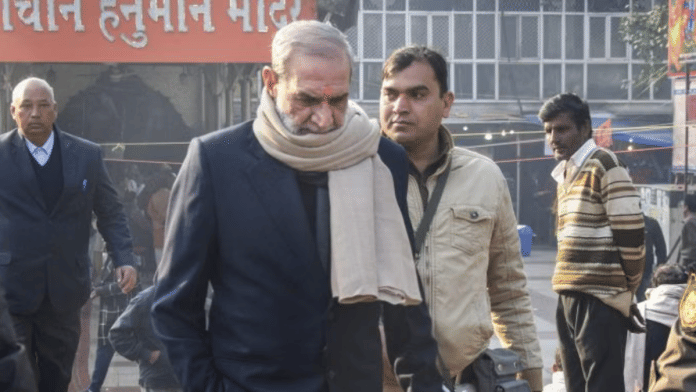



New Delhi: A special Delhi court on Thursday acquitted former Congress MP Sajjan Kumar, now 80, of all charges related to inciting violence in Delhi’s Janakpuri during the 1984 anti-Sikh riots, noting the “suspicion, however strong, can never take the place of proof”.
The judgment, delivered Thursday by Rouse Avenue court Special Judge Dig Vinay Singh, pertains to the events of 1 November 1984 in Janakpuri, where a mob engaged in arson, looting, and murder following the assassination of the prime minister Indira Gandhi.
The anti-Sikh riots erupted across Delhi and parts of north India following the assassination of then prime minister Indira Gandhi by her bodyguards on 31 October 1984.
Over the next few days, organised mobs targeted Sikh homes, businesses and gurudwaras, leading to large-scale killings, arson and displacement. Official estimates put the death toll at nearly 3,000 in Delhi alone, while survivors have long alleged administrative inaction, delayed investigations and impunity for those responsible.
While the Delhi Police painted Kumar as an instigator who acted like a “spark in a dry forest”, the court found that the evidence against him, largely gathered 32 years after the incident, failed to meet the stringent standard of “proof beyond a reasonable doubt”.
Throughout the judgment, Judge Dig Vinay Singh emphasised that the gravity of the crime does not allow the court to bypass the rules of evidence. The court held that while the trauma of the victims was “well understood”, judicial decisions must remain “sans emotions”.
Also Read: Sajjan Kumar, the powerful Jat leader who remained untouched by 1984 riots for 25 years
The arson & tragedy
The FIR, registered in 1992, centered on a violent mob of 200–250 people that descended upon the Janakpuri neighborhood on the morning of 1 November 1984.
According to witness testimonies, the mob arrived via a DTC bus and was allegedly led by individuals in a white car. The rioters targeted the local gurudwara, setting it ablaze and looting its belongings.
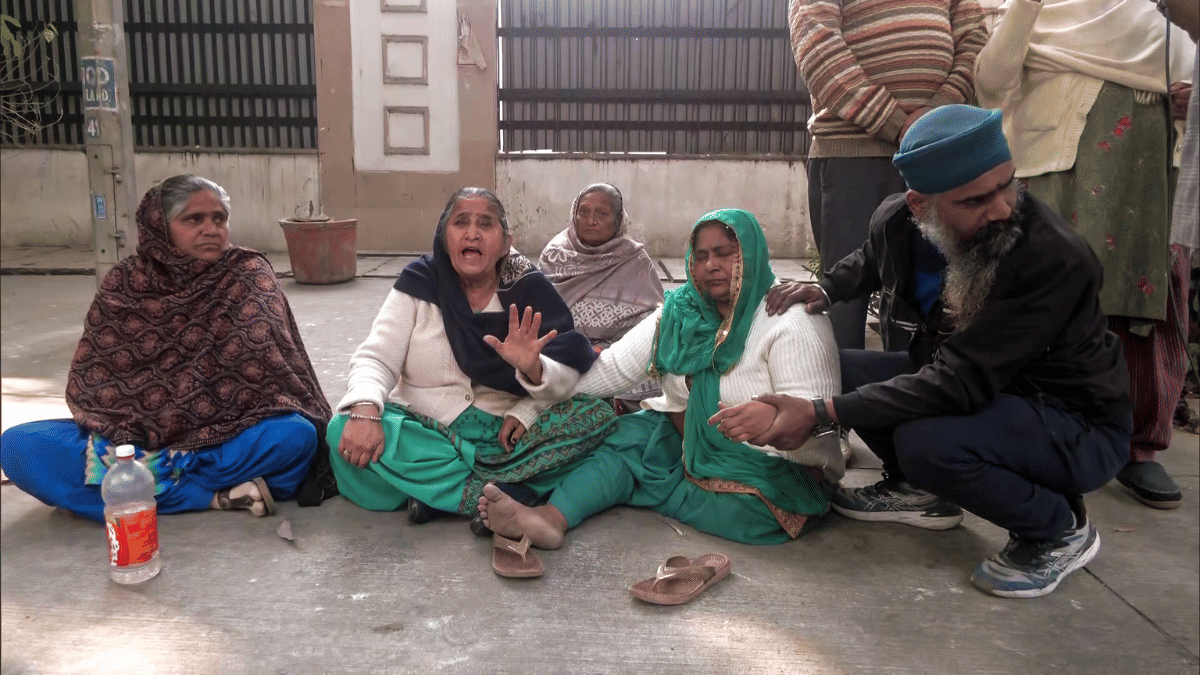
According to the case details one victim, Gurucharan Singh, then a teenager, was reportedly thrown into a burning truck by the mob. Though he was rescued by neighbors, he remained bedridden for decades until his death in 2008. Other residents, including the family of Sardar Nath Singh and Sardar Sohan Singh, suffered severe injuries and the destruction of their homes.
The re-investigation by SIT
For more than 30 years, Sajjan Kumar was not named as an accused in these specific incidents. While multiple commissions, including the Justice Rangnath Misra Commission (1985) and the Jain-Aggarwal Committee (1990), investigated the riots, Kumar’s name did not appear in the initial affidavits or statements.
The turning point came in 2015 when the BJP-led NDA government set up a Special Investigation Team (SIT) to re-examine closed riot cases.
In 2016, the SIT located a key witness, Harvinder Singh, in Punjab. In a fresh statement, Harvinder Singh explicitly identified Sajjan Kumar as the leader who allegedly pointed toward the gurudwara, instigating the mob to attack.
Based on this and other similar “re-discovered” testimonies, the SIT filed a chargesheet against Kumar in 2022.
The acquittal
The court’s decision to acquit Kumar rested on several critical legal pillars: the extraordinary delay in naming him, the “hearsay” nature of witness accounts, and major omissions in historical records.
The court noted that in Harvinder Singh’s original 1985 affidavit and his 1991 statement, Kumar’s involvement was never mentioned.
The court said four of the witnesses named Kumar “for the first time in 2016, i.e., after a delay of 32 years”.
“When a witness names an accused after almost four decades, even though the accused is clearly known to the witness, such an identification ought to be rejected and cannot be relied upon”, read the 60-page detailed judgement.
A man may be convicted of 100 crimes, but to be held guilty of the 101st crime, proof beyond a reasonable doubt (for) that crime is required—Rouse Avenue court.
Many witnesses who testified against Kumar admitted they did not actually see him at the crime scene, according to the order.
For instance, witness Manjeet Kaur stated she “heard his name from others in the crowd” but did not personally witness his presence. The court ruled such accounts “inadmissible”, stating that her testimony regarding the accused “is barred by hearsay principles”.
The police attempted to use the legal doctrine of res gestae (Latin for ‘things done’)—where spontaneous statements made during an event are considered relevant—but the court found that the witnesses could not prove their statements were made concurrently with the violence.
“If there is a delay between the fact and the statement, it cannot be regarded as part of the ‘res gestae‘ doctrine,” the judgment clarified.
Also, witnesses claimed they remained silent for 32 years due to Kumar’s influence as a powerful Congress MP. The court found this explanation “unconvincing” for such a long duration.
The judge pointed out that Kumar had been arrested and was in custody for other cases during this period, which should have “allayed any fear” the victims might have had.
‘Suspicion is not proof’
The judgment stated, “Suspicion, however strong, can never take the place of proof……merely because the accused is an Ex-Member of Parliament… this Court cannot lower the standard of proof required in this case to hold him guilty”.
The defense also highlighted that Kumar had consented to a polygraph test, the results of which did not support the police’s narrative of his involvement. While the SIT chose not to rely on this test, the court noted that the police “cannot go beyond” their own admitted reports.
The court, therefore, concluded that there was “no reliable evidence” that Kumar was present at the Janakpuri crime scene on 1 November 1984.
Kumar is presently in jail in other riot-related cases. “A man may be convicted of 100 crimes, but to be held guilty of the 101st crime, proof beyond a reasonable doubt (for) that crime is required,” the Rouse Avenue court noted.
It concluded, “Sum and substance is that the prosecution (police) has not met its burden of proof against the accused beyond a reasonable doubt, which is essential for conviction in a criminal trial.
“Resultantly, because of a lack of credible evidence as to the presence of the accused in the crime in question or a part of the unlawful assembly or his involvement in any manner, either through instigation, conspiracy, or abetment of any other nature, he is acquitted of the charges.”
As the court announced the acquittal, it summarised the Delhi Police’s failure to complete the “criminological chain” of “why, where, when, how, and who”—thereby leaving the families—who have waited 41 years for closure in the Janakpuri case—without any name convicted.
(Edited by Ajeet Tiwari)