





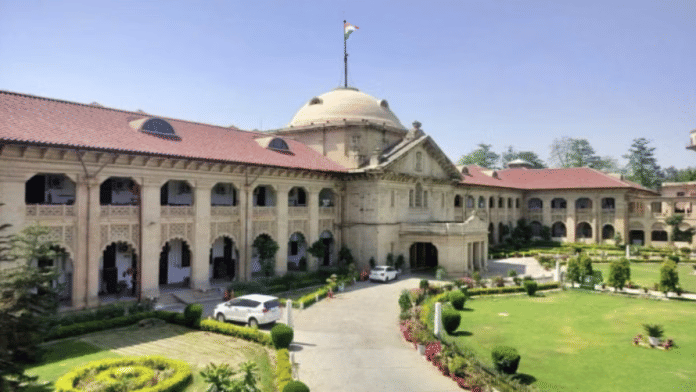



New Delhi: The Supreme Court collegium has invoked Article 224A to re-appoint five retired judges of the Allahabad High Court as ad-hoc judges for a period of two years.
On Tuesday, the Chief Justice of India (CJI) Surya Kant-led appointment panel cleared the names of Justices Mohd. Faiz Alam Khan, Mohd. Aslam, Syed Aftab Husain Rizvi, Renu Agarwal and Jyotsna Sharma as ad-hoc judges. The other members of the panel are Justices Vikram Nath and J.K.Maheshwari.
With five ad-hoc judges, the Allahabad HC will now have 115 judges. Even though this figure is far less than the sanctioned strength of 160, the addition of judges is expected to reduce the backlog in the HC’s criminal jurisdiction.
Appointment of ad-hoc judges is extremely rare, even though the Constitution provides for it. Article 224A enables the Chief Justice of a High Court, with the President’s prior consent, to appoint retired judges as ad hoc judges to handle situations like high backlogs and/or high vacancy rates.
The top court has facilitated such appointments only thrice in the past. It includes appointment of Justice Suraj Bhan to Madhya Pradesh HC in 1972, Justice P. Venugopal to Madras HC in 1982, and Justice O.P.Srivastava to Allahabad HC in 2007. Through a judgement in 2021, the top court had revived what it called a “dormant” provision of the Constitution to address massive pendency.
Sources in the Supreme Court told ThePrint that CJI Kant took upon himself to initiate the process, after he came across media reports on high courts not complying with top court’s judgements on ad-hoc appointments.
A letter was sent to all the HC Chief Justices, asking them to nominate ad-hoc judges for appointment. So far, the collegium received recommendations from three HCs. While Allahabad’s proposal has been approved, the collegium is likely to meet Wednesday to clear the remaining two. Sources said that more HCs are in the process of sending their suggestions.
Incidentally, CJI Kant’s bench had in December last year clarified the 2021 SC decision and granted HC Chief Justices greater flexibility to constitute division benches involving ad hoc judges.
This judgement held that the High Court CJ can set-up benches of two ad-hoc judges, or a bench with one sitting judge and one ad hoc judge, and also decide who will preside over such a composition.
Previously, in January 2025, a three-judges bench had already eased conditions for appointing ad-hoc judges, allowing them to be appointed even if vacancies were below 20 percent.
CJI Surya Kant initiated the process even as the 2021 decision of the top court clarified that Article 224A can be used only after steps have been taken to fill regular judicial vacancies.
“These ad-hoc judges have been chosen specifically to tackle criminal cases that are pending in the Allahabad HC for years now. Their services would be used to dispose of these appeals and bail matters or cases of personal liberty,” a source told ThePrint.
Incidentally, the mechanism to appoint ad-hoc judges is not as tedious and complex as fresh appointments.
Since these judges have already served on the bench, the HC collegium does not undertake the exercise to get their background check done, as is followed in case of a fresh appointment.
“Here, the judgements delivered by these judges are assessed by the HC collegium and accordingly a report is prepared to be sent to the Supreme Court collegium,” the source explained.
“The file is routed to the collegium through the central government, but in ad-hoc appointments, the latter’s role is limited only to forwarding the recommendations with its opinion and unlike in fresh appointments, no intelligence inputs are required for them, unless there is a glaring omission. This expedites the appointment process.”
On its part, the SC collegium skips the interview round for such judges. “Since they have been judges, it was felt that it would not be proper for the collegium to call them for an interview,” the source added.
For now, the SC and HC collegiums are selecting ad-hoc judges from amongst those who have retired less than a year ago. “First, age is on their side and second they are familiar with the new systems introduced pursuant to Covid.”
(Edited by Tony Rai)
Also Read: Wangchuk’s reference to Ladakhis as ‘us’ & govt as ‘them’ enough to invoke NSA, Centre tells SC