





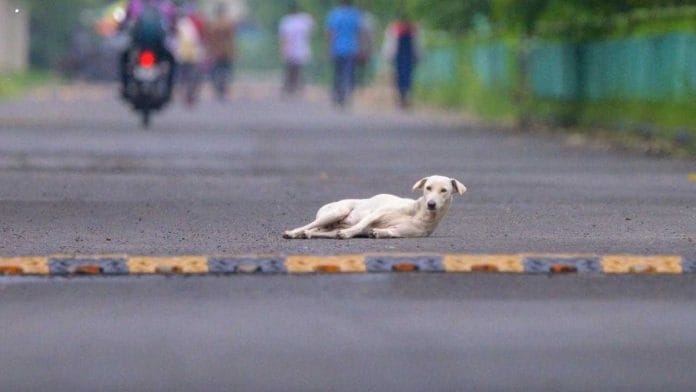



New Delhi: The Supreme Court Thursday directed lawyers arguing in the stray dog management case to read a newspaper report on feral dogs in Ladakh before the next hearing, as the three-judge bench continued its deliberations on the suo motu case.
Justice Sandeep Mehta, concluding the second consecutive day of hearings that lasted over two-and-a-half hours, specifically asked counsels to “have a look” at the 29 December article by The Times of India before returning to court Friday.
“Come back prepared on that,” Justice Mehta said.
The article, which followed a similar piece done by The New York Times just days earlier, documents how populations of feral dogs have increased in Ladakh and are hunting rare wildlife in the high-altitude region.
Both the pieces cite experts to say that inadequate sterilisation drives have allowed dog populations to flourish, with many packs sustaining on human settlements and waste.
The bench of justices Mehta, Vikram Nath and N.V. Anjaria posted the matter for hearing to Friday morning.
Also Read: ABC rules not implemented properly. Don’t blame the dog, blame the government
Compliance update
Continuing to track compliance, amicus curiae Gaurav Agarwal informed the top court Thursday that four of the remaining non-compliant states had filed their affidavits till late Wednesday night. “So, between yesterday’s note and today’s note, sixteen states are done, seven are left,” he said, seeking one more day to complete the consolidated compliance chart.
The update came as the court was told Wednesday that several states—including Madhya Pradesh, Uttar Pradesh, Tamil Nadu, Karnataka and Punjab—had not yet filed compliance affidavits detailing their implementation of earlier directions.
Agarwal said national-level authorities had prepared detailed standard operating procedures (SOPs) to operationalise prior orders, particularly for institutional areas and highways where human-animal conflict had, in some cases, proved fatal.
‘Enforcement lags’
Eight senior advocates, namely C.U. Singh, Dhruv Mehta, Gopal Sankarnarayanan, Vinay Navare, Nakul Dewan, Shyam Divan, Siddharth Luthra and Karuna Nandy appeared for various stakeholders, including educational institutions, resident welfare associations (RWAs), animal welfare organisations such as PETA, and individual petitioners.
The consistent refrain across submissions was that while the legal framework governing stray dog management exists through the Animal Birth Control (ABC) Rules, enforcement remains deeply deficient, with municipal authorities routinely defaulting on their statutory duties.
Several lawyers urged the court to hold civic bodies accountable for non-compliance and suggested constituting an expert committee to monitor progress across states and UTs.
Advocate Nakul Dewan urged the court Thursday to endorse the trap, neuter and release (TNR) model. “It’s important, bearing in mind the nature of dogs, that they be put back in the same place where they were,” he submitted. Dewan also informed the court that micro-chipping of dogs had already begun in Bengaluru. “It’s not expensive,” he added, suggesting technology could aid better monitoring and accountability.
Thursday’s hearing also saw the bench make oral observations about canine behaviour, with Justice Mehta noting that dogs are capable of sensing fear and were more likely to attack when they detect it. When some dog lovers in the courtroom nodded in agreement, the judges intervened to ask them not to react.
“The dog can always smell a human who is afraid of dogs. It will always attack when it senses that. We are talking from personal experience,” said Justice Mehta.
In a lighter moment, the bench remarked that dogs and cats are “natural enemies” and observed that encouraging cat populations could help keep rodent populations in check.
A long-standing issue
The proceedings are part of a longer trajectory of judicial intervention on stray dog management. In August 2025, a different Supreme Court bench issued sweeping directions for Delhi-National Capital Region, ordering that all stray dogs be removed and warning that any organisation obstructing the exercise would face “the strictest action”.
Emphasising zero tolerance, that bench had said “all localities should be made free of stray dogs” and that “there should not be any compromise in undertaking any exercise”.
Those directions were subsequently revisited by the present three-judge bench, which modified the earlier emphasis on permanent shelter for stray dogs and instead mandated vaccination, sterilisation and release of dogs in accordance with the statutory regime.
On 7 November 2025, the Supreme Court passed further orders that stray dogs should be removed from public spaces such as schools, hospitals, sports complexes, bus stands and railway stations. The bench of Justices Nath, Mehta and Anjaria clarified that dogs picked up from such locations were not to be released back to the same premises even after sterilisation and vaccination, but relocated to designated shelters.
Animal rights activists and welfare organizations also challenged this directive, labeling mass relocation of community dogs as “unscientific, impractical and inhumane”, along with a short-term measure.
On Wednesday, the bench heard a wide range of stakeholders—from parents of children bitten by stray dogs, to senior advocates and subject-matter experts—making it clear that no procedural shortcuts would be entertained in what they described as “complex public safety and animal welfare issues”.
(Edited by Prerna Madan)
Also Read: 91% of Indians report feeling safer because of street dogs, says new survey