





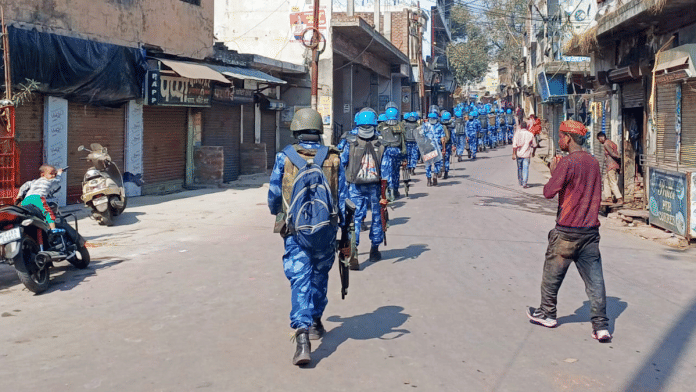



New Delhi: The Allahabad High Court Tuesday put an interim stay on the then Sambhal chief judicial magistrate’s 9 January direction for an FIR against ex-circle officer and now-Additional Superintendent of Police Anuj Chaudhary, among other UP Police personnel, in connection with the November 2024 Sambhal violence.
The Sambhal violence erupted on 24 November 2024 during a civil court-ordered, Archaeological Survey of India (ASI)-monitored survey of the Shahi Jama Masjid.
A single-judge HC bench of Justice Samit Gopal stayed the ‘operationalisation’ of the judge’s direction while hearing a petition by Anuj Chaudhary, filed jointly with former Sambhal Kotwali in-charge Anuj Tomar. Their petition challenged Vibhanshu Sudheer’s direction for an FIR against the police based on a complaint by Yameen, whose son was shot at on the day of the violence.
The Allahabad HC also gave Yameen, the father who had accused the then-CO Anuj Chaudhary and other police personnel of firing at his son near the Shahi Jama Masjid, 14 days to file his counter to the policemen’s plea before the bench.
Until Yameen’s response, the stay order will remain in effect.
The case & the arguments
A Muslim youth and stall owner was allegedly shot at by ASP Anuj Chaudhary, who was with the ASI survey team that visited the Shahi Jama Masjid on 24 November 2024. The civil court had ordered the survey of the mosque, following allegations that it was built on a Hindu temple site.
Before the court, senior advocate S.F.A. Naqvi, appearing for Yameen, the complainant and the youth’s father, argued against the ASI’s plea’s maintainability, saying that the UP government was improperly “jumping to protect its own officers”, who are working under the principal secretary (home).
The lawyer cited the parens patriae jurisdiction, a doctrine under which the state or any other authority—seen as the legal protector of citizens—can’t protect itself.
The doctrine has earlier been invoked in cases of orphans and persons with disabilities.
“The state is trying to protect its own officers, and this cannot be allowed,” the lawyer argued, pointing out that such an action could derail the very cause of justice.
On the other hand, Additional Advocate General (AAG) of Uttar Pradesh, Manish Goyal, appearing for the state, challenged the judge’s FIR order by emphasising the mandatory safeguards under Section 175(4) of the Bharatiya Nagarik Suraksha Sanhita (BNSS).
Under BNSS Section 175(4), magistrates can order an investigation upon receiving a complaint against a public servant who acted in the course of official duties. The AAG argued that it, however, includes safeguards for public servants from frivolous proceedings.
“Arguments are continuing. The UP government challenged the magistrate’s order on the ground that the procedure prescribed under the Bharatiya Nagrik Suraksha Sanhita has been ignored completely,” Goyal, who represented the UP government, told ThePrint.
Emphasising that the facts of the case were not looked into properly, the AAG claimed a “one-sided approach” and stressed that the police had to be examined under the BNSS, which had so far not been done.
On Monday, he argued in court that the judicial magistrate ignored the police report, which had stated that the matter was under investigation, emphasising that he had gone beyond the scope of the BNSS. He also said that Yameen went straight to the judge, who acted on his complaint, without looking at whether he had even approached a police station.
The judge, who directed the FIR against the police officers, has since been transferred thrice in less than a year. His last transfer came in January, when he was shifted to Sultanpur.
(Edited by Madhurita Goswami)