





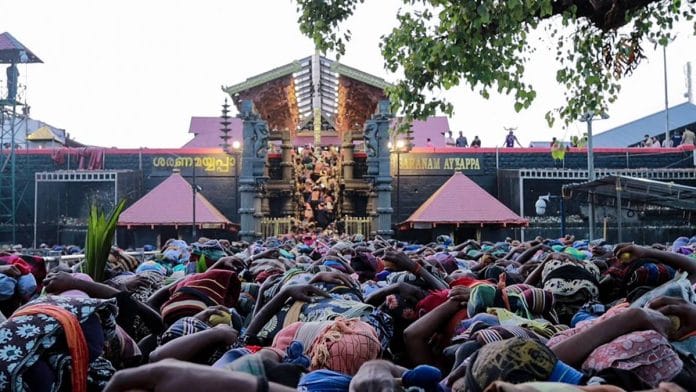



New Delhi: Showing a strong preference for an “Indian interpretation” of the Constitution, the Centre Thursday urged the Supreme Court to study its original Hindi text—written alongside the English one—instead of relying on Western jurisprudence for interpreting Articles 25 and 26, which deal with religious rights and practices.
The interplay between Article 25—individual’s right to practise a religion—and Article 26—autonomy of religious subgroups—is central to the Sabarimala references, which a nine-judge Supreme Court bench led by CJI Surya Kant is hearing. One of the references concerns what effects the two Articles have on each other, and whether they can be construed harmoniously to strike a delicate balance, which the Centre has supported.
While laying stress on the Constitution’s Hindi text, the Centre rejected the Supreme Court’s earlier interpretations of religious “denomination” and also “morality”. It argued that “constitutional morality” was “rooted in the norms or what ought to be”, rather than practices upheld historically and socially.
Besides the Centre, the Nair Service Society, which opposes women entering Sabarimala, also made its submissions before the court Thursday, arguing that the Constitution allowed denominational autonomy that overrode individual rights to profess religion.
To this, the bench remarked that such an approach “is not good for Hinduism”.
Article 25 protects an individual’s faith, belief, and conscience, provided it is subject to public order, morality and health. Section 25(2)(b), however, permits the State to regulate this right for social welfare and reform, or to open Hindu religious institutions of a public character to all classes and sections of Hindus. Additionally, Article 26 protects the right of a religious denomination or subgroup to manage its religious affairs, including its institutions. However, this is also subject to public order, morality, and health.
Also Read: Reconciling religion and science is the only way to find peace and happiness: Zakir Husain
What the Hindi text says about religion
Continuing from where Solicitor General Tushar Mehta concluded Wednesday, two law officers representing the Modi government—K.M. Nataraj and Vikramjit Banerjee—took the judges through the Hindi translation of Articles 25 and 26 to clarify the Centre’s issues with the previous Supreme Court judgments.
In their view, the SC judgments were born from a restrictive Western definition of the term “denomination” found in Article 26 and the misconstrued interpretation of “morality” mentioned in Articles 25 and 26.
Reference was made to the Union Education Ministry-published Brihat Hindi Kosh (dictionary) to assert the adoption of Hindi meanings for the two terms.
In its submissions, the Centre pressed the court to accept the Hindi text of the Constitution as equally authoritative as the English one—the text uses “sampradaya” for “religious denomination” and “sadachara” for “morality”.
The law officers argued that “Sampradaya” has a broader scope and carries a distinct, richer meaning in the Indian Hindu context—one that was not fully captured by the English word “denomination”, as understood in the Western ecclesiastical law.
They said the definition of “religious denomination”—adopted in earlier Supreme Court judgments—as “a collection of individuals classed together under the same name, a religious sect or body having a common faith and organisation and designated by a distinctive name” directly contradicted the wider Indian concept of “sampradaya”, which encompasses various groups adhering to different branches of the same philosophy or doctrine.
“Sampradaya”, according to them, did not denote a formal organisation, as understood in the Western ecclesiastical sense, and so the Hindi meaning of “denomination” must guide the interpretation of Article 26.
Similarly, they asserted that the indigenous understanding of public morality in both Articles 25 and 26 was “sadachara” or “approved conduct” or “good practice”. That it was not an abstract or subjective feeling of right or wrong, but a “tangible adherence to practices that have been historically validated and socially accepted”.
They asked the court ro reject “constitutional morality”, arguing it was “rooted in the norms or what ought to be”. The Centre has been critical of the previous SC rulings for introducing the abstract doctrine of “constitutional morality” to strike down the Sabarimala entry ban on menstruating women.
The Centre argued the Hindi text of the Constitution carried equal interpretive weight, “especially in a desi lens that prioritises the Constitution’s organic connection to Indian civilizational ethos”.
It emphasised that the SC should not interpret the Constitution’s words on religion through a narrow Western jurisprudence but view it in the indigenous sense as an “all-encompassing concept of dharma” followed for “righteous living, duty, and spiritual realisation”.
Nair Service Society arguments
Later in the day, Senior Advocate C.S. Vaidyanathan presented the Nair Service Society’s viewpoints. The group is one of the review petitioners that questioned the Sabarimala judgment, which struck down the temple entry ban on menstruating women.
Vaidyanathan argued that the right of a religious denomination under Article 26 would prevail over an individual’s right under Article 25. Furthermore, the enabling power under Article 25(2)(b), which empowers the State to regulate an individual’s freedom to practice, profess, and propagate religion, belief, faith and conscience for social reform would not apply to Article 26. Essentially, the senior counsel meant that the State cannot intervene in the functioning of a religious denomination or section. He argued Article 26(b) was a fundamental right in itself.
At this juncture, just before the court was about to rise, the bench responded to Vaidyanathan’s remark. “One apprehension, keep aside the controversy of Sabarimala. If you say the right of entry (can be prohibited in any temple), it will affect—negatively—Hinduism. Everybody must have access, keep aside the Sabarimala controversy, to every temple and mutt. If you say it is a matter of religion that only my section must attend my temple and no one else, that is not good for Hinduism,” the bench remarked.
“We will be dividing the society,” it cautioned the senior counsel, observing again, “Let the religion not be adversely affected.”
When Vaidyanathan referred to temples run by private family trusts, the bench told him they were not concerned about such institutions. He added that, except on grounds of public order, morality and health, there could be no regulation on a religious denomination.
At this, the court once again told him that the State can step in to ensure access to the temple to all sections, not just under Article 25(2)(b), but also under Article 26. This is because restricting a particular denomination from entering a temple would be contrary to the concept of morality under it.
(Edited by Madhurita Goswami)
Also Read: Bhairav the ‘divine dog’ returns to Bijnor after rescue—devotion nearly killed him