





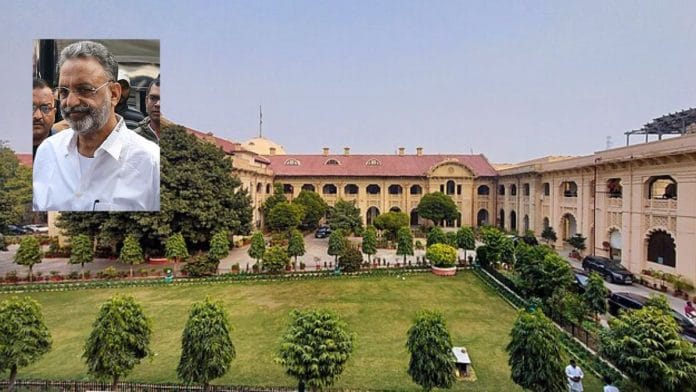



New Delhi: Underlining that a mere relationship with a gangster is no ground to attach someone’s immovable property, the Allahabad High Court last week set aside a Ghazipur court order from 2 September last year which had allowed the attachment of Mansoor Ansari’s property. Mansoor was the cousin of gangster Mukhtar Ansari—a convicted murderer and former MLA, who passed away in 2024.
It was alleged Mansoor had constructed shops at his property from the proceeds acquired by committing offences under Uttar Pradesh’s Gangsters Act.
Section 14 of Uttar Pradesh Gangsters and Anti-Social Activities (Prevention) Act allows the District Magistrate to order attachment of a gangster’s property if he “has reason to believe” that it was acquired by committing an offence under the Act.
The phrase “reason to believe”, the high court clarified, is not the same as ”suspicion” or ”doubt”. Mere “seeing” also cannot be equated to “believing”, according to the 12 March order. The word “belief” has stronger connotation than “suspicion” and, therefore, any action under the law should have direct correlation to the law’s objective, which is to curb anti-social activities, the court said.
Justice Raj Beer Singh was dealing with a challenge to the Ghazipur court order that had rejected Mansoor’s plea against the attachment of his property. He had approached the court under Section 16 of the UP Gangsters Act, which allows one to do so if the DM does not release the property upon a representation by the person whose property has been attached.
Saying that the Ghazipur court ruling was based on “surmises and conjectures”, the Single Judge Bench noted that the attachment order by the DM was not based on proper satisfaction, and was wholly arbitrary. The judge further said that the Special Judge (Gangster Act) had also miserably failed to consider the evidence produced by Mansoor, without assigning any proper reasoning.
The expression “reason to believe” used in Section 14 has some intent and purpose, the high court said, adding that the usage of such words restricts the arbitrary exercise of power when attaching a person’s property.
“Law requires that there must be reason to believe that the property sought to be attached, has been acquired by a “gangster” as a result of commission of any offence under the Act,” the court noted. The term “reason to believe” contemplates an objective determination based on intelligent care, deliberation and involving judicial review, as distinguished from purely subjective considerations, it said.
Further highlighting that there must be a rational nexus between reason and belief, the high court order added that the term “belief” had a much stronger connotation than the word “suspect”, which warranted a need to prove the allegations.
Mansoor’s lawyer argued before the court that last year’s order by Ghazipur court and the attachment order by the DM were arbitrary, and violated the law since there was no case registered against him under the provisions of the Gangster Act, nor did he carry out any offence under it. He also said that the UP government had utterly failed to discharge its burden, and that Mansoor had never been associated with any gang.
On the other hand, the UP government argued that there was no “illegality or perversity” in the September order, or DM’s attachment order. It added that Mansoor was convicted under the 1986 Act, and sentenced to imprisonment for 10 years. As for the attached property, the UP government said that Ansari’s immoveable property was actually “benami”—assets paid for by one person and utilised by another.
Why was the property attached
In February 2023, attachment proceedings were initiated against Mansoor on the basis of a police report, which made “bald allegations” that he had constructed shops at his property from the proceeds acquired from committing offences under UP’s Gangsters Act.
Mansoor argued that the property belonged to his parents. The UP government did not refute this fact, the high court noted, adding that it was valued at about Rs 26 lakh, according to the Public Works Department report.
The Gangsters Act defines a “gang” as a group of persons, acting either singly or collectively, “by violence, or threat or show of violence, or intimidation, or coercion or otherwise with the object of disturbing public order or of gaining any undue temporal, pecuniary, material or other advantage for himself or any other person”.
It adds that members of a gang indulge in anti-social activities, such as distilling, manufacturing, storing or transporting any liquor, or intoxicating or dangerous drugs, or other intoxicants or narcotics. It further specifies that those who illegally occupy any immovable property or disrupt public servants from carrying out their duties are also seen as gangsters. However, this list of anti-social activities under the 1986 Act is vast, and covers everything from inciting communal disharmony to “creating panic” in public.
Why HC set attachment order aside
After analysing the provisions of the Act, the high court noted that Section 14 “clearly provides” that the DM’s order attaching one’s property must be based on “reason”, and not be “arbitrary”.
Outlining that the initial burden is always on the government to satisfy the DM with necessary materials that the alleged gangster acquired the property after committing offences under the Act, the court said that in such cases, the appellant will not be required to disclose his sources of income which led him to acquire it.
The report prepared by the police had said that gangster Mukhtar Ansari had formed a gang with his cousin Mansoor. The police had also said that the building constructed on the property was a result of the anti-social activities Ansari was indulging in.
However, the court found that no case was registered against Mansoor under the Act. “There is absolutely no material to show that appellant (Mansoor) has been associated with the gang of Mukhtar Ansari”, or anyone else, the court noted.
“It appears that there is absolutely nothing to show any nexus between commission of any offence and the construction of the building/shops in question. It appears that the building/shops in question was attached by the District Magistrate merely because appellant is cousin of said Mukhtar Ansari,” the 12 March order read.
(Edited by Mannat Chugh)
Also Read: ED can attach properties bought with ‘proceeds of crime’ before PMLA came into force, says Delhi HC