





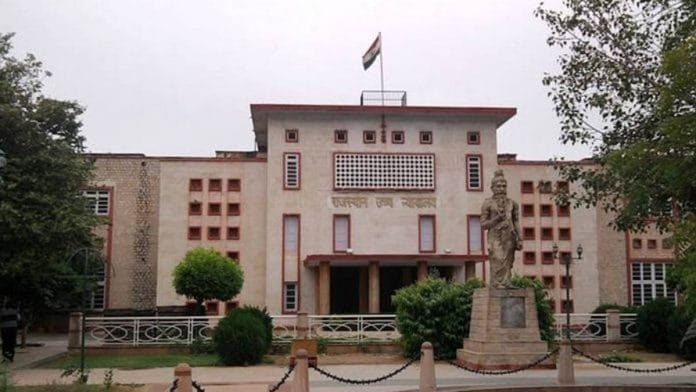



New Delhi: The Rajasthan High Court, while hearing a cyber fraud case, ordered ride-hailing platforms such as Ola and Uber to hire at least 15 percent women drivers, as part of sweeping directions Thursday that included stricter SIM card and KYC rules.
Justice Ravi Chirania’s 27 November order surprised lawyers, who called it “extremely wide” in its scope as it was delivered in a bail hearing in a “digital arrest” case involving an elderly couple duped of over Rs 2 crore.
They said the court’s directions to state authorities to ensure that companies like Ola and Uber are “encouraged” to hire at least 15 percent female drivers within six months for the safety of female passengers went beyond addressing remedies for cyberfraud.
They acknowledged that “digital arrest” had become a more widespread phenomenon, but said the order went beyond the case, extending to employment of gig workers, KYC by banks and even monitoring mobile usage of school children.
The order—which extends to app-based service providers plying cab, bike or scooter taxis—estimates a 25 percent increase in the number of female drivers in the next two to three years.
“The companies shall ensure that on starting this service, female passengers must have the preference, in the software, to opt for female drivers first,” Chirania ruled in the 34-page order.
Lawyer Apar Gupta, co-founder and founder director of the Internet Freedom Foundation (IFF), termed the Rajasthan HC order “befuddling”, especially the directions on female cab drivers. “The entire order does not make sense, in view of the facts before the court. None of the facts in this case relate to the safety of female passengers.”
“Sometimes state-specific legislations require screening practices to ensure the safety of passengers, but this direction in this context is not appropriate. The case was one concerning digital arrest—a form of fraud done on the basis of personal details of the victim, making them feel compelled to give up money. While all other directions somewhat relate to the order’s subject matter, like the one limiting the purchase of SIM cards, or digital usage of children, the one concerning female Uber drivers is befuddling and totally unrelated,” he added.
However, advocate Shrey Sharawat said that courts can step in if there’s a policy vacuum on a subject. “When there is a vacuum of policy on a state subject, courts can certainly step in and direct the formulation of guidelines. This is even more so for constitutional courts like the high courts or the Supreme Court.”
The case before the court
The court’s latest directions stemmed from a case in which people accused of impersonating police officers and placing an elderly couple under “digital arrest” were arrested and were seeking bail.
The couple was threatened that some people had committed cyberfraud of Rs 538 crore using 230 bank accounts, including their accounts, the court noted. It added that no provision in law dealt with this offence.
Denying the accused bail, the court went on to take note of the patterns in cyber crime cases, due to improper investigation, lack of knowledge and understanding of the investigating machinery of the state about cyber crime, the plight of its victims and other connected technical issues.
Also Read: Same same but different—the FIR clubbing riddle & how SC has dealt with it over the years
What HC said
The court directed the Rajasthan government, police and cyber crime authorities to appoint police officials with IT qualifications to detect, monitor, prevent and investigate cyber crimes in the state.
Flagging cybercrime as a “vast” problem, the court said the existing machinery in Rajasthan was not equipped to handle the serious challenges posed by artificial intelligence and deepfakes.
Under the IT Act, 2000, cybercrime investigation can be conducted by officers of the rank of inspector or above, the court said.
The court observed that the police force traditionally recruited people from arts, commerce and science backgrounds with little knowledge and hardly any understanding of the fast-changing digital world, making it tough for them to deal with digital challenges, even with help from part-time or contractual technical experts.
The court pointed out that Punjab had, in the past, issued a special recruitment advertisement for the appointment of inspectors with IT qualifications and experience and suggested that Rajasthan also amend or frame new recruitment rules to hire people with IT qualifications.
“As the present Investigating Officers (Inspectors as per Section 78) are not technically qualified, proper investigation is not being conducted by them and consequently the fate of the trial can be well imagined,” the court said.
“In order to have the IT experts in the office of the DG Cyber for the investigation of cyber crimes, the ACS, Home, in consultation with the Department of Personnel, by making necessary amendments in the existing service rules or by framing new recruitment rules, can have persons having IT qualifications with experience of respective domain for the post of Inspector,” the court added.
In addition, the court also directed the additional chief secretary, home, to regulate the sale and purchase of new and second-hand devices, and ordered that the authorities, shopkeepers and service providers ensure that no individual in Rajasthan is issued more than three SIM cards.
Legal fraternity on ‘digital arrests’
Senior advocate Vikas Pahwa told ThePrint that digital arrest had emerged as one of the most dangerous forms of cyber-enabled extortion in India, where hundreds of people, particularly senior citizens, were becoming victims of this “well-perpetuated fraud”.
“What makes this fraud uniquely sinister is that the offence doesn’t involve any physical detention, yet the victim is psychologically trapped, threatened with fabricated allegations and coerced into transferring large sums of money from their life savings,” he said.
Pahwa noted that the Rajasthan High Court had correctly highlighted the challenges posed by the explosion of mule accounts, layered transactions and the rapid movement of funds, which made investigations extremely complex.
“Today’s cybercriminal is not a petty fraudster; he is part of an organised digital ecosystem complete with fake call centres, spoofed identities, disposable SIM cards, and mule accounts through which money is laundered in seconds,” Pahwa told ThePrint.
He added that the solution lies in appointing cyber-crime investigators with specialised forensic capabilities, stricter KYC norms and AI-driven monitoring systems for banks.
Advocate Shrey Sharawat, currently Member Executive of the Delhi High Court Bar Association, told ThePrint that investigators often lack the training for cybercrimes, prompting them to club together existing criminal offences like cheating, extortion and impersonation of a police officer to punish the offenders.
“People who investigate such crimes often lack proper training. Thus, recruiting those well-versed in IT is logically sound. Better-placed investigative agencies are needed,” Sharawat said.
Delhi-based lawyer Karnika Vallabh also said the issue of digital arrest was central to the case, but the order’s scope was extremely wide as it touched on everything from women’s safety to regulating the purchase of SIM cards.
“Educating the masses on digital scams is of utmost importance here. Children, over the age of let’s say 15, who are independent thinkers, are more educated on the digital space than their older counterparts. Those who hold enough money to transfer it under duress must especially be educated. The law has enough provisions that take care of this offence, but it is now important to raise awareness and implement existing statutes,” she said.
Vallabh also pointed out that some of the directions in the order, such as requiring an officer to physically show up at homes and shops when suspicious activity is detected, were difficult to implement.
Advocate Sriram, who practices at the Supreme Court, also told ThePrint, “The direction is totally unrelated. I don’t know why the court is feeling that this is some new, amazing offence or opportunity to introspect and judicially legislate. It is just IPC provisions with the word digital added to it.”
“It’s not necessary for law enforcement agencies to believe that digital arrest and further cheating, extortion, forgery and criminal intimidation and wrongful restraint are all new areas. They are all very much within the broad walls of the IPC and BNS,” he added.
(Edited by Sugita Katyal)
Also Read: SC jumped the gun in ordering CBI probe into Karur stampede without hearing out state—TN affidavit