








New Delhi: Calling the Transgender Persons (Protection of Rights) Amendment Bill, 2026 a “departure” from the constitutional baseline, the Rajasthan High Court Monday became the first court to opine on the latest amendment.
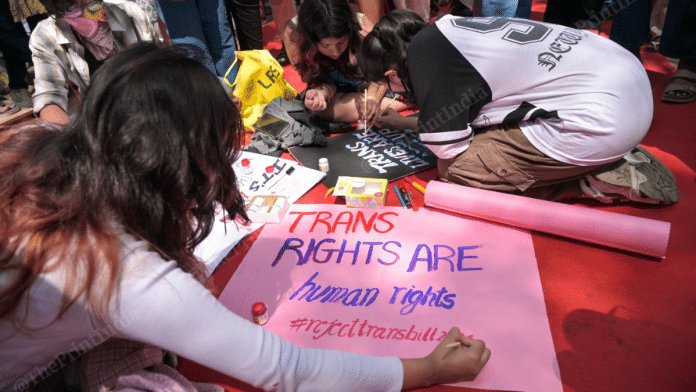
The much disputed Transgender Amendment Bill, 2026 passed by the Lok Sabha and the Rajya Sabha on 24 and 25 March respectively is facing pushback from the community itself.In a case concerning the rights of transgender persons, a division bench of Justices Yogendra Kumar Purohit and Arun Monga gave its verdict relating to their reservations in the Public Service Commissions.
“It is now proposed that legal recognition of gender identity shall be conditioned upon certification, scrutiny, or other forms of administrative endorsement. What was recognised by the Supreme Court as an inviolable aspect of personhood now risks being reduced to a contingent, State-mediated entitlement,” Justice Monga wrote in a post-judgement epilogue.
The judge observed that the 2026 Amendment Bill—awaiting Presidential assent—seeks to omit the right to self-perceived gender identity, proposing that legal recognition of gender identity “shall be conditioned upon certification, scrutiny, or other forms of administrative endorsement”.
“Bottomline being, selfhood is not a matter of concession, it is a matter of right”, he said.
The court warned that what the Supreme Court previously recognised as an “inviolable aspect of personhood” now “risks being reduced to a contingent, State-mediated entitlement”.
It, the epilogue said, serves as a “caveat”, reminding the Rajasthan government that any policy framework must still strive to preserve the “principle of self-identification to the fullest extent possible within the contours of the amended law”.
In the end, the judge said that any framework, be it legislative or executive, “the Rule of Law demands that such measures must withstand scrutiny not merely of legality, but of constitutional conscience”.
Introduced on 13 March, the Bill also faced flack as members of the statutory body National Council for Transgender Persons (NCTP) resigned saying that they were “kept in dark” about it.
A Supreme Court-appointed advisory panel has also asked the central government to withdraw the 2026 Amendment Bill, citing lack of stakeholder consultation and concerns over the removal of self-identification rights.
Also Read: Transgender amendment bill drops self-perceived identity, adds penalties for coerced identity change
OBC-trangender grouping
The HC was dealing with a writ petition filed by Ganga Kumari, a transgender who sought the enforcement of rights affirmed by the 2014 NALSA v. Union of India judgment.
Kumari challenged a January 12, 2023, Rajasthan government notification which included transgender persons in the Other Backward Classes (OBC) list at serial number 92 but did not provide separate horizontal reservation.
Arguing that simply placing transgender persons in the OBC category was a “meaningless illusion”, Kumari argued that it forced individuals from SC/ST families to choose between their birth-based quota and the transgender quota, effectively granting them no additional benefit for their gender identity.
The bench agreed with the petitioner, holding that the impugned circular was a “mere facade and an eyewash”. The notification conferred no real reservation and simply “parrots” the Supreme Court’s recognition of transgender persons as socially and educationally backward without taking concrete affirmative action, the bench said.
It highlighted the minuscule fraction of the transgender population (estimated at 0.024 percent of the total state population), noting that without specific horizontal structures, reserved roster points would arise at such long intervals that the promise of reservation would remain “symbolic and practically ineffective”.
To dismantle the “systemic marginalisation”, the HC issued an interim relief to Kumari. Until a formal policy decision is taken by the Rajasthan government, transgender persons shall be granted 3 percent additional weightage in maximum prescribed marks for selection in public employment and admissions to educational institutions under the State.
It also said that the government must constitute a committee, preferably headed by the principal secretary of the Department of Social Welfare, to conduct a detailed inquiry into the aggravated marginalisation of transgender persons and recommend a workable framework for substantive equality.
Any state framework—legislative or executive—must withstand the scrutiny of “constitutional conscience”, it said.
The bench, meanwhile, highlighted that Indian civilisation is deeply rooted in religiosity and that Hindu scriptures and mythology hold transgender individuals in “immense importance”.
It went on give examples of Mohini (Vishnu’s female avatar), Ila/Sudyumna (a king who alternated between genders), Arjuna (who lived as the eunuch dancer Brihannala during exile), and Ardhanarishvara (the half-male, half-female form of Shiva and Parvati symbolizing gender unity)
These scriptures, it said, do not merely acknowledge gender diversity but “embrace and revere it”, reflecting a conception of identity that transcends rigid gender binaries—thereby asking how a society that celebrates such diversity in its “spiritual imagination” can continue to exclude those who embody that same diversity in reality.
(Edited by Tony Rai)