





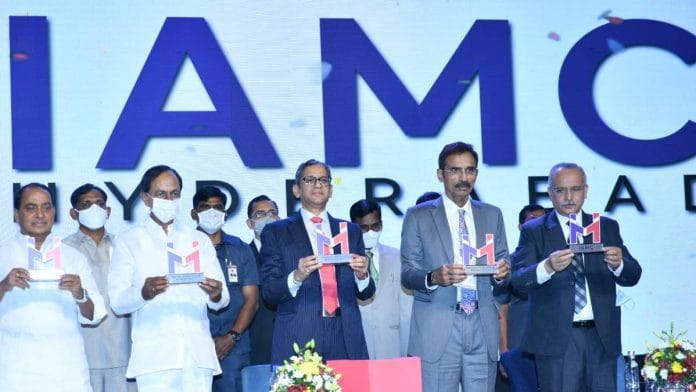



New Delhi: The Supreme Court Wednesday declined to interfere with the Telangana High Court’s decision quashing the allotment of government land free of cost to the controversial Hyderabad-based International Arbitration and Mediation Centre (IAMC).
A bench of Justices Dipankar Dutta and S.V.N. Bhatti dismissed the special leave petitions filed by the IAMC, observing that it was “not inclined to interfere” with the reasoning adopted by the high court, thereby upholding the HC’s June 2025 judgment which had set aside the land allotment made in favour of the IAMC.
Justice Satish Chandra Sharma had recused himself from hearing the matter, earlier.
IAMC Hyderabad has been mired in controversy since inauguration in December 2021 by then Chief Justice of India N.V. Ramana and then Telangana Chief Minister K. Chandrashekar Rao. The foundation laying event was attended by Supreme Court judges L. Nageswara Rao and Hima Kohli, as well as then Telangana High Court Chief Justice Satish Chandra Sharma, all of whom were members of IAMC Hyderabad’s Board of Trustees.
The project soon became the subject of intense public debate within the legal community.
In June 2022, senior advocate and mediator Sriram Panchu, through a strongly worded op-ed published in The Wire, alleged that India’s mediation ecosystem faced the risk of being “captured by retired judges”, questioning what he described as the use of judicial office to secure “post-retirement benefits”.
Pointing to the IAMC trust structure and highlighting how Justice Ramana had authored the trust deed while Justices Kohli and Rao were trustees, Panchu then alleged that the trust had “apparently sought land and largesse from the state government of Telangana, which has happily obliged”.
The claims prompted rebuttals from several senior members of the Bar.
The arguments were rebutted by retired Punjab and Haryana High Court judge K. Kannan, who argued in Live Law that while government bodies were prone to “corruption and nepotism”, judges could establish “institutions of everlasting glory”. Senior Supreme Court advocate Gopal Sankaranarayanan also questioned Panchu’s “unfounded fears” in Live Law.
Kannan and Sankaranarayanan both rejected the suggestion that the IAMC provided post-retirement sinecures, asserting that it was a public trust set up in 2021 to promote institutional arbitration, with infrastructural support from the Telangana government but without governmental interference in its functioning.
The controversy escalated in August 2022, when 65 legal professionals, arbitrators and mediators—including Panchu—submitted a representation to the Centre seeking a probe into what they described were “illegal acts” of Justice Ramana in relation to setting up of the IAMC.
In September 2023, Panchu resigned from the panel of the Singapore International Mediation Centre (SIMC), issuing a scathing resignation letter after SIMC announced a memorandum of understanding with the IAMC. “I do not wish to be on any panel which has Mr Ramana as a member, nor be part of any organisation which embraces him,” he wrote.
Also Read: Nehru & Ambedkar agreed on judges holding power after they retire — it should be allowed
HC on IAMC land allotment
The legal challenge to the land allotment was mounted before the Telangana High Court by petitioners Raghunatha Rao (advocate) and some others.
Last June, a division bench of Justices K. Lakshman and K. Sujana quashed the free land allotment to the IAMC. The petitioners had argued that the IAMC was a private trust and not registered as a company at the time of the grant, and that the allotment violated the Andhra Pradesh (Telangana Area) Alienation of State Lands and Land Revenue Rules, 1975.
They contended that government land could only be disposed of through sale, exchange, lease or public auction under Sections 19 and 20 of the Telangana Urban Areas (Development) Act, 1975, and that there was no provision permitting free allotment. According to them, land valued at “hundreds of crores” had been transferred in an arbitrary manner, causing significant loss to the public exchequer.
Defending the allotment, the Government of Telangana argued that the decision was guided by the recommendations of a high-level committee constituted by the Ministry of Law and Justice in 2017 to promote institutional arbitration in India.
The committee, chaired by Justice B.N. Srikrishna, had emphasised the need for India to develop arbitration institutions comparable to the Singapore International Arbitration Centre, the London Court of International Arbitration and the Hong Kong International Arbitration Centre.
The state submitted that the IAMC was created pursuant to these recommendations through a trust deed dated 20 August, 2021, executed by the then CJI. A memorandum of understanding was subsequently entered into between the state and the IAMC, under which the government agreed to provide land and infrastructure support.
The revenue department maintained that the IAMC was a public charitable, not-for-profit trust intended to provide “world class mediation and arbitration facilities for all sections of society”.
Rejecting the state’s defence, the HC held that the 1975 Rules did not contemplate free alienation of government land to a private body, and that even allotments to private entities could only be made if such bodies were registered under the Companies Act.
The court found that the IAMC was not registered as a company on the date of allotment, and that the land had been transferred without assessment or collection of market value, rendering the allotment vitiated by non-compliance with statutory requirements.
The bench also criticised the government’s “unduly hasty” conduct, noting that possession had been handed over even before finalising and communicating the terms of allotment. “Discretionary exercise of power shall not only be fair and transparent, but also should be seen to be fair and transparent,” the court said.
Emphasising the doctrine of public trust, the HC held that matters involving state largesse could not ordinarily be done free of cost, particularly where valuable natural resources were involved.
The trust deed is also under scrutiny. While it describes the IAMC as a public charitable trust aimed at promoting alternative dispute resolution, it also vests significant powers in the Board of Trustees, including the power to sell trust properties.
The deed expressly bars trustees from receiving remuneration or profits, but the HC held that the structure did not justify free allotment of government land, particularly given the absence of statutory backing and compliance with applicable land alienation rules.
(Edited by Nida Fatima Siddiqui)
Also Read: NV Ramana: The Chief Justice of India who didn’t like shouting in court