





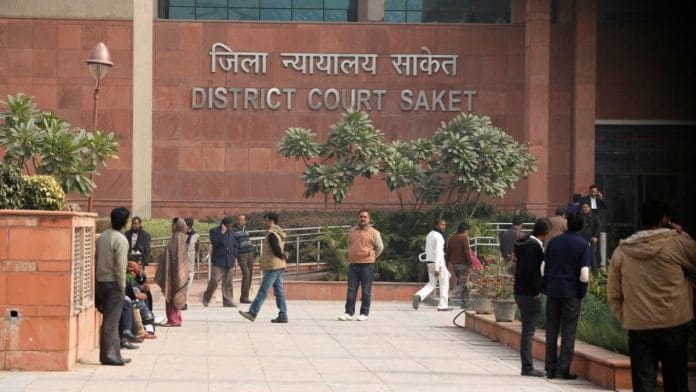



New Delhi: Salary cuts, overwhelming workload where one person handles the responsibilities of three, and late-night work till nine—these are just a few of the daily struggles faced by court staffers who work in India’s district courts.
Friday’s suicide of a court clerk, who had been battling a 60 percent disability, has brought these pressing issues to the fore.
On a frosty Delhi morning, Harish Singh Mahar, a 43-year-old staffer at Delhi’s Saket District Court, jumped to his death from the fifth floor of the court complex’s North Wing. He has left behind a note, citing extreme work pressure, police say.
The incident, early Friday morning around 10, triggered protests by other court employees who have worked with him.
“My name is Harish Singh Mahar. Today, I am committing suicide due to office work pressure. Since I became an ahlmad (court clerk responsible for maintaining the judicial files, case records, and exhibits), I have been having suicidal thoughts,” wrote Harish in his suicide note. “Initially, I believed that I would overcome them if I just let them be, but I failed. I am 60 percent handicapped and succumbed to the growing pressure of this job.”
In his note, Harish also requested the Delhi HC to give relatively less challenging jobs to persons with disabilities, expressing hopes that no one would have to suffer the way he did at work in the future.
Unable to sleep for days on end, Harish had been overthinking a lot over the last few days, his letter has conveyed. He wrote about his concerns that even if he opted for early retirement, there was no way for him to get his life savings or pension till the age of 60.
In the wake of Harish’s death, a strike was scheduled this Saturday by the court staff across Delhi’s district courts, but it was called off last evening, after Delhi High Court Chief Justice D.K. Upadhyay, along with fellow judges, assured the protesters that their grievances about severe workload and understaffing would be heard.
Harish’s death highlights the absence of safeguards for vulnerable employees and an overburdened system that requires major reforms.
The death points to how incidents like this are the inevitable outcome of a system that is stretched way beyond its capacity.
Severe staff shortage
“District courts are severely understaffed,” Deepak Bhardwaj, president of the District and Sessions Courts Employees Welfare Association, told ThePrint, adding that the pendency in each court easily comes to 5000 to 10,000 cases. However, the staff strength has not kept up with the ever-growing number of cases.
According to Bhardwaj, technical activities such as stenography, preparation of certified order copies, and handling of maintenance records are carried out by a very limited number of people, who are catering to thousands of litigants on a daily basis.
Pointing out how files often spill into courtrooms because record rooms are already overflowing, he said that decided matters are not consigned, while new cases keep coming in.
Speaking to ThePrint, Anil Basoya, lawyer and secretary of the Saket Court Bar Association, said the deceased staffer was handling an insurmountable workload.
“He was doing the work of three people,” Basoya said, pointing out that Harish was also suffering from 60 percent disability. He was still assigned over 2,000 files daily, when normally one staffer should be in charge of 400-500 files, according to Basoya.
‘Get the work done’
Despite the staff shortage, the expectations of the higher-ups in the district courts remain uncompromising. “The message is clear. Get the work done anyhow,” Bhardwaj said. He said that sometimes, court staff have to take external help, “paying from their own pocket to get the job done”. Many staff members routinely call in their spouses or children to help complete clerical work late into the evening, he said.
Salary deductions are also rampant, Bhardwaj said, adding that often one or two days’ salary is cut despite the difficult conditions. Any complaints would be met with punitive transfers to Rohini or away to other district courts.
Although he performed well, colleagues say the slowly increasing pressure of the job eventually became overwhelming for Bhardwaj. “This is a wakeup call for court administration to be all the more sensitive to the needs of persons with disabilities,” Basoya said.
Basoya also pointed out that although the personnel and training department’s norms require rotation every three years and leniency in the transfers of both pregnant women and people with disabilities is often highlighted, with these employees also asked to list out their preferences based on proximity and other considerations, the reality on the ground is often different.
A decades-old issue
Grievances rarely move up the chain as judicial officers seldom take them forward, said former district court judge Gurdeep Singh. On top, courts list an average of 100-150 matters every day. With the limited staff, that workload creates immense pressure on the handful of staffers.
“Once a judge signs an order, it reaches the ahlmad, who has to put each file in its place. More often than not, the record keeper goes home around 9 o’clock at night. If the file is not in its place, the clerk will be held accountable,” Singh said.
“I had once written a proposal to the Delhi HC that at least the files of dismissed cases should be weeded out. But alas, nothing material came out of that,” the judge said.
Ultimately, courts should be sensitive to persons with disabilities, the judge said. He added that even able-bodied persons cannot keep up with the kind of work pressure currently prevalent in courts.
“When I was in Karkardooma court, one court clerk, who was a very fine worker, jumped over the railing, but he was saved. What happens is the judicial officers don’t listen while the court staff continue to face humiliation every day. It’s high time this grievance is redressed,” the former judge told ThePrint.
While district court judges and staff battle out bludgeoning pressures and overflowing case files, the situation seems bleak, for now.
“Infrastructure and staffing needs at least a fourfold increase,” the former judge said, adding that ahlmads currently sit in rooms smaller than most people’s bathrooms, flooded with dusty files.
Until structural changes are introduced, these systemic problems are expected to continue amid the silence of exhausted workers.
If you are feeling suicidal or depressed, please call a helpline number in your state
(Edited by Madhurita Goswami)
Also Read: WhatsApp group, DBS ‘honcho’ & stock tips—how retired cop who tried to end life was duped of Rs 8 cr