





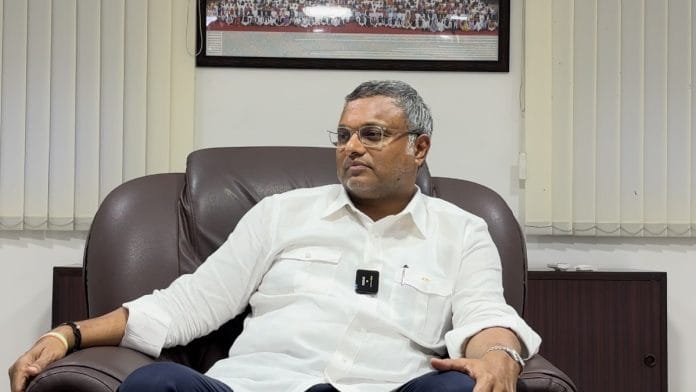



New Delhi: A Delhi court Tuesday framed charges against Congress MP Karti Chidambaram and six others in the Chinese visa scam case, rejecting his argument that the case should be dropped because of the inordinate delay in its registration.
Judge Dig Vinay Singh of the Rouse Avenue court, in a 99-page ruling, framed charges against former finance minister P. Chidambaram’s son for offences under the erstwhile Indian Penal Code (IPC) and the Prevention of Corruption Act, 1988.
The charges include criminal conspiracy, demanding and accepting bribes of Rs 50 lakh, bribing public servants, cheating, forgery, using forged documents, falsification of accounts and destruction of evidence.
However, the court noted that at this stage of framing charges, there was no need to evaluate the veracity of the material presented before it, saying the “strong suspicion” because of the evidence collected by investigators was enough to frame charges.
“Since the stage is that of deciding charges, it be noted that it is well settled in law that at this stage, the Court need not weigh and sift through the evidence as if passing a judgment; a mini-trial is not required, and if the materials collected by the Investigating Agency reflect strong suspicion, that alone suffices to frame charges,” the court said in its 23 December ruling.
The accused argued that the prosecution’s case was based on a “fictional motive”, misinterpretation of visa laws and regulations, and home ministry circulars, and that there was no evidence of criminal conspiracy since reusing visas was legally permissible at the time and in line with established administrative practices.
They also told the court that no public servant had abused their official position or used corrupt means, and that the absence of essential elements of the alleged offences entitled them to be discharged.
But the prosecution argued that substantial evidence, including email correspondence between the accused persons and the statement of the approver, sufficiently established a prima facie case of criminal conspiracy and other offences under the IPC as well as under the Prevention of Corruption Act.
The court said the evidence warranted the continuation of the trial against all the accused, largely agreeing with the prosecution’s argument and rejecting the defence.
Also Read: ‘Can’t conduct mini-trial’: How HC interpreted Lokpal powers in Mahua Moitra cash-for-query case
Who is an approver & when is he pardoned?
One of the originally seven accused, Vikas Makharia, associate vice president of Punjab-based Talwandi Sabo Power Ltd (TSPL), was later granted a pardon by the court and became an approver.
TSPL was setting up a thermal power plant in Punjab’s Mansa district in collaboration with a Chinese company, Shandong Electric Power Construction Corporation (SEPCO).
Legally, an “approver” is a person who is directly or indirectly involved in an offense, or privy to it. Usually, an accomplice or an accused turns approver and agrees to help the prosecution for a lesser sentence or pardon.
Section 306 of the Code of Criminal Procedure (CrPC) allows for pardoning accomplices of a crime at any stage of the investigation or inquiry or trial of an offence on the condition that the person makes a full and true disclosure of the circumstances of the offence within their knowledge related to other accused.
It adds that this may be done to get evidence from anyone “supposed to have been directly or indirectly concerned in or privy to an offence”.
What the court decided
Underlining that there is no restriction on recording the confession of a co-accused who turns approver before the start of the trial, the court said such a confession cannot be rejected because the person is an accused.
“If an accused wishes to make such a confession, it cannot be prevented simply because the person is an accused. It is entirely different for such a person to later express a willingness to become an approver,” the court said.
The court also rejected the defence argument that a case cannot fully rely on the uncorroborated testimony of the approver.
“Material corroboration is provided by the fact that Rs fifty lakhs were paid via cheque from TSPL,” the court noted, adding that the case did not just rely on the approver’s unproven testimony, but also emails exchanged between the accused and the approver.
The accused also challenged the grant of pardon to the approver, citing procedural flaws that rendered his statement akin to that of an unpardoned accomplice.
The court cited a three-judge bench ruling of the Supreme Court to underscore that it is a settled principle of law that the competency of an accomplice is not impaired because he could have been tried jointly with the accused. Instead of being tried, he has been made a witness for the prosecution, the court said.
Finally, the defence also alleged an inordinate delay in the registration of the FIR, but the court said the delay by itself cannot be a ground to discharge an accused. “The prosecution ought to be given an opportunity to explain the delay, which can occur only after trial,” the court said.
“In the present matter, the crime did not come to the notice of the investigating agency for 11 years. It was not until the Investigating Agency stumbled upon evidence of the crime that the inquiry was initiated, and an FIR was registered,” the court also pointed out.
What the court considered while framing charges
Clarifying that at the stage of framing charges, the judge simply needs to determine if there is sufficient ground to proceed with the case, the court said that at this stage it had to only look at the broad possibilities, the total effect of the evidence and the documents before it, and any basic infirmities.
“However, this does not entitle the court to make a roving inquiry into the pros and cons. At this stage, the probative value of the material on record cannot be assessed, and the material presented by the prosecution has to be accepted as true,” the court ruled.
It clarified that the defence of the accused cannot be examined at this stage under Section 227 of the CrPC, which deals with discharging an accused, nor does the accused have the right to produce any document.
Recalling a 2022 Supreme Court ruling, the Delhi court said that the accused’s arguments at this stage “should be limited to the material provided by the prosecution”.
The established principle is to rely on the materials presented by the prosecution, both in oral statements and documentary evidence, and to act upon them without subjecting them to cross-examination, assuming in favour of the prosecution, the court also noted.
Origins of the case
The matter dates back to 2009, when TSPL was setting up a thermal power plant in collaboration with a Chinese company.
According to the prosecution, after the project was significantly delayed and the company was about to incur penalties, they sought to bring in Chinese experts and additional manpower for their company. However, they were restricted by the limit on the number of Project Visas that could be issued.
The prosecution said this led the company to allegedly bribe Ministry of Home Affairs officials Rs 50 lakh to issue them a large number of visas, in violation of the law.
Despite being limited to 187 visas and facing restrictions on reusing visas, TSPL allegedly received 263 visas by misrepresenting the project, the prosecution also said.
The prosecution’s case was that TSPL, along with its employees—Viral Mehta, vice president and head of construction; CFO Anup Aggarwal; and Mansoor Siddiqi, project head and director—conspired with Karti and a man called Bhaskaraman, who was allegedly his close aide, to obtain additional visas to speed up the project.
(Edited by Sugita Katyal)
Also Read: Did ED break own rulebook in National Herald case? Why court junked charge sheet against Gandhis