





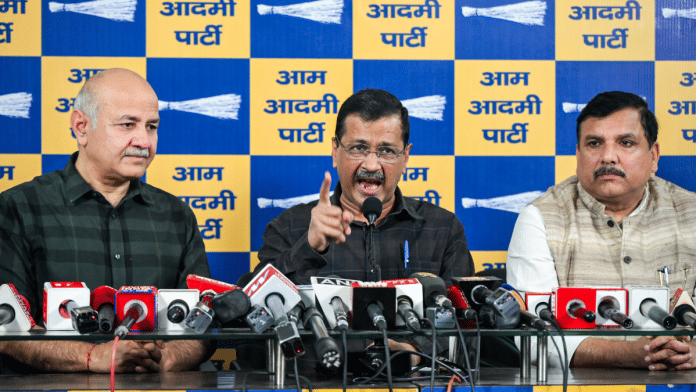



New Delhi: The criminal law cannot be invoked to revisit or punish administrative discretion in the absence of prima facie material showing dishonest intent, quid pro quo, or abuse of office, a special court in Delhi observed while discharging former chief minister Arvind Kejriwal and his then deputy Manish Sisodia in the 2022 excise policy case.
In a detailed 598-page order, Rouse Avenue Court Special Judge (Prevention of Corruption Act) Jitendra Pratap Singh underscored that policy formulation is inherently experimental, and that failure of a policy, or lawful profit earned by private players under it, does not by itself constitute criminality.
Upon considering the material placed on record for the limited purpose of framing of charge, the court said that it is often seen that the prosecution seeks to project its case as “a coherent and well-knitted narrative”.
“While it may superficially appear so, a closer examination within the contours permitted at this stage may reveal that facts have been arranged to support a predetermined conclusion. The Court is required to guard against being carried by presentation alone, and must instead test whether the record discloses a consistent and legally sustainable sequence suggestive of the commission of an offence”, it added.
Thus, in the absence of foundational elements, the court held that the allegation of conspiracy remains “indeterminate and amorphous, lacking the legal specificity required even at the threshold stage”.

If the prosecution prima facie fails to show how the institutional procedure was subverted pursuant to a prior meeting of minds, “secrecy remains a rhetorical explanation rather than a legally sustainable inference”.
“Policy formulation is inherently experimental; a policy may succeed or fail, and failure by itself is not evidence of criminality. Profit earned by private participants is not illegal per se; it becomes suspect only when it is shown to flow from collusion, undue favour, or manipulation of process…criminal liability continues to require mens rea (criminal intent).
“Excessive criminalisation of policy decisions risks paralysing governance, as decision-makers may be deterred from taking bona fide decisions in public interest,” the judge wrote.
The framers of a policy cannot be criminally prosecuted, he said, merely because the policy did not yield the expected results or because private entities lawfully earned profit under it.
‘Excessive criminalisation of policy decisions risks paralysing governance, as decision-makers may be deterred from taking bona fide decisions in public interest,’ Special Judge Jitendra Pratap Singh.
“Criminal prosecution is justified only where the material discloses either a conscious and deliberate violation of mandatory procedure coupled with dishonest intent, or dishonest or collusive intent camouflaged behind formal procedural compliance,” the order said.
Stating the limits of criminal prosecution in policy decisions, the court has explicitly noted that in a developing economy, policy changes are routine and often necessary for increasing revenue, improving regulatory frameworks, or advancing public welfare objectives.
Policies concerning licensing, taxation, distribution models, privatisation, or private participation inherently involve the exercise of executive discretion. Thus, “the mere circumstance that a particular policy does not yield the expected outcomes, or that private participants lawfully earn profits under such policy, cannot, without more, justify criminal prosecution,” the court reiterated.
Internal discussions not incriminating material
In the order, Special Judge Jitendra Pratap Singh also said criminal law cannot be invoked to revisit or punish administrative discretion, “particularly when the record shows that the actions in question were confined to policy formulation and implementation undertaken in the ordinary course of governance”.
Special Judge Jitendra Pratap Singh also examined in detail how a substantial part of the prosecution in a case arising from policy decisions centred on “internal file notings, administrative observations, and governmental deliberations.”
Such notings, by their nature, the judge said, record internal discussions and divergent views. “They do not, without more, constitute incriminating material, nor do they indicate dishonest intention or an overt criminal act”, the court said.

Noting that a detailed evaluation of evidence is not possible at the stage of framing of charges by the court, the judge said, “Where the case is predominantly documentary and rests substantially on internal notings and policy papers, the Court must undertake the limited scrutiny mandated by law to ensure that criminal process is not employed as a vehicle to challenge executive decisions under the guise of prosecution.”
Therefore, at the stage of charge, the court is required to see whether the documents relied upon, when taken at face value, “disclose the ingredients of the alleged offences”, and whether there exists “independent material pointing to mens rea (criminal intent), quid pro quo (an exchange for something), or abuse of office, beyond mere administrative processing”.
Governmental framework & penal provision
To assess the limits of criminal liability in matters involving formulation of government policy, the court looked at the Transaction of Business of the Government of National Capital Territory of Delhi Rules, 1993 (ToBDR).
This framework, the court noted, incorporates mandatory consultations, institutional checks, identification of matters requiring prior approval or submission, and structured movement of files through a prescribed hierarchy.
These rules are intended to ensure orderly governance and collective responsibility. They are not penal provisions, said the judge.
Importantly, he noted that “a deviation from procedure may, at the highest, amount to an administrative lapse, but cannot, by itself, be treated as criminal misconduct unless accompanied by prima facie material indicating dishonest intent”.
Furthermore, where a policy is framed and processed by the competent department in accordance with the Business of Delhi (Allocation) Rules, 1993, “its initiation cannot be criminalised merely because it reflects a new, reform-oriented, or revenue-driven approach”.
“Non-compliance with administrative procedure, in the absence of material showing corrupt intent, does not by itself constitute a criminal offence”, the court said, while noting that the Central Secretariat Manual of Office Procedure (CSMOP) aims to ensure transparency, uniformity, and traceability in governmental functioning.
Criminal liability in policy formulation cases
The court detailed that from the standpoint of criminal liability, policy formulation cases broadly fall into three categories.
The first category being the “alleged violations of statutory rules or mandatory procedure”. Criminal liability, the court noted, may arise only where the prosecution is able to prima facie demonstrate deliberate and conscious bypassing of mandatory procedural safeguards, actions taken by a department outside its competence, or suppression or manipulation of material notings or consultations.
“Even in such cases, a procedural deviation alone is insufficient; there must be material indicating dishonest intention.”
The second category, he said, concerns cases of formal procedural compliance masking mala fide intent.
Noting that there may be situations where the file movement appears regular, the competent department acts within its jurisdiction, and the prescribed procedural route is ostensibly followed.
‘Wisdom, efficacy, or eventual success or failure of policy is not matter for criminal adjudication. Administrative errors or incorrect judgments, without material suggesting corrupt intent, cannot attract criminal prosecution,’ Judge Jitendra Pratap Singh.
However, if the substance of the policy prima facie demonstrates that “it was consciously designed to confer undue advantage upon specific private parties”, criminal prosecution may be justified, “provided such intent is supported by cogent and independent material, and not merely inferred from the outcome of the policy”.
The third and most common category, the court said, concerns bona fide policy decisions unaccompanied by evidence of corruption.
Where the prescribed procedure is followed, the competent department initiates and processes the proposal, file movement is transparent, and there is no prima facie indication of quid pro quo, personal benefit, or collusion – “the policy decision is protected as a bona fide exercise of administrative discretion”, he said.
“The wisdom, efficacy, or eventual success or failure of a policy is not a matter for criminal adjudication. Administrative errors or incorrect judgments, without material suggesting corrupt intent, cannot attract criminal prosecution”, the court said.
Criminal liability in policy decisions
The judge said that in cases where the investigating authority alleges that file movement and policy decision-making were influenced by “bribes, upfront payments, or kickbacks”, the court must examine whether the prosecution material discloses “a prima facie demand/arrangement/payment and its linkage to an official act”.
The court must see, the judge noted, if there is a discernible quid pro quo; a nexus between the alleged gratification and the policy clauses or file outcomes; and material connecting the accused to such influence,” beyond assumptions arising from the existence of file notings or the eventual policy outcome”.

When the above is absent, said the judge, “a prosecution founded largely on administrative record risks converting governance review into criminal adjudication”.
Also, the court agreed that in cases of criminal conspiracy, the proof is rarely direct evidence – rather it may be inferred from “surrounding circumstances”.
“Policy outcomes often result from multi-tier institutional processes involving consultations, departmental inputs, Cabinet-level decisions, and statutory/constitutional oversight. Criminal law cannot be used to retrospectively criminalise policy choices or market consequences unless the prosecution is able to prima facie demonstrate a meeting of minds to subvert the policy framework for an unlawful purpose.”
Rather, the essence of punishing one for criminal conspiracy lies in agreement itself, the court said.
“Economic gain, uneven commercial outcomes, or subsequent profitability cannot, by themselves, constitute conspiracy….Where the narrative rests on fragmented circumstances and invites the Court to ‘join the dots’ by presumption, the legal threshold is not met.”
(Edited by Ajeet Tiwari)