





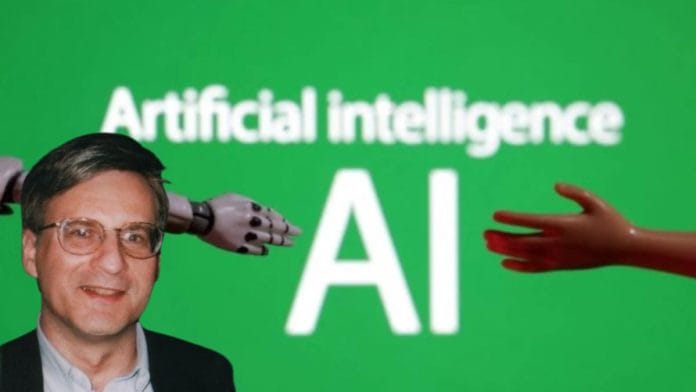



New Delhi: A computer scientist, AI generated artwork and a legal system built around human creativity. US researcher Dr Stephen Thaler is confronting one of the sharpest questions in intellectual property law: if AI creates, who is the author?
Thaler has filed patent applications in various nations, including the US, the UK, New Zealand, seeking recognition of his AI system DABUS (Device for the Autonomous Bootstrapping of Unified Sentience) as an inventor or author and separately pursued copyright protection for its autonomous artwork.
In the US, the Copyright Office denied registration, citing the requirement that a “human being” needs to be the author of a work. The ruling was last month upheld by the US Supreme Court which declined to hear Thaler’s review plea. US federal courts had also upheld the human authorship requirement.
India is the latest theatre in Thaler’s international campaign for the recognition of generative AI by intellectual property law. He has approached the Delhi High Court seeking resolution of his copyright application pending before the Registrar of Copyrights for four years. The HC Thursday directed the Copyright Office to decide the application within eight weeks.
As of today, Thaler’s copyright campaign is far narrower than the patent one. He has pursued a patent in 18 jurisdictions across the globe with limited success; South Africa stands out as the only clear grant. The copyright, on the other hand, has been pursued in America and now in India.
Regarding copyright for the AI artwork ‘A Recent Entrance to Paradise’, the US Court of Appeals held, with comprehensive citations, that copyright for a creative work requires a human being. It rejected Thaler’s argument under the work-made-for-hire doctrine, and said that human authorship is presupposed even there. The court effectively ruled that AI cannot be the sole author of a creative work for copyright purposes.
The court decision was not limited to the single artwork in question. Comparing a copyright to a property right, the court equated a machine’s inability to own property with its ineligibility to be an “author”. Also, the court remarked upon a machine not having a “life” and hence the duration of copyright cannot be determined according to the US Copyright Act. Further, the court pointed out the statute’s inheritance, signature, intention and nationality provisions—all of which an “inert instrument” cannot satisfy. The US Supreme Court declined review.
Also Read: Sam Altman proposes a new ‘robot tax’. AI can’t benefit only the corporate elite
Several copyright battles
Thaler describes himself online as someone who “built generative AI before it had a name, and gave machines the spark of sentience”.
A PhD in physics and CEO of a technology company, Imagination Engines, he is also the creator of DABUS. The artwork for which Thaler is seeking copyright was created by DABUS. He has spent years using the AI system as a test case across jurisdictions for machine inventorship and authorship.
In the patent context, his argument is that AI can be treated as an inventor, whereas in the copyright context, he contends that AI generated works can qualify for protection with the machine named as the creator. His litigation strategy has turned him into a recurring figure in the global debate on creativity and generative AI.
“Thaler has been at the forefront of the AI vis-à-vis creation debate,” his lawyer Chirag Ahluwalia told ThePrint in a telephonic interview Friday. He explained that the Indian copyright application was filed in 2022; well before the appeal rejection in the US.
He also said that there was no bar under Indian law on foreign nationals applying for copyright. According to Ahluwalia, the purpose of such litigation is to push the boundaries of intellectual property law with regard to AI. “It is not about the modicum of creativity, but the recognition of AI as an author,” he added.
Ankit Sahni, an IP lawyer and lead counsel in Thaler’s case, is no stranger to AI copyright clashes. In 2020, Sahni got an initial Indian copyright registration, the first-of-its-kind, for ‘Suryast’, an AI generated artwork.
The AI system concerned, Raghav AI, was created by Sahni, and it was listed alongside him as co-author for the copyright. The Copyright Office subsequently issued a withdrawal notice, seeking clarifications on Raghav’s legal status as an “author” under the Copyright Act, 1957.
His copyright application was rejected in the US too, and Sahni is now pursuing the same in Canada.
Thaler’s India case is similar yet different to his failed American application.
Like the US case, it concerns the copyright of the AI generated artwork, ‘A Recent Entrance to Paradise’. But in India, the application sits within a statutory framework that has an express reference to “computer generated” works. Without America’s watertight human authorship requirement, the Indian scenario is potentially more flexible to a favourable interpretation.
Still, the Indian authorship standard is far from easy. Currently, under the 1957 Act, AI generated works lack recognition due to the established criteria of “modicum of creativity/skill and judgment” to establish authorship. This standard was upheld by the Supreme Court in the landmark Eastern Book Company case, whereby the essential threshold for originality requires human intellectual effort and not merely “sweat of the brow”.
This is a human-centric standard which AI generated content will find tough to meet through prompts alone. Although Section 2(d)(vi) mentions computer-generated artistic works, there is much room for ambiguity.
The contest between generative AI and copyright is playing out elsewhere too. Copyright battles over AI training datasets are multiplying, from the 2025 settlement in the Anthropic case to pending disputes involving The New York Times, OpenAI and Meta.
In India, the ANI vs Open AI case is a landmark copyright lawsuit amid fragmented legality. News agency ANI alleges OpenAI used its copyrighted content to train ChatGPT without permission, causing copyright infringement.
The Information Technology (IT) Act addresses AI only indirectly through provisions on fraud and deepfakes, while the Digital Personal Data Protection Act regulates personal data used for AI training but does not resolve authorship or ownership questions. A Department for Promotion of Industry and Internal Trade (DPIIT) working paper had proposed a hybrid licensing model for AI training, but that idea remains unenforced.
Thaler’s relentless campaign raises a crucial question: whether there is an urgent need for legal systems across the globe to rethink authorship and inventorship in the age of AI.
Judge Jonathan Beach in DABUS’ Australian patent case, rhetorically questioned, “we are both created and create. Why cannot our own creations also create?” while granting Thaler a rare legal victory. The decision was overturned on appeal, but the judge’s question remains pertinent.
Saumya Sharma is an alum of ThePrint School of Journalism and an intern with ThePrint.
(Edited by Nida Fatima Siddiqui)
Also Read: UNDP-commissioned report flags ‘shadow use’ of AI in India’s legal sector. ‘Unaware of risks’