





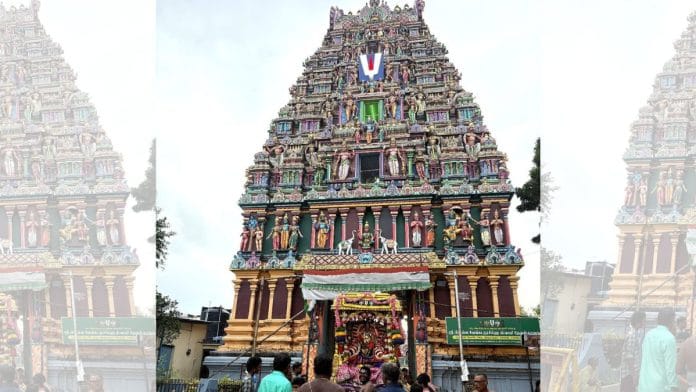



New Delhi: The Hindu Religious and Charitable Endowments Department can inspect and inquire into a temple that receives public donations, the Madras High Court has observed, in a matter involving alleged financial irregularities in Chennai’s Sri Prasanna Venkata Narasimma Perumal Temple.
A bench of Justice S. Subramaniam and Justice Mohammed Shafiq has now directed the Hindu Religious and Charitable Endowments (HR&CE) Department commissioner to appoint an officer of a rank no lower than additional commissioner to conduct a “comprehensive inquiry” into alleged financial irregularities at the temple. It set a four-week deadline for hearing all sides, after which the HR&CE department can take appropriate action.
These directions have come based on the court’s conclusion that the temple is a “public institution”, and therefore subject to the state government’s oversight in cases of maladministration. The division bench has also asked the commissioner himself to determine if the temple is public or private, based on the Supreme Court’s 1999 Marua Dei vs Muralidhar Nanda order. The commissioner may initiate further action on finding any financial illegality.
A key issue in the case has been whether the temple claimed to be a private shrine of the Balija Chetty community falls under government jurisdiction. The division bench passed the ruling, hearing an appeal filed by Dr K.J. Renuka against a June 2024 Madras High Court single-judge order.
The original petitioner in the case before the single-judge bench had sought registration of a lease deed. The single judge had directed the registration of a new lease deed, observing that an existing deed lacked terms.
In her challenge to this order, Dr Renuka submitted to the division bench that the rent specified in the existing deed was far below market rates for the Saidapet area and that registering it would cause the temple substantial financial loss.
The division bench has now set aside the single-judge order and directed a probe into the temple’s affairs.
Also Read: 30% seats for women in Bar Councils: SC broke up ‘old boys’ club’, but ‘backlash over bias’ looms
What the temple & TN govt argue
The Sri Prasanna Venkata Narasimma Perumal Temple’s argument has been that it is a ‘denomination temple’—managed by a religious denomination or sect—as opposed to the general public or the government.
The Tamil Nadu government has rebutted this with the assertion that it can manage the temple in case of maladministration, illegality, or irregularity. It can even interfere and initiate appropriate action against the temple, the government has added.
The temple cited Article 26 of the Constitution, which grants religious denominations and sects freedom over their religion-related affairs, institutions, and property.
However, the state government rebutted, saying that the temple’s administration did not include mismanagement.
The high court noted that there were several complaints against the temple, including allegations that 140 housing and 40 commercial properties at Saidapet alone belonged to the temple. Despite this, the court further noted, the HR&CE Department had taken no action against the temple.
Test laid down in Marua Dei
Before the 1999 ruling in Marua Dei vs Muralidhar, the SC had wrestled with how any temple could be classified as public or private. Afterwards, the court decided that a religious institution that assumes “public character” can be declared as a “public institute”. It reached this conclusion, relying upon the SC’s 1970 Goswami Shri Mahalaxmi Vahuji vs Rannchhoddas Kalidas ruling.
The SC, in 1970, had ruled that certain questions must be answered in the affirmative to check whether a temple is public. The first question was whether the temple was built or raised by the public. The other was whether the temple allowed members of the public to worship.
At the same time, the SC also specified in the 1979 order that if a temple was originally private, or its origins not traceable, there must be proof to term it as public. The proofs could be gathered from how the temple was built—with public funds/not—and whether it operated or had been managed with public contributions.
In the 1999 case, the SC had relied on a second ruling, in the 1919 Lakshmana vs. Subramania case, where a Judicial Committee was dealing with a temple that initially was a private temple.
The ‘Mahant’ of the temple opened it on certain days each week to the Hindu public, who were free to worship in the greater part of the temple, but on payment of fees, in one part. The ‘Mahant’ used the income primarily to meet the expenses of the temple, while the balance supported him and his family.
“The privy council then held that the conduct of the ‘Mahant’ showed that he had held out and represented to the Hindu public that the temple was a public temple at which all Hindus might worship, and the inference was, therefore, that he had dedicated it to the public,” the SC had noted in its 1999 order.
(Edited by Madhurita Goswami)
Also Read: SC ruling on wedding gifts another win for Muslim women. But battle over personal laws continues